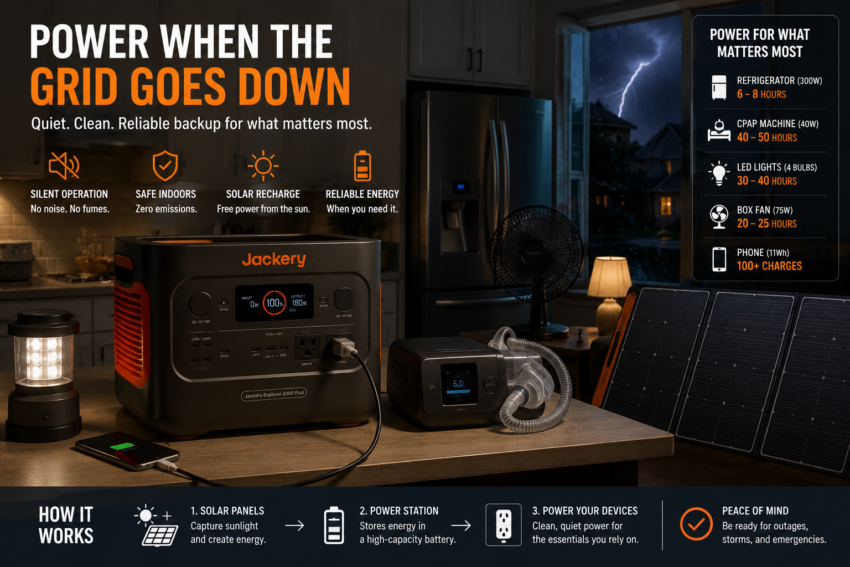
Disclaimer: This article is for informational purposes only. Always follow manufacturer safety guidelines when operating any power equipment indoors or around sensitive electronics.
You lose power at 11pm. The fridge is running, the sump pump needs to kick on, and your kid’s CPAP machine is sitting there useless. A gas generator would work — but you don’t have one, and even if you did, you’d be dragging it outside in the dark.
That’s exactly the situation a good solar generator is built for. Quiet, no fumes, no fuel runs. Just stored energy ready to go when the grid isn’t.
But “solar generator” has become a dumping ground term. It covers everything from a glorified USB battery bank to a serious 2,000-watt home backup system. Getting this wrong costs you $500–$3,000+. So here’s what actually matters before you pick one.
What Is a Solar Generator, Really?
A solar generator is a portable power station — a battery with an inverter, charge controller, and ports built in — that you can recharge via solar panels. That’s it. No engine, no exhaust, no moving parts.
The solar panels don’t power your home directly. They charge the battery. The battery powers your appliances. Understanding that flow matters because it tells you two things: how big the battery needs to be and how fast you can refill it.
Most units also charge from wall outlets and car adapters, so solar is just one of several input options — useful to know if cloudy days are common where you live.
How to Size a Solar Generator for Home Backup
This is where most buyers go wrong. They buy based on price, not on what they actually need to run.
Start here: make a list of what you want to keep running during an outage. Then look up the wattage of each device — it’s usually printed on the back or in the manual.
| Appliance | Typical Running Watts | Typical Starting Watts |
|---|---|---|
| Refrigerator | 150–400W | 800–1,200W |
| CPAP (no heat) | 30–60W | ~60W |
| Box fan | 50–100W | ~100W |
| LED lights (5 bulbs) | 30–50W | ~50W |
| Phone/laptop charging | 20–65W | ~65W |
| Space heater | 750–1,500W | ~1,500W |
| Window AC unit | 500–1,500W | 1,500–2,200W |
| Sump pump | 300–800W | 1,000–2,000W |
Two numbers matter: running watts (what the device draws continuously) and surge/starting watts (the spike when a motor starts). Your generator’s inverter must handle the surge. Your battery capacity determines how long everything runs.
A basic “essentials only” setup — fridge, lights, phones, CPAP — typically needs a 1,000–2,000Wh battery with a 1,500–2,000W inverter. Want to run a window AC or power tools? You’re looking at 2,000Wh+ and a 2,000W+ inverter.
The Best Solar Generators for Home Backup in 2026
These are real, widely available units with verified specs. We’ve broken them down by use case so you can match the right one to your actual situation.
Best Overall: Jackery Explorer 2000 Plus
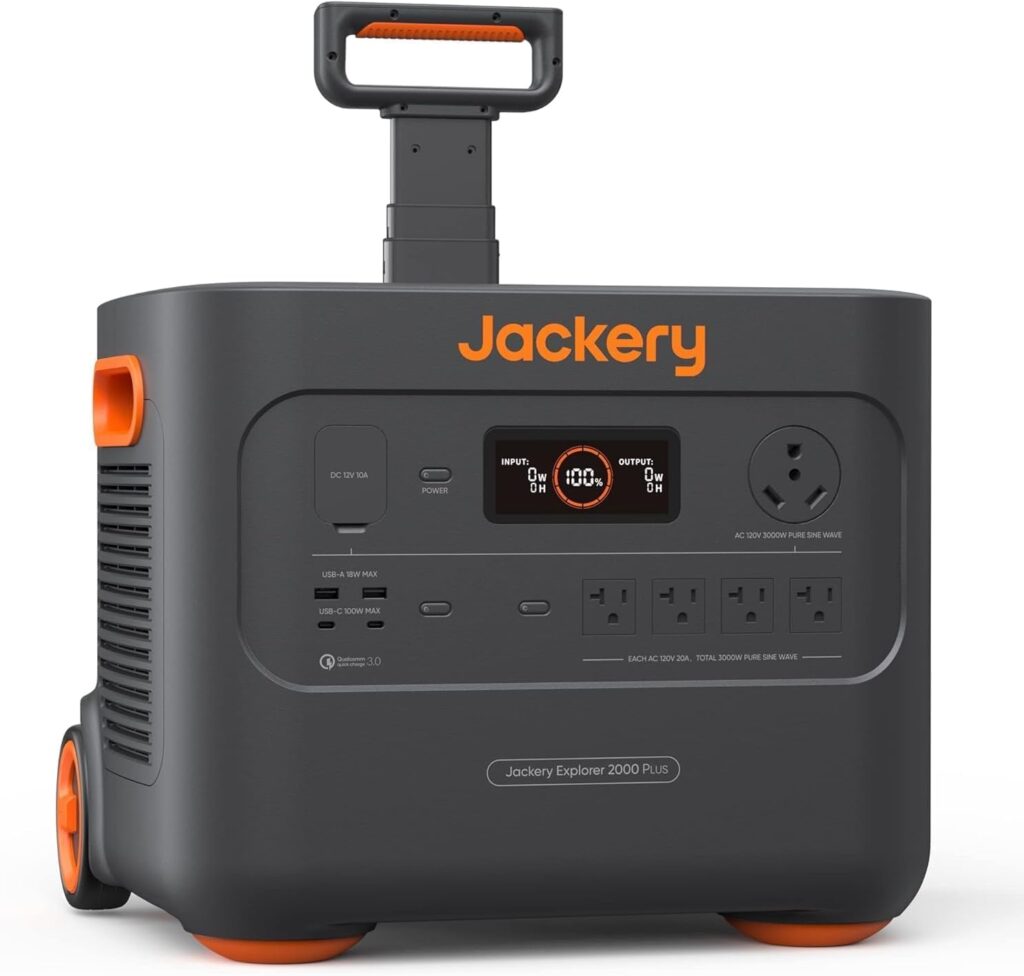
The Jackery Explorer 2000 Plus is the sweet spot for most households. It ships with a 2,042Wh LFP (lithium iron phosphate) battery — the safer, longer-lasting chemistry — and a 3,000W inverter that handles surge loads up to 6,000W. That covers a fridge, lights, fans, and most medical devices comfortably.
What makes it stand out is expandability. You can add up to five battery packs to reach 12kWh total — effectively turning it into a whole-home short-term backup. It also accepts up to 1,200W of solar input, meaning a decent panel setup can refill it in a few hours of good sun.
Capacity: 2,042Wh base (expandable to 12kWh)
Inverter: 3,000W (6,000W surge)
Solar input: Up to 1,200W
Battery type: LFP
Best for: Most homeowners wanting serious backup without going full off-grid
Best Budget Pick: Jackery Explorer 1000 v2
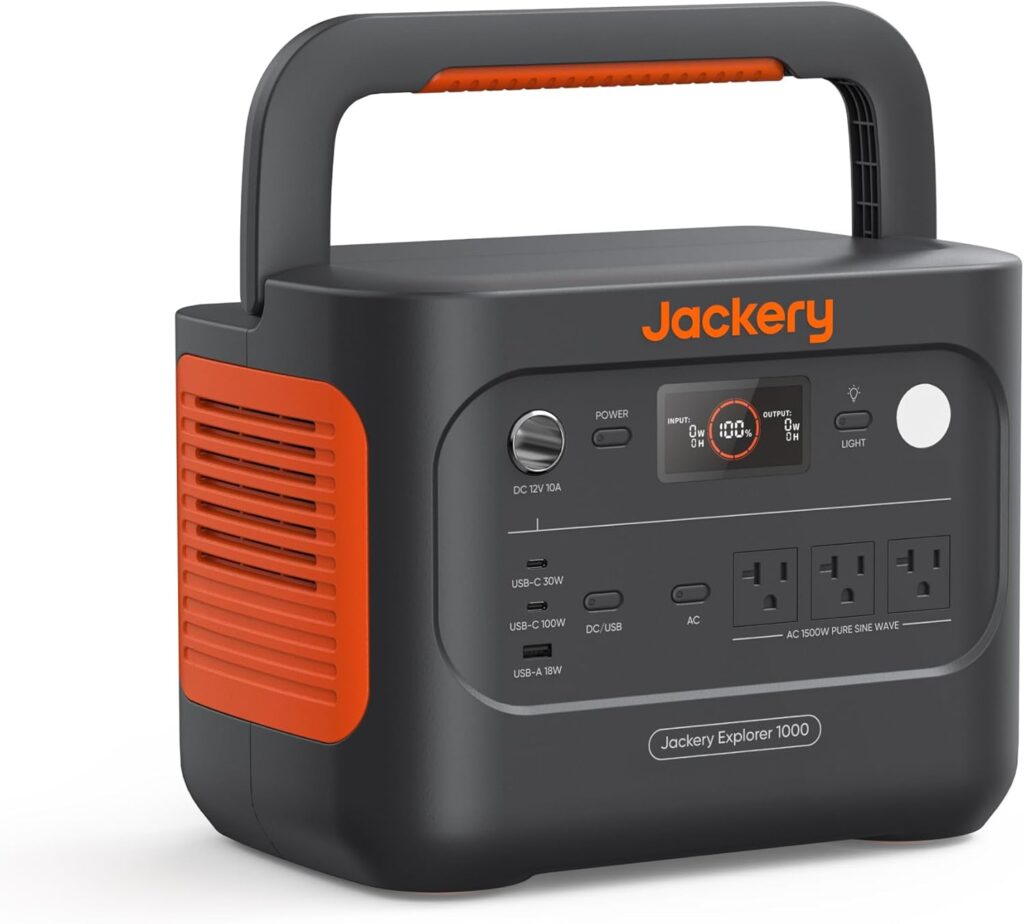
If your backup needs are modest — phones, a fan, a CPAP, maybe a lamp — the Jackery Explorer 1000 v2 gets the job done at a significantly lower price point. It carries 1,070Wh and a 1,500W inverter, which handles most essential loads except large appliances.
It’s also genuinely portable — about 23 lbs — so it doubles as a camping or tailgate unit when there’s no emergency. The LFP battery is rated for 4,000 cycles, which means a decade-plus of regular use before capacity noticeably degrades.
Capacity: 1,070Wh
Inverter: 1,500W (3,000W surge)
Solar input: Up to 400W
Battery type: LFP
Best for: Renters, apartment dwellers, light backup needs
Best High-Capacity Option: Bluetti AC300 + B300 Battery
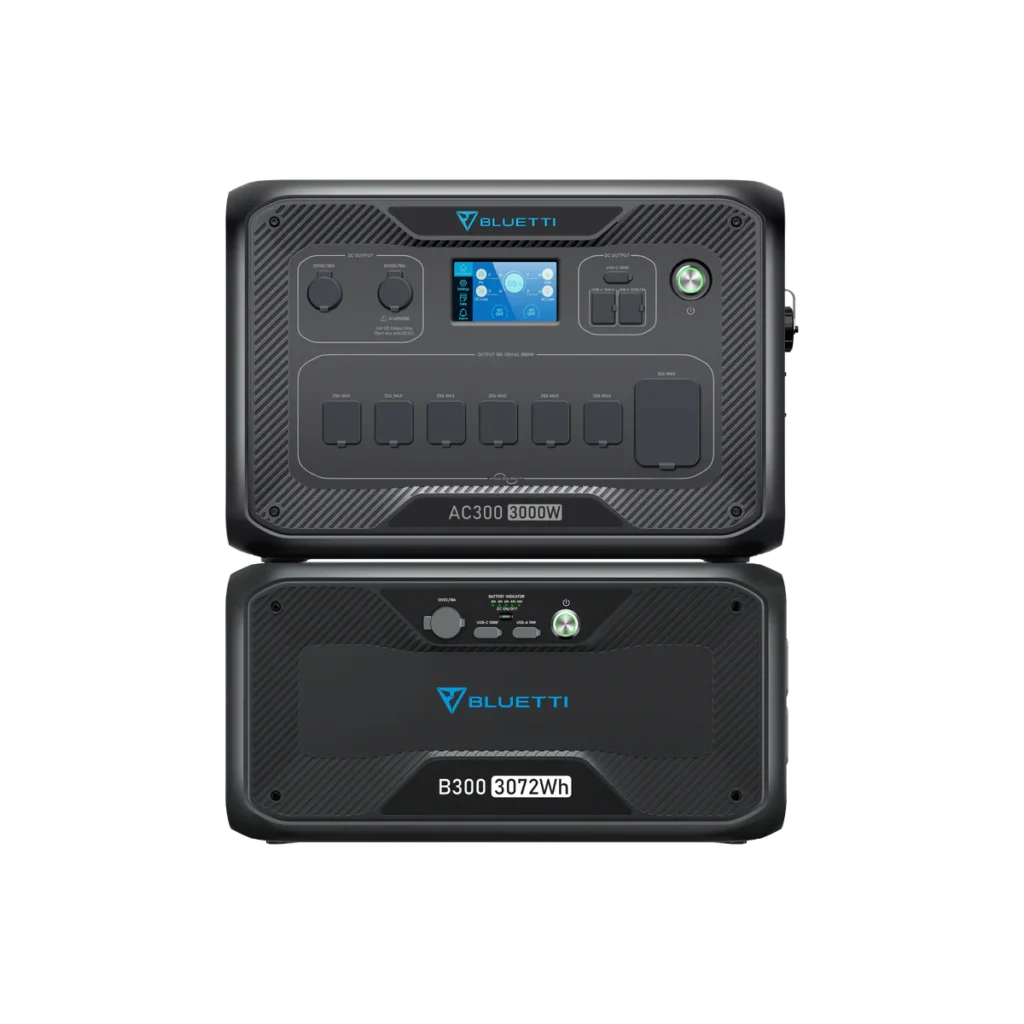
The Bluetti AC300 is a modular powerhouse. The base unit has no internal battery — it runs entirely on external B300 battery modules (3,072Wh each), and you can connect up to four for 12.3kWh total. The inverter is rated at 3,000W continuous with 6,000W surge.
It supports up to 2,400W of solar input and can also accept grid power at up to 3,000W for rapid recharging. If you want the flexibility to scale your home backup system over time rather than buying everything upfront, this modular approach is one of the smartest on the market. We’ve done a deep dive on Bluetti’s flagship AC200MAX if you want to see how their build quality holds up in the real world.
Capacity: 3,072Wh per B300 module (up to 12.3kWh)
Inverter: 3,000W (6,000W surge)
Solar input: Up to 2,400W
Battery type: LFP
Best for: Power-hungry households, long outages, scalable setups
Best Compact Mid-Range: EcoFlow DELTA 2
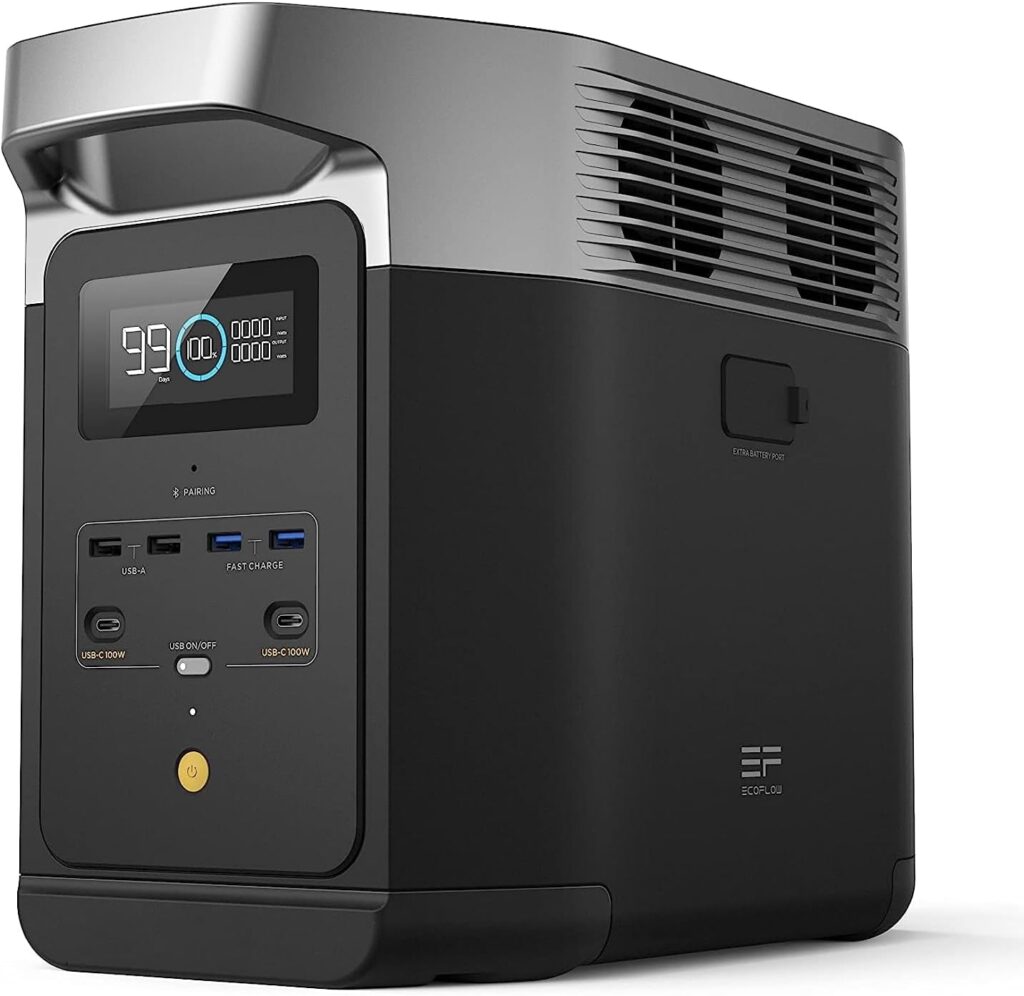
The EcoFlow DELTA 2 is one of the most polished units in its class. It starts at 1,024Wh but expands to 2,048Wh with an add-on battery. The inverter sits at 1,800W (2,700W surge), which puts it right in the sweet spot for a fridge plus essentials.
EcoFlow’s X-Stream fast charging is genuinely impressive — it can go from 0 to 80% on wall power in about 50 minutes. That’s not solar charging, but it means if you know a storm is coming and you have grid power, you’re not waiting hours to top up. The app integration and display are also among the most user-friendly in the segment.
Capacity: 1,024Wh (expandable to 2,048Wh)
Inverter: 1,800W (2,700W surge)
Solar input: Up to 500W
Battery type: LFP
Best for: Homeowners wanting reliability, ease of use, and fast recharging
Side-by-Side Comparison
| Model | Capacity | Inverter | Solar Input | Battery Type | Best For |
|---|---|---|---|---|---|
| Jackery Explorer 2000 Plus | 2,042Wh (exp. 12kWh) | 3,000W / 6,000W surge | 1,200W | LFP | Best overall |
| Jackery Explorer 1000 v2 | 1,070Wh | 1,500W / 3,000W surge | 400W | LFP | Budget / light use |
| Bluetti AC300 + B300 | 3,072Wh+ (exp. 12.3kWh) | 3,000W / 6,000W surge | 2,400W | LFP | High capacity / scalable |
| EcoFlow DELTA 2 | 1,024Wh (exp. 2,048Wh) | 1,800W / 2,700W surge | 500W | LFP | Ease of use / fast charge |
Solar Generator vs. Gas Generator: Which One Is Actually Better for Home Backup?
The honest answer is: it depends on what you’re backing up and for how long.
| Factor | Solar Generator | Gas Generator |
|---|---|---|
| Indoor use | ✅ Safe indoors | ❌ Carbon monoxide risk — outdoor only |
| Noise | ✅ Silent | ❌ Very loud |
| Fuel storage | ✅ None required | ❌ Gas degrades, needs storage |
| Runtime during extended outage | ⚠️ Limited by battery + solar input | ✅ Run as long as you have fuel |
| Powering large appliances (AC, well pump) | ⚠️ High-end units only | ✅ Most gas generators handle this |
| Maintenance | ✅ Nearly zero | ❌ Oil changes, carb cleaning, storage prep |
| Upfront cost | ⚠️ Higher per watt-hour | ✅ Cheaper for equivalent wattage |
For short outages of 1–3 days, a solar generator is almost always the better choice for most households. It’s safer, quieter, and needs nothing from a hardware store at midnight. For week-long outages or whole-home power coverage, a gas generator still wins on raw runtime — though pairing a solar generator with solar panels closes that gap fast.
What to Look for When Buying
Beyond capacity and inverter size, there are a few things that separate a genuinely useful unit from one that disappoints the moment you need it.
Battery chemistry: LFP (lithium iron phosphate) beats NMC (nickel manganese cobalt) for home backup. LFP is safer, tolerates heat better, and lasts 2–4x more charge cycles — often 3,500–4,000 cycles vs. 800–1,000. All four units above use LFP. That matters.
Inverter type: You want a pure sine wave inverter. Modified sine wave can damage sensitive electronics — CPAP machines, certain medical devices, newer TVs. Every serious home backup unit ships with pure sine wave. Still worth confirming before you buy.
Solar input wattage: This determines how fast the sun can refill your battery. A 1,000Wh battery with 200W solar input needs 5+ hours of direct sun to refill. Double the input wattage, and you halve that time. If you’re pairing your generator with panels, check out how solar charge controllers work — understanding input limits prevents costly mismatches.
Expandability: The best units let you add battery modules over time. Buying a modular system from day one is almost always cheaper than replacing a unit you’ve outgrown.
Ports and outlets: Count how many AC outlets you actually need. Most units have 2–4. If you’re running a fridge, charging laptops, and powering a fan at the same time, 2 outlets gets crowded fast. Also check for USB-C PD ports if you’re charging modern devices.
How to Maximize Your Solar Generator’s Performance
The unit is only part of the system. How you use it determines how long it lasts and how well it serves you when things go wrong.
Keep it charged year-round. LFP batteries store best at 50–80% capacity. Don’t let it sit fully depleted for months. Many units have a storage mode that maintains an optimal charge level automatically.
Position panels for maximum output. Angling matters more than most people realize. A panel lying flat on a deck in winter captures a fraction of what a properly tilted panel does. If you want to go deep on this, the physics behind solar panel azimuth and declination is worth understanding — it translates directly into faster recharge times when you need them most.
Run high-draw appliances strategically. If you’re on battery power, don’t run the microwave and the coffee maker at the same time. Spreading high-wattage loads out preserves battery life and avoids tripping the inverter’s overload protection.
Recharge from the wall before storms. If a power outage is forecast, top the unit up from grid power first. Solar charging is the fallback, not the primary plan.
If you’re thinking longer-term about a solar setup at your property — whether that’s a home, a shed, or an RV — the same sizing principles apply. Our guide to setting up solar power for a shed walks through the component decisions in a way that maps directly to home backup thinking.
Frequently Asked Questions
Can a solar generator power an entire house?
Not a standard home, no. A solar generator can cover essential loads — fridge, lights, fans, phone charging, medical devices — for 12–72 hours depending on capacity. Running a whole home including HVAC, water heater, and electric stove requires a whole-home battery system like a Tesla Powerwall, not a portable unit.
How long will a solar generator last during a power outage?
It depends on your load. A 2,000Wh battery running a 200W fridge continuously will last about 8–10 hours (factoring in inverter efficiency). Add a CPAP, some lights, and phone charging, and you’re looking at 6–8 hours of combined runtime. Solar panel input extends this significantly during daylight.
Can I use a solar generator indoors?
Yes — that’s one of the biggest advantages over gas generators. Solar generators produce no exhaust and are completely safe indoors. Gas generators must only be used outdoors due to carbon monoxide risk.
What size solar generator do I need for a refrigerator?
You need at minimum a 1,000Wh battery and a 1,500W inverter (for surge capacity). A 1,500–2,000Wh unit with a 2,000W+ inverter is more comfortable if you want to run other things at the same time.
Is LFP better than lithium-ion for home backup?
Yes, for home backup specifically. LFP (lithium iron phosphate) is a type of lithium-ion battery, but it’s more thermally stable, less prone to fire, and lasts far more cycles — typically 3,500–4,000 vs. 800–1,000 for standard NMC lithium. For a device you’re storing in your home and counting on in emergencies, LFP is the better choice.
Do solar generators work on cloudy days?
They still charge, just more slowly. A panel rated at 200W might produce 40–80W on an overcast day. The battery will still recharge — it just takes longer. This is why battery capacity matters more than solar input in most real-world outage scenarios.
Can I connect solar generators to my home’s electrical panel?
Some units support connection to a transfer switch, which lets them power circuits in your home’s panel. This requires a licensed electrician and the right transfer switch. Most people simply plug appliances directly into the unit’s outlets, which is simpler and works fine for most backup scenarios.
The Bottom Line
The best solar generator for home backup isn’t the flashiest or the most expensive — it’s the one sized correctly for what you actually need to run, built with LFP chemistry, and ready to go when the grid isn’t.
For most households, the Jackery Explorer 2000 Plus hits the right balance of capacity, inverter power, and expandability. Budget-conscious buyers with lighter needs will do just fine with the Jackery Explorer 1000 v2. If you’re building a serious long-term backup system and want room to grow, the Bluetti AC300 modular setup is the smarter investment.
Whatever you choose, buy it before you need it. Solar generators don’t run out of stock until the moment everyone needs one at once — and that’s the worst time to be comparison shopping.
Always follow manufacturer safety guidelines for storage, charging, and use. Solar generators are not a substitute for professional whole-home backup systems in high-dependency medical or critical infrastructure situations.