This post contains affiliate links. If you buy through our links we may earn a small commission — at no extra cost to you. This never influences our recommendations.
What Solar Panel Efficiency Actually Means
Efficiency is the most misunderstood spec in solar — and the one buyers focus on most. Here’s what it actually tells you.
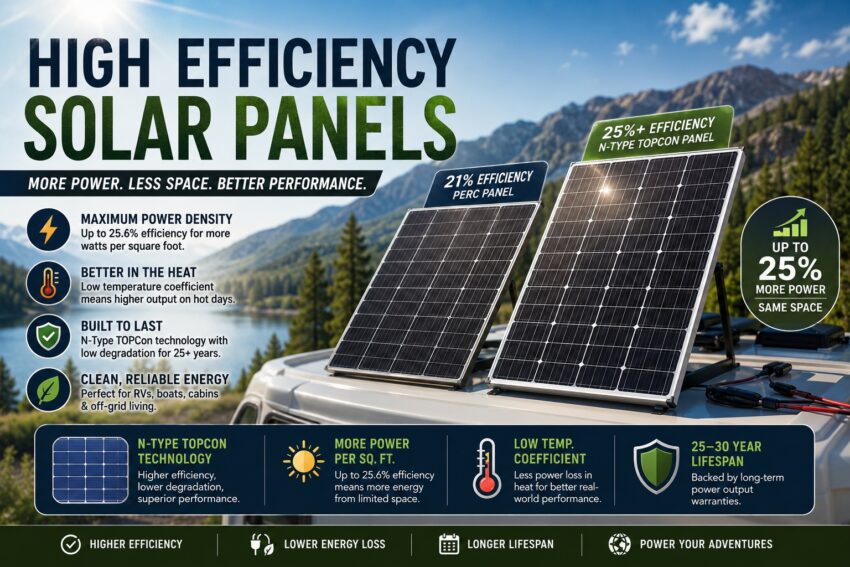
A solar panel’s efficiency is the percentage of sunlight hitting the panel that gets converted into usable electricity. A 25% efficient panel converts one quarter of incoming solar radiation into electrical power. The rest becomes heat.
In practical terms, efficiency determines how much power you get from a given surface area. Two panels sitting side by side in the same sunlight — one at 21% efficiency, one at 25% — will produce different amounts of electricity despite receiving the same amount of sun. The 25% panel produces roughly 19% more power from the exact same footprint.
That’s the real-world value of high efficiency solar panels: more watts per square foot. When roof space is limited — on an RV, a van, a boat cabin, or a constrained rooftop — every percentage point of efficiency translates directly into usable power.
What efficiency doesn’t tell you: how much total power a panel produces. A 400W panel at 21% efficiency produces more electricity than a 100W panel at 25% efficiency. Efficiency and wattage are separate specifications. You need both.
The Cell Technologies Behind High Efficiency Panels
The efficiency ceiling of a solar panel is set by its cell technology. Four main technologies compete in the current consumer market — and the differences are meaningful.
PERC (Passivated Emitter and Rear Contact)
The established standard. A reflective layer on the back of the cell captures light that passes through the silicon, reducing waste. Current best PERC panels achieve 21–22% efficiency. Most panels under $70 use PERC — proven, reliable, and cost-effective, but not the highest efficiency available. See our budget solar panel guide for the best PERC options at lower prices.
N-Type TOPCon (Tunnel Oxide Passivated Contact)
The current performance leader in the consumer market. N-type silicon is inherently less susceptible to light-induced degradation than P-type PERC. TOPCon adds a passivating tunnel oxide layer that dramatically reduces electron recombination — the main source of efficiency loss in conventional cells. Current N-Type TOPCon panels from Renogy and ECOBOSS achieve 25–25.6% efficiency, with annual degradation rates of ~0.4%/yr vs ~0.5%/yr for PERC. The result over 25 years: meaningfully more lifetime energy from the same panel.
HJT (Heterojunction Technology)
Uses a hybrid of crystalline silicon and amorphous thin-film silicon to achieve some of the highest efficiencies in consumer panels — up to 24–25%+. HJT panels also have exceptional low-light performance and very low temperature coefficients (-0.24 to -0.26%/°C). Less common in the consumer Amazon market than N-Type TOPCon, primarily appearing in residential rooftop systems.
Bifacial Panels
Not a separate cell technology but a panel design — bifacial panels generate power from both sides, capturing reflected light from the surface beneath. On highly reflective surfaces (white rooftops, sand, snow), bifacial rear gain can add 10–25% additional output. On dark surfaces, the gain is minimal.
How to Read Efficiency Specs Without Getting Misled
Cell efficiency vs. module efficiency
Cell efficiency is the efficiency of individual solar cells tested in ideal lab conditions. Module efficiency is the efficiency of the whole assembled panel — always lower, accounting for gaps between cells, frame borders, and interconnection losses. When a panel claims “25% efficiency,” check whether that refers to cell or module efficiency. Module efficiency is typically 1–3% lower.
Temperature coefficient — the real-world performance killer
Every solar panel loses output as it heats up. The temperature coefficient tells you by how much. A panel rated -0.29%/°C loses 0.29% of its rated output for every degree Celsius above 25°C. On a hot summer day when the panel surface reaches 65°C — realistic for a dark rooftop in direct sun — that’s a 40°C rise:
- At -0.27%/°C (Renogy ShadowFlux): 10.8% power loss
- At -0.29%/°C (Renogy N-Type): 11.6% power loss
- At -0.35%/°C (typical PERC): 14% power loss
- At -0.45%/°C (lower quality): 18% power loss
In hot climates, temperature coefficient matters nearly as much as rated efficiency. N-Type TOPCon panels consistently outperform PERC in real-world summer heat — even when rated efficiencies look similar on paper.
Degradation rate — the long game
Quality N-Type panels degrade at ≤0.4%/yr vs ≤0.5%/yr for PERC. Over 25 years, N-Type retains ~90% of original output vs ~87.5% for typical PERC. The difference compounds — a 200W N-Type panel produces meaningfully more total lifetime energy than a 200W PERC panel of the same initial rating.
The Best High Efficiency Solar Panels Right Now — Verified Amazon Picks
Every panel below is verified on Amazon with specs confirmed from official listings. All use N-Type TOPCon 16BB cell technology — the current performance standard for consumer off-grid solar.
| Panel | Wattage | Efficiency | Temp Coeff | IP Rating | Warranty | Price |
|---|---|---|---|---|---|---|
| Renogy 100W N-Type 16BB | 100W | 25% | -0.29%/°C | IP65 | 25yr power | ~$80 |
| Renogy 200W N-Type 16BB | 200W | 25% | -0.29%/°C | IP65 | 25yr power | ~$120 |
| Renogy 200W ShadowFlux | 200W | 25% | -0.27%/°C | IP67 | 25yr power | ~$140 |
| ECOBOSS 100W N-Type 16BB | 100W | 25.6% | Low | IP68 | 30yr | ~$65 |
| ECOBOSS 200W N-Type 16BB | 200W | 25.6% | Low | IP68 | 30yr | ~$110 |
Renogy 100W N-Type 16BB — Best Overall 100W High Efficiency Panel
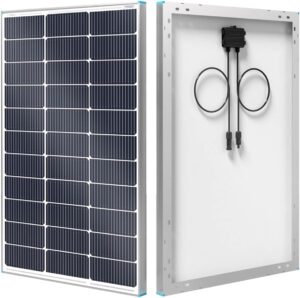
The Renogy 100W N-Type is the benchmark for 100W high efficiency panels on Amazon. At 25% cell efficiency with 16BB N-Type TOPCon technology, it delivers 20W more output than a conventional PERC 100W panel of the same physical size — 11% smaller and 8% lighter than Renogy’s own PERC 100W. That size and weight reduction with no wattage loss is exactly what efficiency improvement looks like in practice.
The temperature coefficient of -0.29%/°C is a key performance differentiator in hot conditions. This panel maintains stronger output through summer heat than PERC alternatives with inferior coefficients. The 16BB busbar design minimizes hot spots and hidden microcracks, extending service life. IP65 protection handles all weather conditions. The degradation rate of ≤0.4%/yr means this panel retains approximately 90% of its original output at year 25.
Pros: 25% N-Type efficiency, -0.29%/°C temperature coefficient, 20W more than PERC same size, 16BB anti-hotspot, 25yr power warranty, Renogy reliability, IP65
Cons: IP65 rather than IP67/68, slightly more expensive than ECOBOSS equivalent
Best for: RV roofs, boat decks, van builds, and any off-grid installation where maximum watts from minimum space is the priority
Renogy 200W N-Type 16BB — Best Value Per Watt
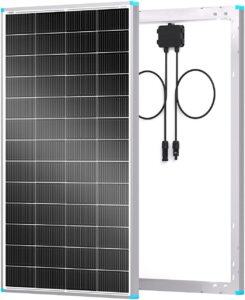
Everything that makes the 100W N-Type exceptional scales up here — the same 25% cell efficiency, same -0.29%/°C temperature coefficient, same 16BB anti-hotspot design, same 25-year power warranty — in a 200W format that delivers exceptional value per watt at around $120.
For RV and boat installations where the goal is maximum wattage from limited roof space, a single 200W N-Type panel is more practical than two 100W panels. Same wattage output, fewer MC4 connections, one less potential failure point, and a cleaner installation. Compatible with both 12V and 24V battery systems. At ~$0.60/watt for 25% N-Type efficiency, this is one of the strongest value propositions in the high efficiency solar panel market on Amazon.
Pros: 25% N-Type efficiency, -0.29%/°C temp coefficient, 12V/24V compatible, 25yr power warranty, best value per watt in high efficiency category, MC4 connectors
Cons: IP65 only, larger footprint may not suit all mounting configurations
Best for: RV roofs and boat decks where space matters, anyone building a 200–400W off-grid system who wants maximum performance per square foot
Renogy 200W ShadowFlux Anti-Shading N-Type — Best for Shaded or Hot Environments
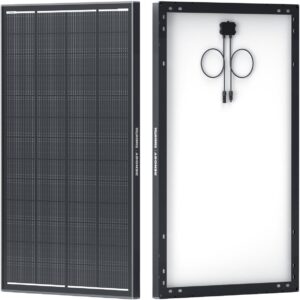
The Renogy ShadowFlux is specifically engineered for real-world conditions where shading is unavoidable. Standard solar panels lose disproportionate output when even a small area is shaded. The ShadowFlux uses proprietary LECO (Low Energy Carbon Oxide) cell technology with advanced anti-shading architecture that minimizes the impact of partial shading on the rest of the panel.
The temperature coefficient of -0.27%/°C is the lowest in our roundup — meaning this panel loses the least output in high heat of any panel here. IP67 waterproofing makes it more suitable for marine and exposed outdoor installations than the standard N-Type. The compact, high-power-density design maximizes watts per square inch — specifically designed for RV, van, and boat rooftops.
Pros: Best temperature coefficient in roundup (-0.27%/°C), anti-shading LECO technology, IP67, highest power density, 25yr power warranty
Cons: Premium price (~$140), anti-shading advantage only materializes in genuinely shaded conditions
Best for: Installations with partial shading from trees or structures; marine applications needing IP67; hot climates where temperature performance matters most
ECOBOSS 100W N-Type 16BB — Highest Efficiency 100W Panel on Amazon
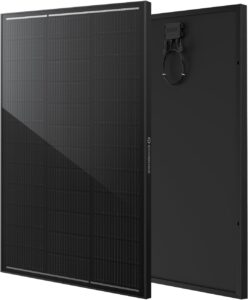
The ECOBOSS 100W holds the highest efficiency rating in our roundup at 25.6% — 0.6 percentage points above the Renogy N-Type, which translates to roughly 2–3% more output from an identical-sized panel. For buyers who want the absolute maximum efficiency available in the consumer Amazon market, ECOBOSS currently leads.
The IP68 waterproof rating exceeds Renogy’s IP65 — fully submersion-rated, making it the better choice for marine applications where spray and humidity are constants. The 30-year lifespan claim is notably longer than Renogy’s 25-year output warranty. At ~$65 for a 100W N-Type TOPCon panel, the price per watt is genuinely competitive. ECOBOSS is a newer brand than Renogy with a thinner support track record — worth knowing before buying.
Pros: 25.6% efficiency — highest in roundup, IP68 waterproof, 30-year lifespan, lower price than Renogy equivalent, N-Type 16BB technology
Cons: Newer brand — less established track record and community documentation than Renogy
Best for: Marine applications where IP68 is needed, buyers who want the absolute highest efficiency 100W panel at the best price
ECOBOSS 200W N-Type 16BB — Best Budget High Efficiency 200W Panel
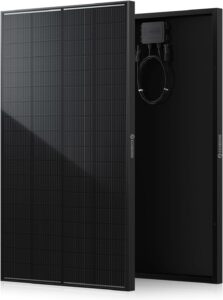
The ECOBOSS 200W matches the 25.6% efficiency of its 100W sibling in a 200W format at ~$110 — less than the Renogy 200W N-Type at ~$120 and well below the ShadowFlux at ~$140. It also carries IP68 waterproofing and the 30-year lifespan claim, making it the most weather-resistant 200W option in our picks at the lowest price.
If you’re building a multiple-panel system and want high efficiency across all panels without paying Renogy prices, the ECOBOSS 200W is the most cost-effective path. The 16BB N-Type TOPCon cells deliver the same low degradation rate and heat performance advantages as the Renogy equivalent.
Pros: 25.6% efficiency, IP68 waterproof, 30-year lifespan, lowest price per watt in the high efficiency 200W category, N-Type 16BB technology
Cons: Newer brand with less track record than Renogy
Best for: Multi-panel systems where cost efficiency matters, marine use requiring IP68, buyers who want maximum efficiency at minimum price
High Efficiency vs. Standard Efficiency — When Does the Upgrade Actually Pay Off?
High efficiency matters most when:
- Mounting space is constrained. RV roofs, van rooftops, boat decks — anywhere you can’t just add more panels. A 25% efficient panel produces 19% more power in the same space as a 21% panel.
- You’re in a hot climate. N-Type TOPCon’s superior temperature coefficient (-0.27 to -0.29%/°C vs -0.35 to -0.45%/°C for PERC) delivers measurably more real-world output in summer heat.
- You want better long-term performance. Lower degradation means more total lifetime energy — relevant if panels will be on a roof for 20+ years.
- Weight matters. High efficiency panels are physically smaller for the same wattage — lighter on the roof, easier to handle.
High efficiency matters less when:
- You have unlimited space. Ground mount systems can simply add more PERC panels instead of paying for higher efficiency.
- Budget is the absolute priority. A 21% PERC panel at $45 produces the same power as a 25% N-Type at $80 — you’re paying for a smaller footprint, not more total watts.
- The installation is temporary. Testing solar doesn’t require premium efficiency panels.
Who Makes the Best High Efficiency Solar Panels?
For consumer off-grid (Amazon-available): Renogy and ECOBOSS currently lead the consumer N-Type TOPCon market. Renogy has the stronger 13-year track record and broader support ecosystem. ECOBOSS has the slightly higher efficiency rating (25.6% vs 25%) and IP68 waterproofing at a lower price point.
For residential rooftop installations: The premium efficiency leaders are Maxeon (formerly SunPower), REC, and LONGi — achieving 22–24.1% module efficiency on full-size residential panels. These are installed through solar installers rather than sold on Amazon. They represent the highest module efficiency commercially available but at significant price premiums.
The emerging competition: Callsun and Rvpozwer are newer N-Type brands appearing on Amazon with 25%+ efficiency claims at competitive prices. Worth watching — but with less verified track record than Renogy or ECOBOSS at this stage.
Pairing High Efficiency Panels With the Right Equipment
A high efficiency panel is only as good as what it’s paired with. N-Type panels output higher voltage than equivalent PERC panels — always pair them with an MPPT charge controller to take full advantage. A PWM controller wastes 20–30% of the efficiency gains you just paid for.
- Solar charge controllers — MPPT is essential for N-Type panels. See our guide for the best options at every price point.
- RV solar panel kits — complete system packages with panels, MPPT controller, and wiring included.
- Solar generators for home backup — pairing high efficiency panels with a quality power station for off-grid or emergency backup.
- Flexible solar panels — for curved surfaces and weight-critical applications where rigid panels won’t work.
Frequently Asked Questions
What is the most efficient solar panel you can buy on Amazon?
ECOBOSS currently claims the highest efficiency rating among consumer N-Type panels on Amazon at 25.6% cell efficiency — 0.6 percentage points above Renogy’s 25% N-Type panels. Both use 16BB N-Type TOPCon technology. For context, the highest module efficiency in residential rooftop solar (Maxeon 7) reaches 24.1% — consumer off-grid panels at 25%+ cell efficiency are genuinely competitive at the cell level.
Is a 25% efficient panel worth the extra cost over a 21% panel?
For space-constrained installations (RV, van, boat): yes, usually. You get 19% more power from the same footprint, better heat performance, and lower long-term degradation. For ground-mounted systems with unlimited space: less so — adding one more PERC panel often costs less than upgrading every panel to N-Type. The calculation depends on whether you’re constrained by space or budget.
What does N-Type mean in solar panels?
N-type refers to the type of silicon used in the solar cell. Standard PERC panels use P-type silicon (doped with boron). N-type silicon is doped with phosphorus, creating charge carriers with higher mobility that are less susceptible to impurities and degradation. In practical terms: N-type panels are more efficient, degrade more slowly, and perform better in heat than equivalent P-type PERC panels.
What is the best temperature coefficient for a solar panel?
Lower (more negative) is better — a lower coefficient means less efficiency lost per degree of heat. The best consumer panels currently achieve -0.27 to -0.29%/°C (Renogy ShadowFlux and Renogy N-Type). Standard PERC panels typically run -0.35 to -0.40%/°C. At 65°C panel temperature, -0.27%/°C loses 10.8% output while -0.40%/°C loses 16% — a meaningful real-world difference in hot climates.
How long do high efficiency solar panels last?
Quality N-Type TOPCon panels are rated for 25–30 years. Renogy’s 25-year power output warranties guarantee 80% of rated output at year 25. The lower degradation rate of N-Type (~0.4%/yr vs ~0.5%/yr for PERC) means they retain more output throughout that lifespan. The junction box, connectors, and frame typically outlast the warranty period when properly maintained.
Which brand makes the best solar panels for off-grid use?
For consumer off-grid applications on Amazon: Renogy for the most proven 13-year track record and strongest support ecosystem; ECOBOSS for the highest efficiency rating (25.6%) and IP68 waterproofing at a lower price. Both represent genuine advances over PERC panels. For residential rooftop systems, Maxeon, REC, and LONGi lead on module efficiency — but these are installed through solar contractors rather than sold on Amazon. For a full system, also see our RV solar panel kit guide.
The Bottom Line
The performance gap between a 21% PERC panel and a 25% N-Type panel is real, measurable, and compounds over time. In space-constrained, heat-exposed, long-term off-grid installations — which describes most RV, van, and boat solar setups — that gap translates into meaningful extra energy every single day for 25 years.
Renogy is the safe choice: the most proven brand in consumer off-grid solar, with the technology and track record to back up the efficiency claims. ECOBOSS offers slightly higher efficiency and IP68 waterproofing at a lower price for buyers who are willing to go with a newer brand.
Either way — if you’re buying panels today, there’s no good reason to settle for PERC when N-Type TOPCon is this accessible. The price gap has narrowed enough that the upgrade pays for itself in real-world performance, faster than most people expect.
For budget-focused buyers who don’t need maximum efficiency, see our cheap solar panels guide — the best PERC options are genuinely good value when space isn’t the constraint.