This post contains affiliate links. If you buy through our links we may earn a small commission — at no extra cost to you. This never influences our recommendations.
What Is a 10kW Solar System — And Is It Right for You?
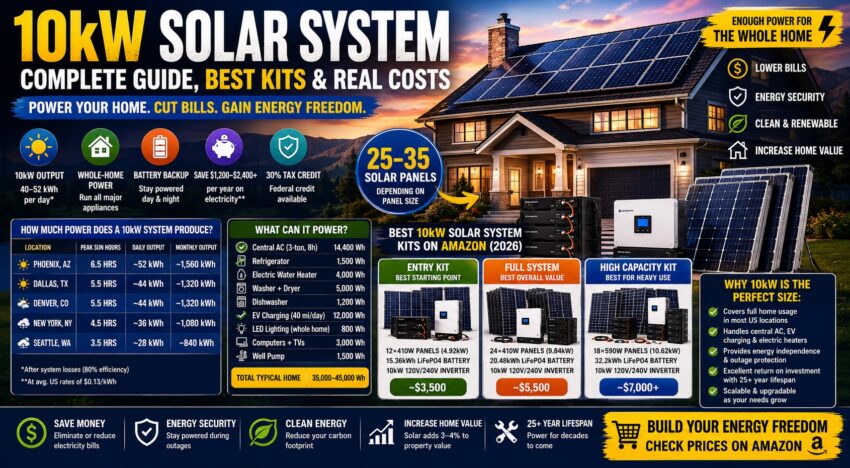
A 10kW solar system generates approximately 10,000 watts of power at peak output — enough to cover the entire electricity consumption of a typical American home, power most of an off-grid property year-round, or provide serious whole-home backup for extended outages.
It’s not a starter system. A 10kW installation requires 25–35 solar panels depending on panel wattage, a battery bank in the 15–40kWh range for meaningful storage, a 10kW inverter capable of 120V/240V split-phase output, and professional installation in most US jurisdictions. The total cost ranges from $8,000–$25,000 depending on components, installation, and whether you’re building grid-tied or off-grid.
But for the right application — a home that uses 1,000–1,500kWh per month, an off-grid property in a moderate-sun climate, or a family wanting genuine energy independence — a 10kW solar system is the right-sized answer.
How Much Power Does a 10kW Solar System Actually Produce?
Daily output (kWh) = System size × Peak sun hours × System efficiency
For a 10kW system in 5 peak sun hours with 80% real-world efficiency:
10kW × 5hrs × 0.80 = 40kWh per day
| Location | Peak Sun Hours | Daily Output | Monthly Output |
|---|---|---|---|
| Phoenix, AZ | 6.5 hrs | ~52kWh | ~1,560kWh |
| Dallas, TX | 5.5 hrs | ~44kWh | ~1,320kWh |
| Denver, CO | 5.5 hrs | ~44kWh | ~1,320kWh |
| Los Angeles, CA | 5.5 hrs | ~44kWh | ~1,320kWh |
| New York, NY | 4.5 hrs | ~36kWh | ~1,080kWh |
| Seattle, WA | 3.5 hrs | ~28kWh | ~840kWh |
The average American home uses approximately 886kWh per month (US EIA data). A 10kW system in most US locations produces 1,000–1,500kWh per month — covering the full electricity bill and then some in sunnier regions. Annual output averages 12,000–16,000kWh, representing $1,200–$2,400 in electricity savings at average US rates.
What Can a 10kW Solar System Power?
| Appliance | Daily Wh | Covered by 10kW? |
|---|---|---|
| Central AC (3-ton, 8 hrs) | 14,400Wh | ✅ |
| Electric water heater | 4,000Wh | ✅ |
| Refrigerator | 1,500Wh | ✅ |
| Washer + electric dryer | 5,000Wh | ✅ |
| Dishwasher | 1,200Wh | ✅ |
| LED lighting (whole home) | 800Wh | ✅ |
| EV charging (40-mile daily) | 12,000Wh | ✅ |
| Computers + TVs | 3,000Wh | ✅ |
| Well pump | 1,500Wh | ✅ |
| Total typical home | ~35,000–45,000Wh | ✅ Covered |
A 10kW system is the minimum practical size for whole-home coverage of a typical American household — including central AC, an electric water heater, and EV charging. Smaller systems cover partial loads; a 10kW system covers the whole picture.
10kW Solar System Components — What’s in a Complete Kit
1. Solar Panels: 24–26 panels at 400W each, or 17–18 panels at 590W each. N-Type monocrystalline panels with 25%+ efficiency degrade the least over 25 years. See our high efficiency solar panels guide for the technology comparison.
2. Inverter: Converts DC from panels and batteries to AC for home use. A whole-home 10kW system requires split-phase capability — 120V and 240V simultaneously. Two 5kW inverters in parallel or a single 10kW all-in-one both achieve this. Split-phase is essential for 240V appliances (central AC, electric dryer, EV charger).
3. Battery Bank: For meaningful overnight and cloudy-day coverage, a 10kW system needs 15–40kWh of LiFePO4 battery storage. LiFePO4 is the only chemistry appropriate at this scale — better safety, 3,000–5,000 cycle life, and 95% usable capacity.
4. MPPT Charge Controller: At 10kW, typically integrated into the all-in-one inverter/charger unit. Dual MPPT inputs are preferable, allowing different panel strings to be optimised independently. See our MPPT solar charge controller guide for the sizing principles that apply whether built-in or standalone.
5. Wiring, Combiners, and Safety Hardware: MC4 connectors, DC combiners, circuit breakers, battery busbars, and grounding hardware. Always verify these are included before ordering a kit.
Grid-Tied vs. Off-Grid 10kW Systems
| Factor | Grid-Tied | Off-Grid |
|---|---|---|
| Battery required | Not necessarily | ✅ Essential |
| Net metering (sell excess) | ✅ Yes | ❌ No |
| Works during grid outage | ❌ No (without battery) | ✅ Yes |
| Installation complexity | High (utility approval) | Moderate-high |
| Cost | Lower (no battery) | Higher (battery bank) |
| Best for | Homes with utility connection | Rural properties, cabins, energy independence |
Grid-tied without battery: Most cost-effective for homes on the utility grid — excess power goes back via net metering. Problem: the system automatically shuts down during a grid outage for safety, leaving you without power even with panels above you.
Off-grid: The only option for properties without utility connection. Panels charge the battery bank; the inverter runs the home 24/7 regardless of grid status. All the complete kits reviewed below are designed for off-grid or backup operation.
Grid-tied with battery backup: Best of both worlds — net metering plus outage coverage. Requires a hybrid inverter and careful configuration; typically beyond DIY scope for a 10kW system.
10kW Solar System Cost — What to Budget
| System Type | Components Cost | Installation | Total |
|---|---|---|---|
| DIY off-grid (Amazon kit) | $3,500–$7,000 | $1,500–$3,000 | $5,000–$10,000 |
| Professionally installed off-grid | $6,000–$12,000 | $3,000–$6,000 | $9,000–$18,000 |
| Grid-tied (no battery) | $8,000–$15,000 | $3,000–$8,000 | $11,000–$23,000 |
| Grid-tied with battery backup | $12,000–$25,000 | $5,000–$10,000 | $17,000–$35,000 |
Federal tax credit: The 30% Residential Clean Energy Credit applies to 10kW solar systems at owner-occupied residences — covering panels, battery, and inverter. A $10,000 system yields $3,000 back on federal taxes; a $20,000 system yields $6,000. This significantly improves the economics and should be factored into every comparison.
Payback period: At average US electricity rates of $0.13/kWh and 14,000kWh annual production, a 10kW system saves approximately $1,820/year. A $15,000 net-of-credit system pays back in 8–10 years. At higher electricity rates (California, Hawaii, Northeast), payback shortens to 5–7 years.
Best 10kW Solar System Kits on Amazon in 2026 — Verified Picks
ECO-WORTHY is the dominant brand for complete 10kW off-grid kits on Amazon — offering the widest range of configurations at prices significantly below equivalent professional installation cost.
Important: A 10kW system is a significant electrical installation. Most US jurisdictions require a permit. Electrical work connecting to home wiring requires a licensed electrician in most states. Budget for this before purchasing.
| Kit | Panels | Battery | Inverter | Price |
|---|---|---|---|---|
| ECO-WORTHY 10KW Entry Kit | 12×410W (4,920W) | 15.36kWh LiFePO4 | 10KW 120V/240V | ~$3,500 |
| ECO-WORTHY 10KW Full System | 24×410W (9,840W) | 20.48kWh LiFePO4 | 10KW 120V/240V | ~$5,500 |
| ECO-WORTHY 10KW High Capacity | 18×590W (10,620W) | 32.2kWh LiFePO4 | 10KW 120V/240V | ~$7,000+ |
ECO-WORTHY 10KW Entry Kit — Best Starting Point
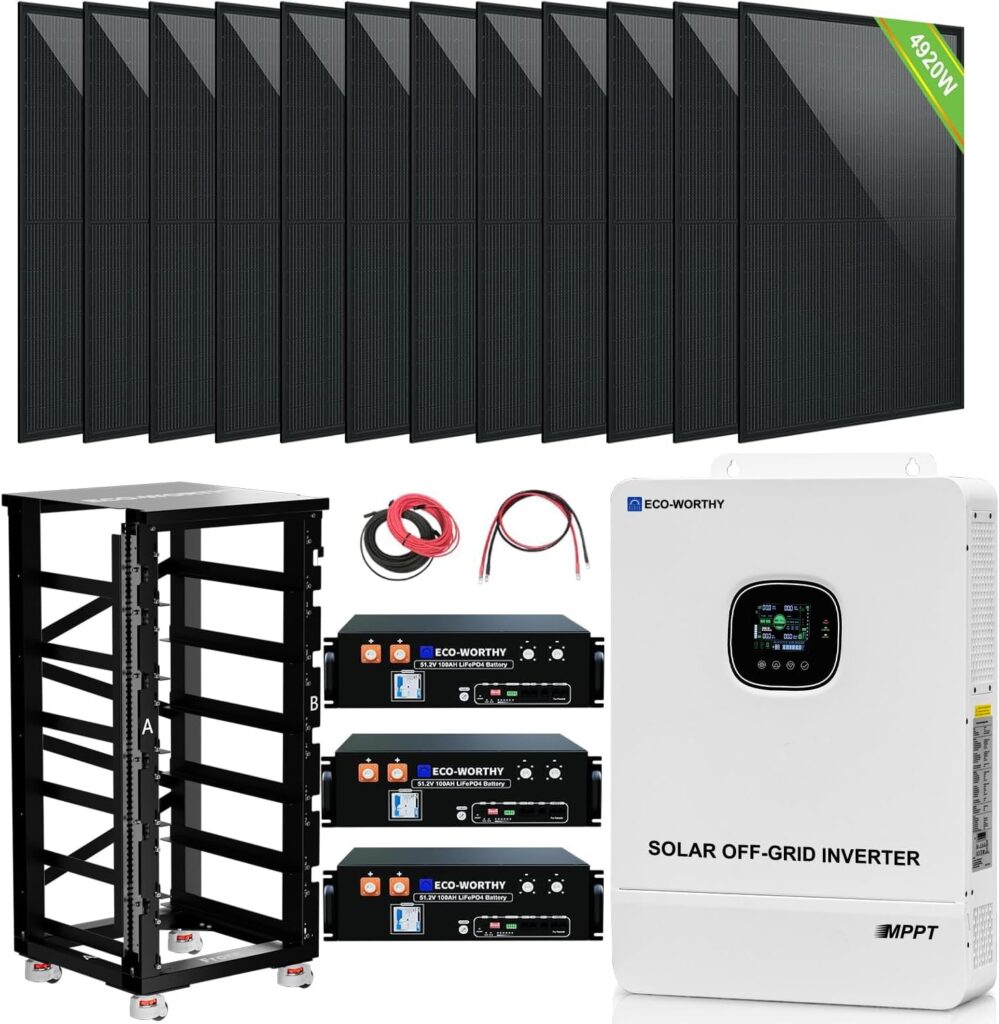
The most accessible 10kW system on Amazon: a genuine whole-home 10KW 120V/240V inverter paired with 15.36kWh of UL1973 and UL9540A certified lithium battery and 4,920W of solar panels (12×410W). The UL certifications on the battery are meaningful — these are the same safety standards used in professional commercial installations.
The honest limitation is the 4,920W of panel capacity: with 5 peak sun hours, it generates approximately 20kWh daily — covering a moderate home’s essential loads but not a whole-home load including central AC and EV charging. Best treated as a strong starting system that can be expanded — the inverter supports additional panel input and the battery rack accepts additional packs.
Pros: Lowest price entry to 10kW inverter capacity, UL-certified battery, split-phase 120V/240V output, complete kit, WiFi monitoring, expandable battery and panel capacity
Cons: 4,920W panel input is limited relative to the 10kW inverter — add panels to unlock full potential, 15.36kWh battery covers 1 day at moderate consumption
Best for: Rural cabins, moderate off-grid homes (under 30kWh daily), buyers wanting to start smaller and expand
ECO-WORTHY 10KW Full System — Best Overall Value
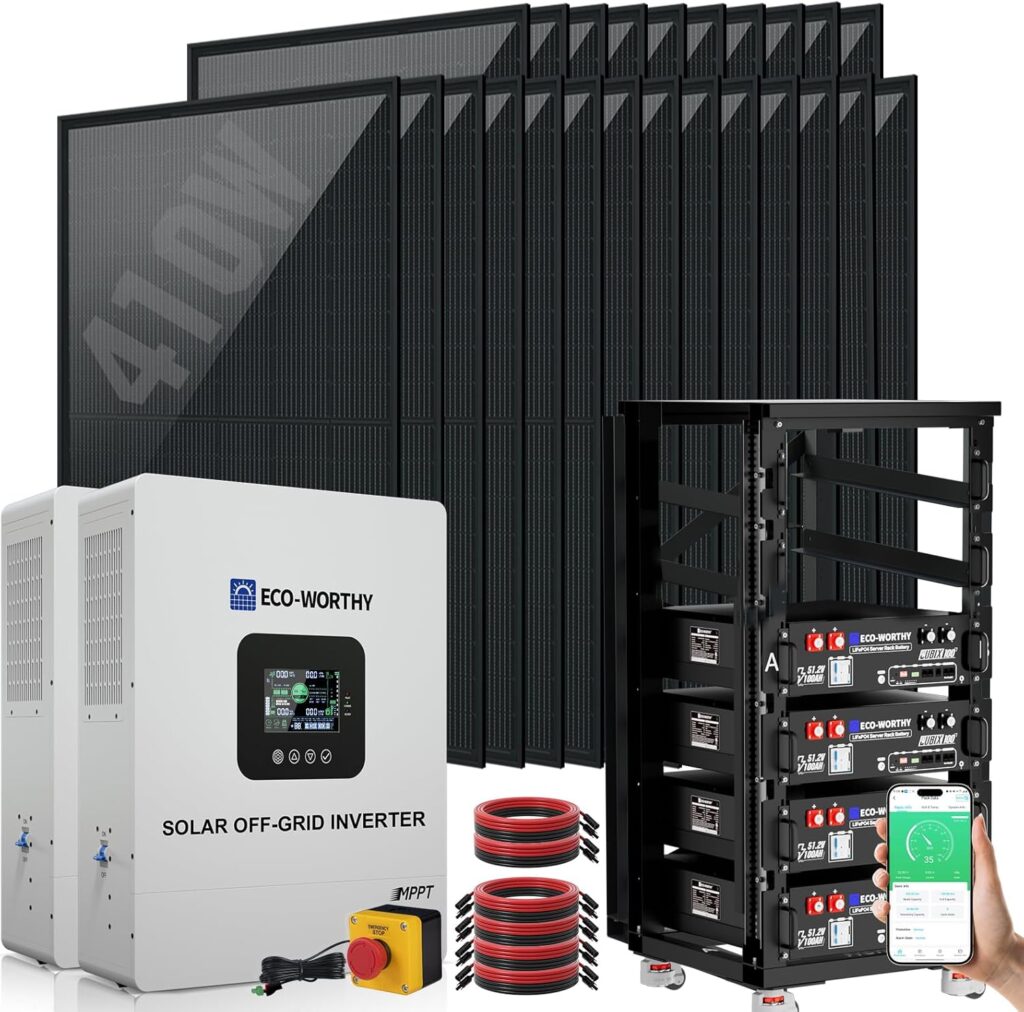
The genuinely complete 10kW system: near-matched panel capacity (9,840W) to inverter output (10kW), meaningful battery storage (20.48kWh), and everything required for whole-home off-grid operation included. The 9,840W of panels generates approximately 40kWh daily in 5 peak sun hours — covering a typical American household’s complete daily consumption.
The system is fully expandable — stack up to 32 batteries for massive 163.84kWh storage and add solar panels anytime. UL1973, UL9540A, and CEC certifications on the batteries represent professional-grade quality at consumer pricing. The dual-inverter architecture (2×5kW) provides redundancy — if one unit fails, the system continues at half output rather than going down completely. The free 6-layer battery rack with 600A busbar represents real value — professional battery racks cost $500–$1,000 separately.
Pros: Near-matched panel-to-inverter capacity, 20.48kWh battery covers full day’s typical home consumption, UL-certified battery, expandable to 163kWh, redundant dual-inverter, free battery rack, WiFi monitoring
Cons: Higher price than entry kit, installation complexity requires licensed electrician, ECO-WORTHY support less developed than professional-grade brands
Best for: Off-grid homesteads, rural properties replacing generator power, serious whole-home solar from Amazon
ECO-WORTHY 10KW High Capacity Kit — Best for Heavy Energy Use
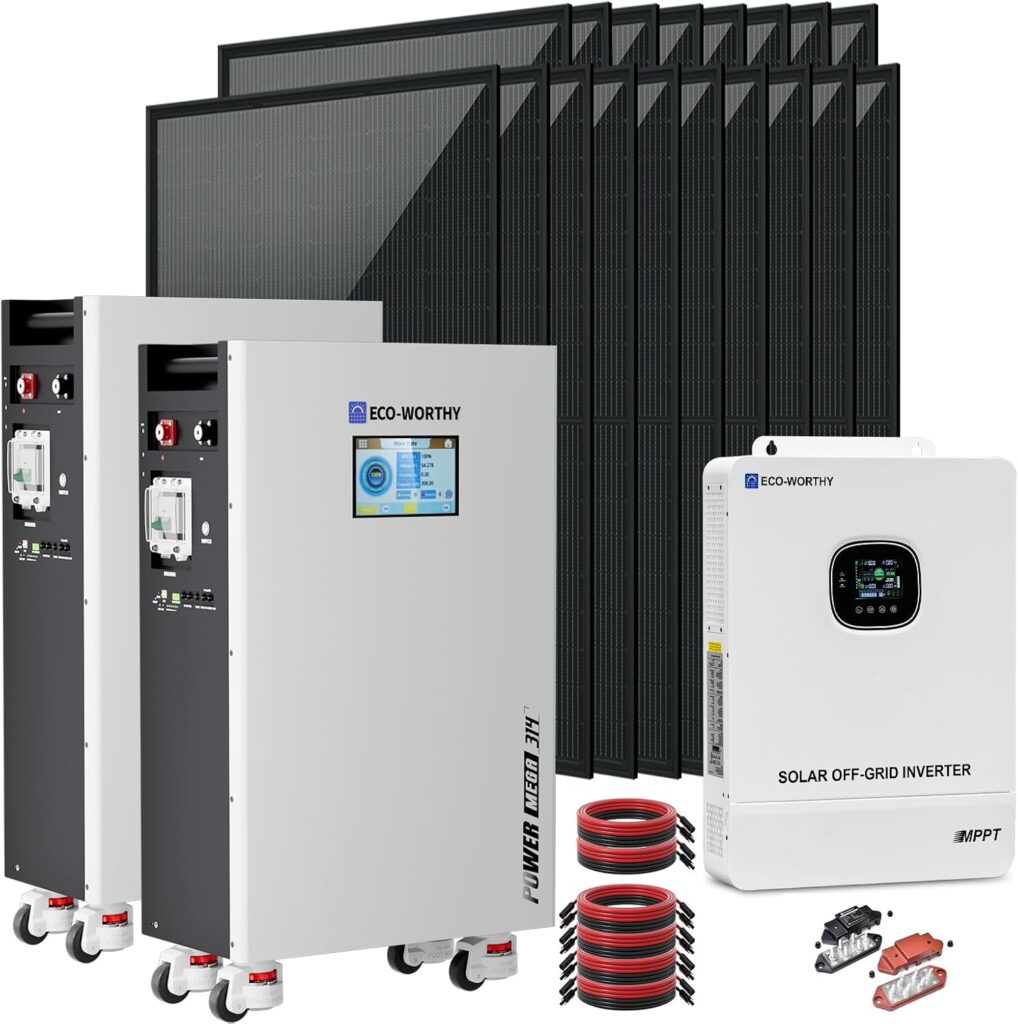
The step up to 590W panels (18 panels vs 24 smaller panels) reduces installation complexity and rooftop footprint for equivalent output. The 32.2kWh battery bank covers roughly 1.5–2 days of typical home consumption from storage — meaningfully more autonomy than the full system. Dual MPPT controllers handle two independent panel strings simultaneously, allowing optimal tracking of panels with different orientations or partial shading. The 10,620W panel capacity with dual MPPT support represents the most capable single-kit system in the ECO-WORTHY 10kW lineup.
Pros: Highest panel output (10,620W), largest standard battery (32.2kWh), fewer panels to install (18 vs 24), dual MPPT controllers, 39kWh+ potential daily generation
Cons: Highest price, 590W panels are large and heavy (require two people to handle safely)
Best for: Larger homes, properties with EV charging needs, off-grid homesteads in lower-sun climates where maximum output matters
How to Size Your 10kW System Correctly
Before buying any kit, verify it matches your actual consumption:
Step 1 — Find your monthly kWh usage
Check 12 months of utility bills and find your average monthly kWh. The US average is 886kWh/month; high-use homes (electric heat, AC, EV) reach 1,500–2,000kWh/month.
Step 2 — Calculate required daily production
Monthly kWh ÷ 30 = daily kWh needed. For 886kWh/month: 886 ÷ 30 = 29.5kWh/day.
Step 3 — Calculate required panel wattage
Daily kWh needed ÷ peak sun hours ÷ 0.80 = panel wattage needed.
For 30kWh daily at 5 peak sun hours: 30 ÷ 5 ÷ 0.80 = 7,500W minimum. A 10kW system (9,840W) provides 31% headroom — the right buffer for cloudy days and seasonal variation.
Step 4 — Size the battery bank
For 1-day autonomy: daily kWh ÷ 0.95 (LiFePO4 efficiency) = battery needed.
For 30kWh/day: 30 ÷ 0.95 = 31.6kWh minimum for 1-day autonomy.
This explains why the entry kit’s 15.36kWh battery is undersized for a full home — it’s right-sized for a cabin. The full system’s 20.48kWh is adequate for average homes; the high-capacity kit’s 32.2kWh covers heavy users.
Installation — What’s Required for a 10kW System
Permitting: Most US jurisdictions require a building permit for any solar installation and an electrical permit for wiring. Grid-tied systems additionally require utility interconnection approval, adding 4–16 weeks to the timeline.
Electrical work: Connecting a 10kW inverter to home wiring requires understanding of load center wiring, grounding, and safety disconnects. In most states this legally requires a licensed electrician. Budget $1,500–$4,000 for professional electrical work on an otherwise DIY system.
Structural assessment: For roof-mounted panels, verify the roof can support the additional load — 24 panels at ~50 lbs each adds 1,200 lbs. Significant for older homes.
Ground mounting: If roof mounting isn’t suitable, ground mounting adds racking and foundation cost but gives better orientation flexibility and easier maintenance. See our ground mounted solar panels guide for the full setup process.
Frequently Asked Questions
How many solar panels do I need for a 10kW system?
At 400W per panel: 25 panels. At 410W: 24 panels. At 590W: 17–18 panels. The ECO-WORTHY kits use 410W or 590W panels in configurations of 12–24 panels depending on the kit tier. See our monocrystalline solar panels guide for a full comparison of panel technologies at this scale.
How much does a 10kW solar system cost?
From Amazon as a complete DIY kit: $3,500–$7,000 for components. Add $1,500–$4,000 for professional electrical installation and $500–$1,500 for permitting. Total: $5,500–$12,500. Professionally installed by a solar company: $15,000–$25,000 before the 30% federal tax credit ($10,500–$17,500 after).
How much electricity does a 10kW solar system produce?
In most US locations, 35–52kWh per day, or 12,000–16,000kWh per year. This covers the complete electricity consumption of a typical American home (886kWh/month average) with surplus in most locations. In the Pacific Northwest, it covers 80–95% of average home consumption.
Can a 10kW solar system power a whole house?
Yes — for a typical American home under 1,200kWh/month. The system must include a 10kW split-phase inverter (for 240V appliances), adequate LiFePO4 battery storage for overnight use, and sufficient panel wattage to recharge the battery daily. The ECO-WORTHY Full System kit (9,840W panels + 20.48kWh battery) meets this threshold for average homes.
What size battery do I need for a 10kW solar system?
For a typical home using 30–40kWh daily, 20–40kWh of LiFePO4 battery provides 1–2 days of autonomy. The entry kit’s 15.36kWh covers a cabin or light use; the full system’s 20.48kWh covers an average home; the high-capacity kit’s 32.2kWh covers heavy users or provides extra buffer for cloudy stretches.
Do I need a permit for a 10kW solar system?
In virtually all US jurisdictions, yes. Building and electrical permits are required for any permanent solar installation. Check with your local building department before purchasing equipment — the permit process typically adds $500–$2,000 in fees and 2–8 weeks to the timeline.
Final Verdict
| Your Situation | Best Kit |
|---|---|
| Cabin or moderate off-grid use | ECO-WORTHY Entry Kit (B0D6GNN255) |
| Whole-home off-grid, average use | ECO-WORTHY Full System (B0DRJBRTBP) |
| Larger home, EV charging, heavy use | ECO-WORTHY High Capacity (B0GJ5LKS99) |
| Starting smaller, scaling up | Entry kit + add panels and batteries over time |
| Grid-tied professional installation | Consult a licensed solar installer |
A 10kW solar system is one of the most significant home energy investments available — the right size for a typical American household to achieve genuine energy independence. The ECO-WORTHY kits on Amazon make the component cost accessible; professional electrical installation and permitting are the non-negotiable additions that ensure safety and code compliance.
For the individual components that make up a complete 10kW system, see our full guides:
- Off-grid solar system design guide — complete wiring, sizing, and component selection
- High efficiency solar panels — N-Type vs PERC for a 10kW array
- MPPT charge controllers — standalone controller selection
- Ground mounted solar panels — if roof mounting isn’t viable
- How long solar panels last — 25-year output expectations for a 10kW investment