This post contains affiliate links. If you buy through our links we may earn a small commission — at no extra cost to you. This never influences our recommendations.
Jackery Explorer 5000 Plus Review — The Short Version
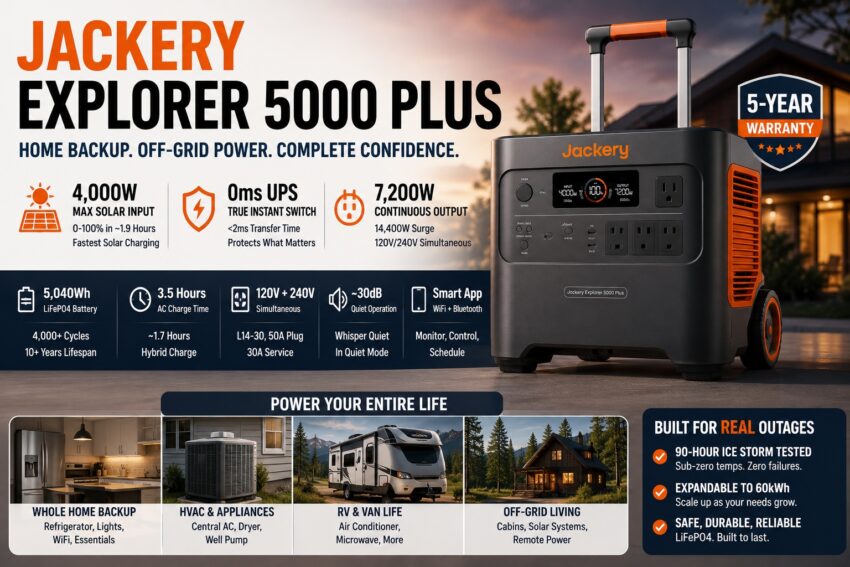
There are two kinds of people shopping for the Jackery Explorer 5000 Plus. The first has experienced a serious, extended power outage — the kind that lasts days rather than hours — and decided they’re never going through that again unprepared. The second is building a serious off-grid setup and has realised that portable power stations in the 1,000–2,000Wh range simply can’t handle the loads they need.
Both are right to land here. The Explorer 5000 Plus is Jackery’s flagship unit — and it sits in a genuinely interesting position in the home backup market: more capable than conventional portable power stations, less expensive than most professionally installed home battery systems, and unique in combining 4,000W of solar input with 7,200W of continuous output in one unit that doesn’t require an electrician to operate.
🛒 Buy on Amazon (Prime shipping, easy returns)
🏪 Buy on Jackery.com (direct from manufacturer, exclusive bundles)
Jackery Explorer 5000 Plus: Specs at a Glance
| Spec | Detail |
|---|---|
| Battery Capacity | 5,040Wh LiFePO4 |
| Expandable to | 60kWh (10 additional battery packs) |
| AC Output | 7,200W continuous |
| Peak / Surge | 14,400W |
| Voltage Output | 120V + 240V simultaneous |
| Battery Chemistry | LiFePO4 |
| Cycle Life | 4,000+ cycles to 70% capacity |
| Solar Input | 4,000W max (high + low voltage MC4) |
| AC Charge Time | 3.5 hours |
| Hybrid Charge Time | ~1.7 hours |
| UPS Transfer Time | 0ms (Smart Transfer Switch) |
| Noise Level | ~30dB (quiet mode) |
| Weight | 134.5 lbs |
| Key Ports | L14-30 twist lock, 50A plug (30A service), USB-A, USB-C, 12V DC |
| App | Jackery app (WiFi + Bluetooth) |
| Warranty | 5 years |
| Price | ~$2,999–$3,500 |
The Three Things That Set the Explorer 5000 Plus Apart
1. 4,000W solar input — the highest in the portable power station category
The 4,000W maximum solar input stands out immediately. Most competing systems max out at 1,200–1,600W solar input. This means the Explorer 5000 Plus charges 2.5–3× faster from solar when you have adequate panel capacity available — achieving 0–100% in approximately 1.9 hours under ideal conditions versus 6–8 hours for most competitors. Even on overcast days, the higher input capacity maintains a significant recharge rate advantage.
2. 0ms UPS switching — genuinely instantaneous
Independent testing using oscilloscopes to monitor voltage switching during simulated grid failures confirmed actual switchover time of under 2 milliseconds — effectively instantaneous for all practical purposes. The EcoFlow DELTA Pro 3 claims 10ms; the Jackery HomePower 3600 Plus specifies sub-20ms. The Explorer 5000 Plus’s sub-2ms measured performance is the fastest transfer time available in any consumer power station — critical for medical equipment, computers, and sensitive electronics.
3. True 120V/240V simultaneous output from a single unit
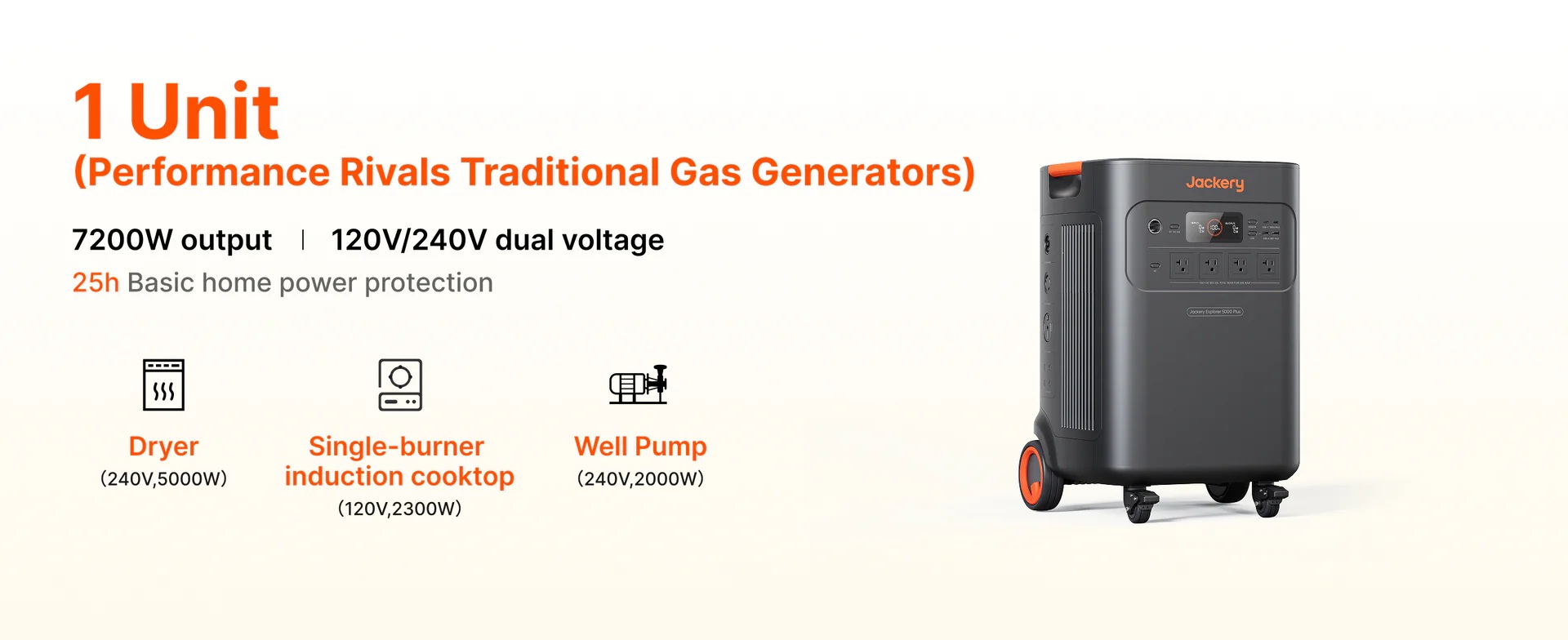
The 7,200W continuous output includes simultaneous 120V and 240V — running large 240V appliances (central AC, electric dryer, EV charger) at the same time as standard 120V circuits, from a single unit without parallel operation.
Real-World Performance — The 90-Hour Outage Test
A severe January ice storm in Mason County provided the ideal unplanned test scenario. Grid power failed at 11 PM on a Thursday and wasn’t restored until Monday morning — a 90-hour outage with outdoor temps dropping to 12°F and wind chill well below zero. The Jackery Explorer 5000 Plus, positioned in a conditioned basement utility room, became the entire household power infrastructure for nearly four days — with 7,200W to 14,400W expandable output keeping the whole home operational. The 0ms UPS response time meant the transition from grid to battery was imperceptible to all electronics in the house.
This is the evidence that matters more than any laboratory specification. The Explorer 5000 Plus is not a “camping power station that could theoretically handle home backup” — it handled an actual multi-day winter outage at sub-zero temperatures without failure.
Solar Charging Performance — Where It Pulls Ahead
Using the maximum 4,000W solar input configuration, 0–100% was achieved in approximately 1.9 hours under ideal conditions. Under real-world conditions with partially cloudy skies: 2.5–3 hours. Even on overcast days with reduced solar intensity: 4–5 hours. This outperforms every competitor by significant margins — most systems with 1,200–1,600W solar limits require 6–8+ hours even in perfect conditions.
For homeowners with existing rooftop solar, the 4,000W input capacity absorbs the full output of a typical residential solar array simultaneously. The recommended pairing is the Jackery SolarSaga 500X — the 500W panel designed for the Explorer 5000 Plus ecosystem. Six SolarSaga 500X panels deliver 3,000W of the 4,000W maximum input. Third-party panels work but require careful voltage matching. See our Jackery solar panel guide for the complete SolarSaga lineup compatibility.
Build Quality and Design
The design doesn’t feel like a prototype. The Explorer 5000 Plus has real heavy-duty wheels and a solid telescoping aluminium handle — one of the sturdiest sliding handles on any power station. At 134.5 lbs, this is not a unit you carry — it’s a unit you roll. Jackery describes it as packing 5kWh capacity into a compact 3kWh-sized body — significantly smaller than comparable systems at this power level.
The display panel shows battery percentage, input wattage, output wattage, estimated runtime, and active port status simultaneously. The Jackery app (WiFi + Bluetooth) mirrors all this data remotely and adds scheduling, UPS mode configuration, and quiet mode activation.
One port clarification worth noting: The 50A plug is limited to 30A of actual service — a limitation that has caused frustration for some buyers expecting true 50A RV service. Verify your RV’s power requirements before purchasing.
The Honest Limitations
134.5 lbs — semi-permanent placement only. This is a whole-home system designed for placement, not frequent relocation. If you need to move your power station regularly — at campsites, between locations, in and out of vehicles — the Jackery HomePower 3600 Plus at 77 lbs is the better option.
Smart Transfer Switch sold separately. The 0ms UPS automatic home circuit backup requires the STS (Smart Transfer Switch), sold as an additional accessory. Without it, the Explorer 5000 Plus works as a direct plug-in power source but doesn’t auto-switch home circuits on grid failure.
Expansion batteries add significant cost. Reaching 20–30kWh of storage for multi-day whole-home backup requires additional battery packs, each sold separately. Factor this into budget planning.
4,000 cycles rated to 70% capacity — not the 80% benchmark most competitors use. At 70% of 5,040Wh after 4,000 cycles, you’d have approximately 3,528Wh remaining — still substantial, but the cycle rating is measured to a deeper degradation point than most competitors. Worth knowing when comparing specifications directly.
AC charging is 1,800W. For buyers primarily grid-charging rather than solar-charging, the 3.5-hour AC-only charge time is acceptable but not class-leading at this capacity.
Explorer 5000 Plus vs. Key Competitors
| Explorer 5000 Plus | EcoFlow DELTA Pro Ultra | Anker SOLIX F3800 | |
|---|---|---|---|
| Base Capacity | 5,040Wh | 6,144Wh | 3,840Wh |
| AC Output | 7,200W | 7,200W | 6,000W |
| Solar Input | 4,000W | 5,600W | 2,400W |
| UPS Transfer | 0ms | Online UPS | ~20ms |
| Max Expansion | 60kWh | 90kWh | 26.9kWh |
| 240V Single Unit | ✅ | ✅ | ✅ |
| Price | ~$2,999 | ~$4,849 | ~$2,399 |
| Warranty | 5 years | 5 years | 5 years |
The Explorer 5000 Plus stores about 1,000Wh less than the DELTA Pro Ultra but sells for approximately $1,500 less — a major difference. The 0ms UPS transfer and 4,000W solar input (vs Anker’s 2,400W) are genuine differentiators. EcoFlow’s DELTA Pro Ultra wins on base capacity and maximum solar input; Anker wins on lower entry cost and lighter weight. For the full comparison, see our best solar battery backup system for home guide.
Who Should Buy the Explorer 5000 Plus
Homeowners in serious outage-prone regions. The 90-hour real-world outage test at 12°F confirmed it handles extended multi-day winter outages without failure. For households in hurricane zones, rural areas, or northern climates with ice storm risk — this is the right specification.
Off-grid homesteads and remote cabins. The 4,000W solar input creates a solar-first energy system that recharges faster from solar than anything else at this price point. Expanded to 20–30kWh, it powers a small home through multi-day cloudy stretches.
Full-time RV and van life users with large power needs. The 240V capability, 7,200W output, and expandable storage handle full-home RV loads — rooftop AC, electric cooking, EV charging — in a way that smaller power stations cannot.
Medical equipment users requiring 0ms UPS. CPAP, oxygen concentrators, infusion pumps, and other devices that cannot tolerate even 10ms interruptions are best served by this unit’s instantaneous transfer performance.
Who Should Look Elsewhere
Buyers who need portability. At 134.5 lbs, frequent repositioning is impractical. The Jackery HomePower 3600 Plus at 77 lbs is the right option if your use case involves moving the unit regularly.
Budget-conscious buyers for light backup. If essential-load backup is all you need, the EcoFlow RIVER 2 Pro or Jackery Explorer 1000 v2 handles this at a fraction of the cost. The Explorer 5000 Plus earns its price for heavy whole-home loads — it’s overkill for lighter applications.
Buyers primarily relying on AC charging. At 1,800W AC input, it’s not the fastest AC charger at this capacity level. Units with faster AC input deliver better value if you’re primarily grid-charging rather than solar-charging.
Frequently Asked Questions
Can the Explorer 5000 Plus power central air conditioning?
Yes — the 7,200W continuous output and 14,400W surge capacity handle most central AC systems including 3-ton and 5-ton units. Central AC typically draws 1,500–3,500W running and higher at startup — well within the Explorer 5000 Plus’s surge and continuous ratings.
Does it work without the Smart Transfer Switch?
Yes — you can plug appliances directly into the unit’s outlets immediately without the STS. The Smart Transfer Switch is required only for automatic home circuit backup where the unit takes over specific circuits when the grid fails without manual intervention.
How long will it power a typical home?
On its 5,040Wh base capacity, a home running essential loads (~1,500W average duty-cycle) operates for approximately 15–20 hours. With daily solar recharging from a 4,000W panel array, it runs indefinitely through any outage in good weather. See our off-grid solar system guide for detailed load calculations.
What solar panels are recommended?
The Jackery SolarSaga 500X is the purpose-designed pairing. Six 500X panels deliver 3,000W of the 4,000W maximum solar input. Third-party panels work with careful voltage matching. See our Jackery solar panel guide for the complete SolarSaga lineup compatibility.
What is the warranty?
5 years from Jackery, covering defects in materials, workmanship, and performance. Register your product on Jackery.com immediately after purchase to establish warranty coverage.
Where to Buy — Amazon vs. Jackery Direct
Amazon typically offers Prime shipping, easy returns, price history visibility, and bundle configurations in one place. The Explorer 5000 Plus has been available at promotional pricing as low as $2,999 — significantly below the $3,500 MSRP.
Jackery direct can unlock exclusive bundle pricing, promotional discounts, and direct manufacturer warranty service. Jackery’s site shows the complete accessory ecosystem — expansion battery packs, Smart Transfer Switch, SolarSaga 500X panels — making it easier to plan a complete system purchase. For the Smart Transfer Switch and SolarSaga 500X panels, Jackery direct often offers better bundle pricing than buying components separately on Amazon.
🛒 → Buy the Jackery Explorer 5000 Plus on Amazon
(Prime shipping · Easy returns · Price history · Bundle options)
🏪 → Buy the Jackery Explorer 5000 Plus on Jackery.com
(Manufacturer direct · Exclusive bundles · Full accessory ecosystem)
Final Verdict
The Explorer 5000 Plus hits a sweet spot for people who need reliable home backup without diving all the way into high-end whole-home systems. At ~$3,000, it delivers the same price as the Anker SOLIX F3800 with more battery capacity and output power — and the 0ms UPS transfer and 4,000W solar input are genuinely differentiating features that no competitor matches simultaneously at this price.
The limitations are real: 134.5 lbs means semi-permanent placement, the Smart Transfer Switch is an additional purchase for seamless home integration, and the AC charge rate lags behind some competitors. Evaluate these against your specific use case.
For most homeowners in the $3,000 power station category who want genuine whole-home backup with fast solar recharging and instantaneous UPS transfer — the Explorer 5000 Plus is the strongest available option at this price point.
🛒 → Buy on Amazon |
🏪 → Buy on Jackery.com
For more on building a complete solar backup system around the Explorer 5000 Plus, see our off-grid solar system guide and our best solar battery backup system for home guide. For how it compares to the HomePower 3600 Plus, see our full Jackery HomePower 3600 Plus review.