This post contains affiliate links. If you buy through our links we may earn a small commission — at no extra cost to you. This never influences our recommendations.
A solar water pump moves water without grid power, without a generator, and without a monthly electricity bill. For homesteaders, ranchers, off-grid cabins, and anyone with a well or water source away from mains power, it’s often the most practical solution available. No trenching for electrical lines, no fuel costs, no noise.
This guide covers the two main types of solar water pumps, how to size one correctly for your needs, and the best complete kits available on Amazon right now.
Surface vs Submersible Solar Water Pumps
The first decision is pump type — and it comes down entirely to your water source depth.
Surface pumps sit above the water line and pull water up through a suction pipe. They work for shallow sources up to 20 feet deep: ponds, streams, cisterns, and rainwater collection tanks. Surface pumps are easier to access for maintenance and typically cost less. They can push water long horizontal distances for irrigation after pulling it up from the source.
Submersible pumps go down into the well and push water upward. They handle lift heights of 100–300+ feet, making them the standard choice for deep wells, boreholes, and underground water sources. Nearly every well pump application — livestock, irrigation, off-grid household supply — uses a submersible pump. All four products in this guide are submersible.
If your water source is a shallow pond or rainwater barrel under 20 feet deep, a surface pump may be appropriate. For anything deeper — and for most permanent installations — a submersible pump is the right choice.
Key Specs to Understand Before You Buy
Flow rate (GPM — gallons per minute): How much water the pump moves per minute at rated conditions. A 1.6 GPM pump delivers about 96 gallons per hour; a 3.2 GPM pump delivers about 192 gallons per hour. Match flow rate to your actual daily water needs — livestock, irrigation volume, or household use.
Max head (lift height): The maximum vertical distance the pump can push water upward. A pump rated for 230ft max head can push water from 230 feet below the pump outlet. Real-world lift always includes the depth of the pump plus any vertical rise in the discharge pipe. Never buy a pump with a max head that’s exactly your required lift — leave at least 20% headroom.
Panel wattage and voltage: Larger pumps need more solar input. A 96W pump runs on a single 100–200W panel. A 140W pump needs 400W of panels for full performance. Voltage matters too — 12V pumps pair with single panels and small systems; 24V pumps need panels wired in series or a larger array but run more efficiently over long wire distances.
Battery backup: Pump-only solar kits stop when clouds roll in. Kits with a LiFePO4 battery store energy so the pump can continue running for 1–2 hours without direct sun — important for consistent livestock and irrigation supply in variable weather.
How Much Water Do You Actually Need?
A quick reference before sizing your pump:
| Application | Daily Water Need | Minimum Flow Rate |
|---|---|---|
| 1 horse | 10–15 gallons/day | 0.5 GPM for 30 min/day |
| 1 cow | 25–50 gallons/day | 1.6 GPM for 30 min/day |
| Small herd (10 cattle) | 250–500 gallons/day | 1.6–3.2 GPM for 2–3 hrs/day |
| 1 acre drip irrigation | 400–600 gallons/day | 1.6–3.2 GPM |
| Off-grid cabin (2 people) | 50–100 gallons/day | 1.6 GPM for 1 hr/day |
| Large farm / ranch irrigation | 1,000+ gallons/day | 5+ GPM (400W+ system) |
The practical approach: pump into a storage tank during peak sun hours, then gravity-feed or pressure-feed from the tank as needed. This decouples water supply from pump runtime and makes the system far more reliable than pumping on demand.
Best Solar Water Pumps — Verified Picks
| Product | Flow Rate | Max Head | Panel | Battery | Best For |
|---|---|---|---|---|---|
| ECO-WORTHY 200W Kit | 1.6 GPM | 230ft | 200W included | None | Best entry-level kit |
| ECO-WORTHY 200W + 30Ah Battery | 1.6 GPM | 230ft | 200W included | 30Ah LiFePO4 | Best for cloudy climates |
| ECO-WORTHY 400W Farm Kit | 5.6 GPM | 230ft | 4×100W included | MPPT controller | Best for livestock & irrigation |
| ECO-WORTHY Pump Only 3.2 GPM | 3.2 GPM | 230ft | Not included | None | Best if you have panels already |
Best Entry-Level Kit: ECO-WORTHY Solar Well Pump Kit — 200W Panel Included
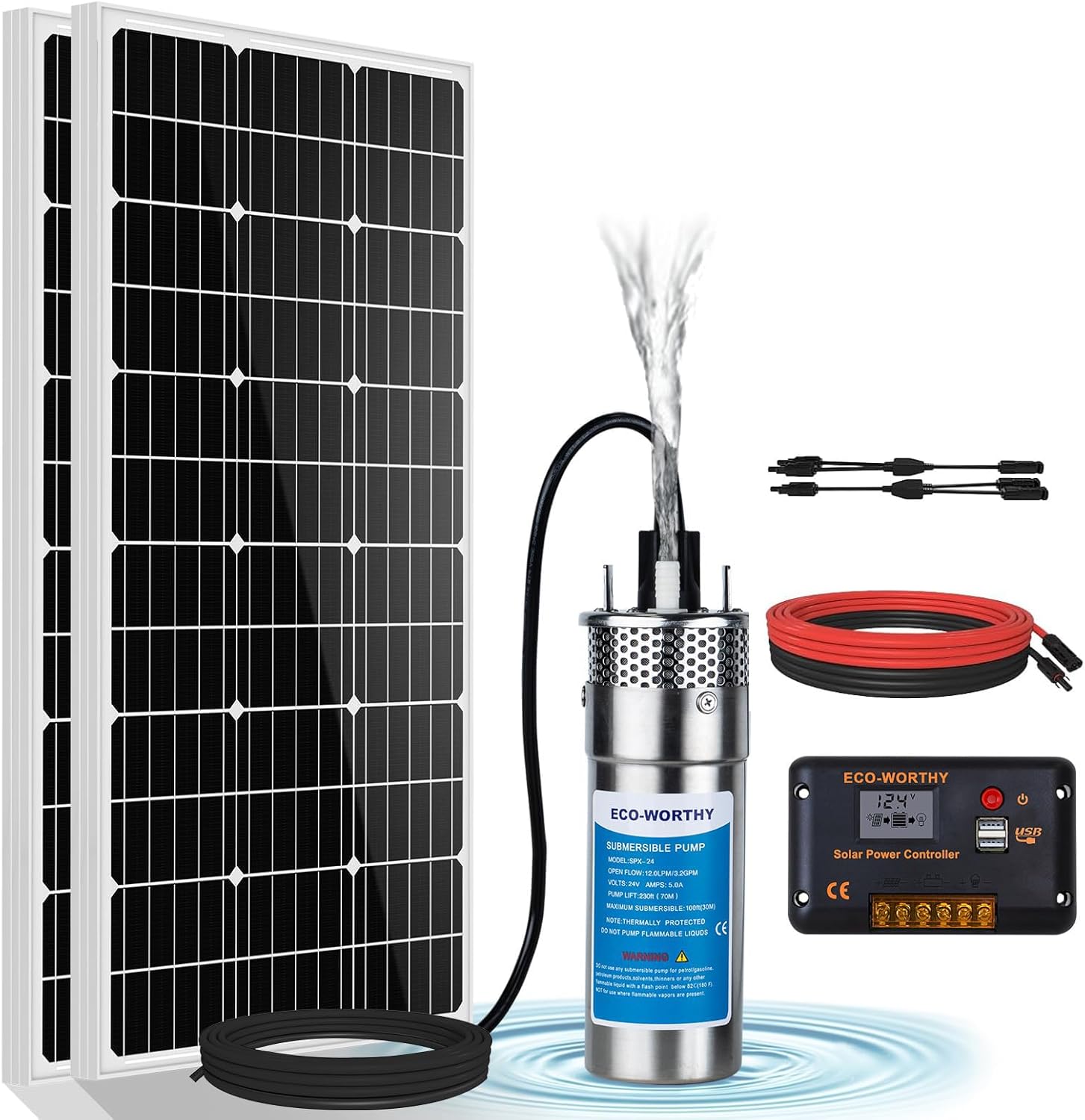
The cleanest starting point for anyone new to solar water pumping. One 200W monocrystalline panel, a 12V submersible pump delivering 1.6 GPM at up to 230ft of head, and all the wiring to connect the two. Drop the pump in the well, angle the panel toward the sun, and it starts pumping in direct sunlight — no additional components needed.
The 1.6 GPM flow rate handles a small livestock herd, a garden irrigation system, or off-grid cabin water supply comfortably when paired with a storage tank. The pump itself is stainless steel construction — significantly more durable than plastic body alternatives in sediment-heavy or mineral-rich well water. No battery means the pump runs only while the sun is shining, which is adequate for most applications that use a storage tank as a buffer.
Pros: Complete kit — nothing else needed to start, 200W panel included, stainless pump body, 230ft max head, 12V simple wiring
Cons: No battery backup — stops on cloudy days; 1.6 GPM limits suitability for large herds or high-volume irrigation
Best for: Small homesteads, off-grid cabin water supply, garden irrigation, first-time solar pump buyers
Best for Cloudy Climates: ECO-WORTHY 200W Kit + 30Ah LiFePO4 Battery
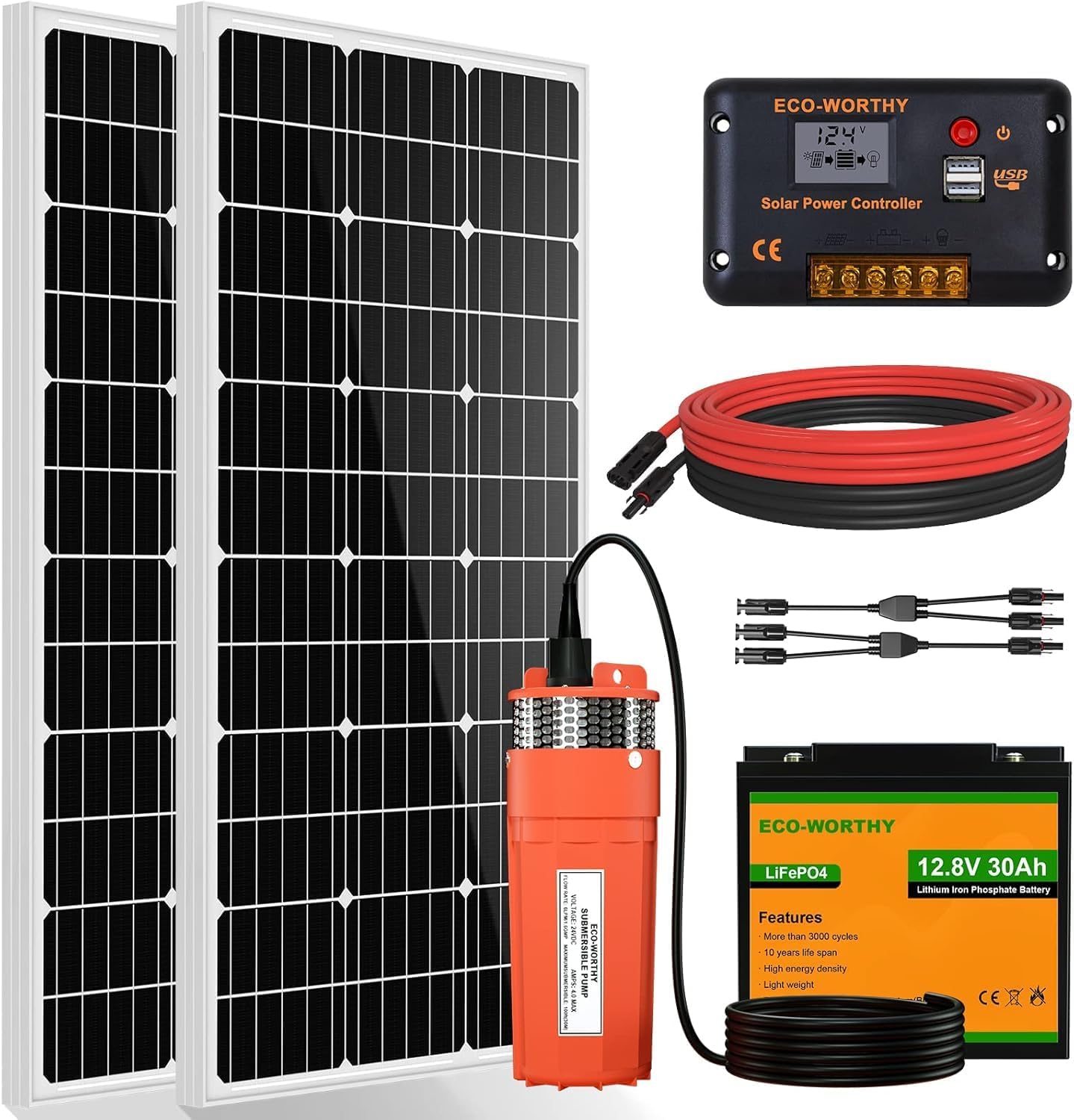
The same 200W panel and 1.6 GPM submersible pump as the entry kit, but this version adds a 30Ah LiFePO4 battery and controller. On a sunny day the battery charges fully in approximately two hours, then powers the pump for an additional 1–2 hours after the sun drops or clouds move in. That’s the difference between a pump that stops unpredictably and one that runs through afternoon cloud cover.
LiFePO4 chemistry means 3,000+ charge cycles — the battery outlasts the pump by a wide margin. The built-in BMS protects against overcharge, over-discharge, and short circuit. For locations with frequent afternoon cloud cover, northern climates, or any situation where pump reliability matters more than upfront cost, this is the right step up from the panel-only kit.
Pros: Battery backup for 1–2 hours of cloudy-day operation, LiFePO4 longevity, BMS protection, complete kit with controller
Cons: Higher price than no-battery kit; 1.6 GPM still limits high-volume applications
Best for: Cloudy or variable weather climates, livestock water where supply reliability is non-negotiable, off-grid cabins
Best for Livestock and Farm Irrigation: ECO-WORTHY 400W Farm Kit
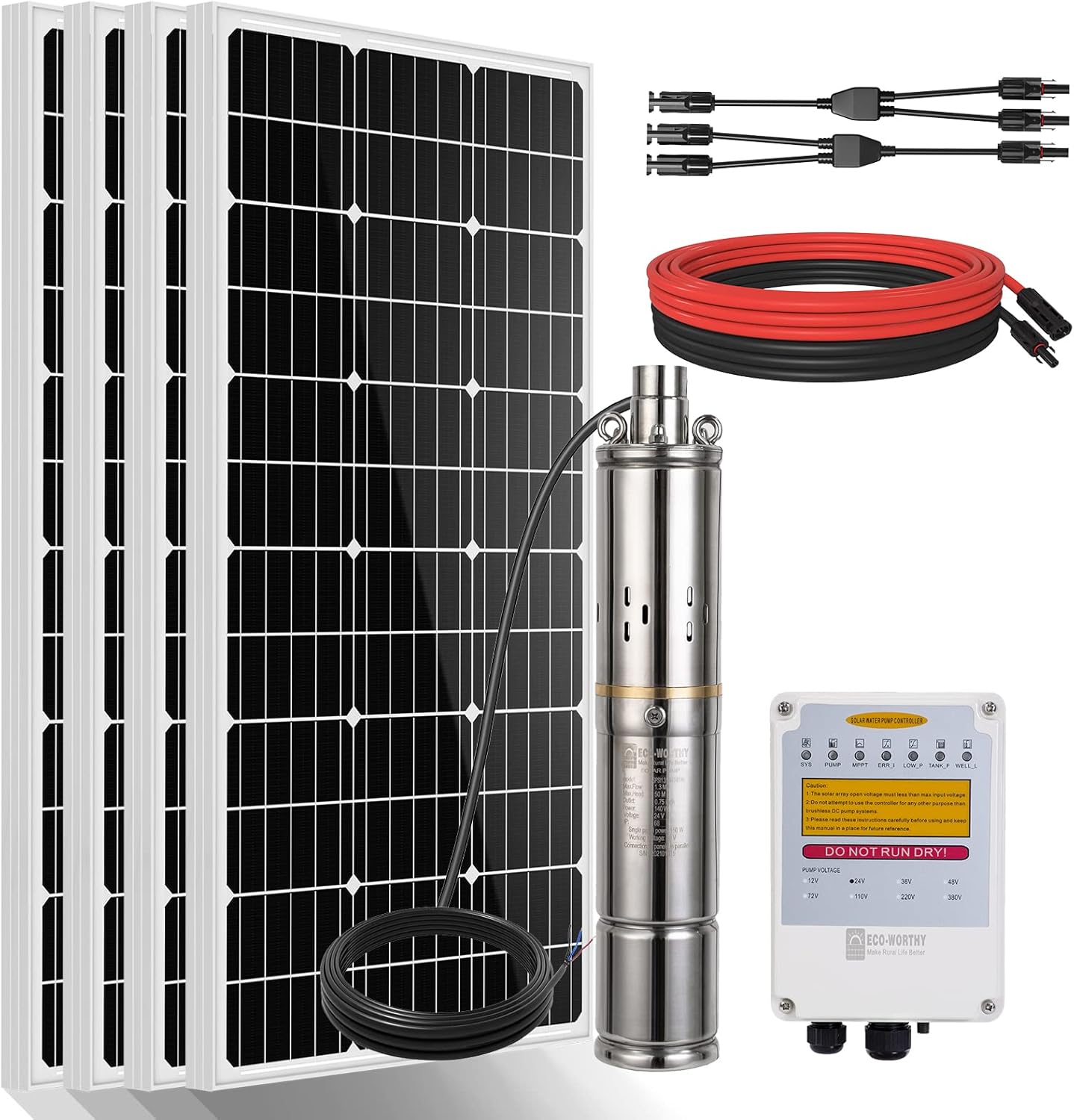
The serious option for high-volume water needs. Four 100W monocrystalline panels power a 140W submersible pump that delivers 5.6 GPM — three and a half times the flow rate of the 1.6 GPM kits. At 5.6 GPM, this system fills a 500-gallon livestock tank in under 90 minutes of strong sun. It handles irrigation for multiple acres of drip lines, watering for herds of 20+ cattle, or filling a large storage tank for an off-grid homestead’s daily use.
The included MPPT controller maximises power extraction from the panel array across changing light conditions — significantly more efficient than PWM controllers. All four panels wire together in an array that’s expandable if your needs grow. Stainless steel pump body, IP68 waterproof rating. This is the system for anyone who genuinely needs to move water at farm or ranch scale from a solar array.
Pros: 5.6 GPM high-flow output, MPPT controller for maximum panel efficiency, complete 4-panel kit, stainless pump body, expandable
Cons: Significantly higher price, requires more installation space for four panels, no battery backup included
Best for: Livestock herds, farm-scale irrigation, large off-grid homesteads, anyone with 10+ head of cattle or multiple acres of irrigation
Best Pump-Only: ECO-WORTHY 12V Submersible Pump — 3.2 GPM
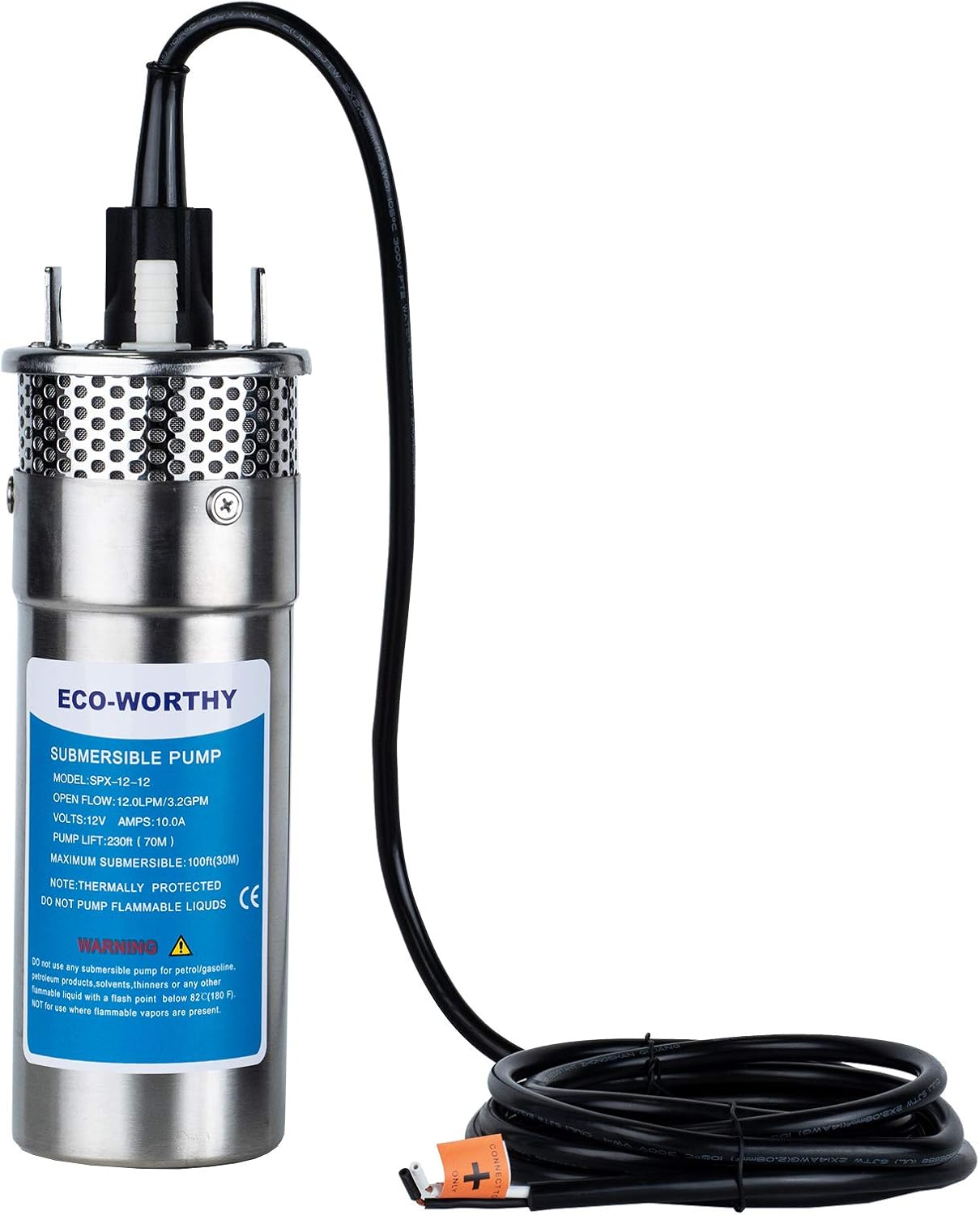
If you already have solar panels and a charge controller in place — from a cabin system, an existing off-grid setup, or a van build — this pump-only option gives you the most efficient path to adding water pumping without paying for panels you don’t need. At 3.2 GPM and 230ft max head, it doubles the flow rate of the 1.6 GPM entry pump and handles significantly larger daily water requirements.
Runs directly from solar panels or a 12V battery, making it compatible with any existing 12V solar system. The brushless DC motor is low-maintenance and runs quietly. Stainless steel housing. This is the pick for anyone expanding an existing system, replacing a failed pump in an existing installation, or pairing the pump with their own panel selection. See our 200W solar panel guide for compatible panel options.
Pros: 3.2 GPM high flow, 230ft max head, pairs with any existing 12V system, lower cost than full kits, brushless motor
Cons: No panel or controller included — needs an existing solar setup or separate purchase
Best for: Expanding an existing solar system, replacing an old pump, buyers who already have panels
Installation Tips That Make the Difference
Add an inline sediment filter at the pump intake. Sediment is the number one cause of early pump failure. A $15–20 screen filter on the intake prevents grit and debris from entering the pump housing. Clean it monthly during heavy use seasons — more often if your water has high mineral content.
Don’t run the pump dry. Submersible pumps rely on water flow for motor cooling. If the well level drops and the pump loses submersion, it overheats quickly. A float switch ($15–25) cuts power to the pump when water drops below a set level. Worth adding to any permanent installation.
Use a storage tank, not on-demand pumping. Run the pump during peak sun hours to fill a storage tank. Gravity-feed or use a small pressure pump from the tank as needed. This is more reliable, less demanding on the pump, and makes your water supply independent of real-time sun conditions.
Panel placement matters as much as pump specs. Position the panel in true south-facing, unobstructed direct sun for the majority of the day. Even 20% shading on the panel reduces pump flow significantly — especially on panel-direct systems without battery backup. A 6ft stake-mounted panel in the open often outperforms a roof-mounted panel with partial obstruction.
Wire sizing for long runs. If the distance from panel to pump controller exceeds 15–20 feet, use 10AWG wire to minimise voltage drop. Voltage drop on long thin-wire runs is a common cause of underperformance in solar pump installations. See our off-grid solar system guide for wire sizing tables.
Frequently Asked Questions
How much water can a solar water pump produce per day?
It depends on pump flow rate and daily sun hours. A 1.6 GPM pump running 6 hours of direct sun delivers roughly 576 gallons per day. A 3.2 GPM pump under the same conditions delivers about 1,152 gallons. Add a battery backup and you gain another 1–2 hours of runtime on cloudy days. For specific needs, calculate: flow rate (GPM) × 60 minutes × daily pump hours = daily gallons.
Do solar water pumps work on cloudy days?
Panel-only kits produce reduced flow in overcast conditions — typically 10–30% of rated output under heavy cloud cover. Kits with a LiFePO4 battery (like the ECO-WORTHY 200W + 30Ah) store energy and can continue pumping for 1–2 hours after sun drops or clouds move in. For critical water supply — livestock in particular — a battery backup kit or a storage tank large enough for 1–2 days of demand is strongly recommended.
How deep can a solar well pump work?
The pumps in this guide are rated for up to 230ft of max head — meaning 230ft of total vertical lift from pump to discharge point. For a pump sitting 200ft down in a well with a 30ft vertical rise to the tank, total head is 230ft — right at the limit. Always leave 20% headroom below the max head rating. For wells deeper than 200ft, step up to a higher-rated pump.
Can I run a solar water pump directly from a solar panel without a battery?
Yes — all the kits above (except the battery kit) run directly from the solar panel with no battery required. The pump runs when the sun shines and stops when it doesn’t. For livestock and cabin applications, pairing a panel-direct pump with a large storage tank is the standard approach — pump during the day, use stored water at night and on cloudy days.
What maintenance does a solar water pump need?
Clean the solar panel regularly — dust and debris reduce output meaningfully over time. Inspect and clean the intake filter monthly during heavy use seasons. Check pump cables and connections annually for corrosion or wear. Flush the pump if you notice reduced flow — mineral buildup on the impeller is common in hard water areas. With clean water and an inline filter, a quality submersible pump lasts 5–10 years of regular use.
Final Verdict
| Your Situation | Best Pick |
|---|---|
| Starting out, small homestead or cabin | ECO-WORTHY 200W Kit (B07RSXC3Q1) |
| Cloudy climate or reliable livestock supply needed | ECO-WORTHY 200W + 30Ah Battery (B0GSVQJ37J) |
| Large herd, farm-scale irrigation | ECO-WORTHY 400W Farm Kit (B086KXDKRV) |
| Already have panels — need pump only | ECO-WORTHY 3.2 GPM Pump (B07RZ7LMZV) |
For most homesteads and small ranches, the ECO-WORTHY 200W kit is the cleanest starting point — complete, simple, and well-proven. In variable weather or for livestock where supply reliability matters, add the battery: the 200W + 30Ah LiFePO4 kit costs more upfront but eliminates the frustration of a pump that stops every time a cloud passes. For serious farm-scale water needs, the 400W kit’s 5.6 GPM output is the right tool.
For complete off-grid system design around a solar water pump — battery sizing, additional panel capacity, and charge controller selection — see our off-grid solar system guide. For solar panels to pair with the pump-only option, our 200W solar panel guide and solar panels for off-grid living guide cover the best options.