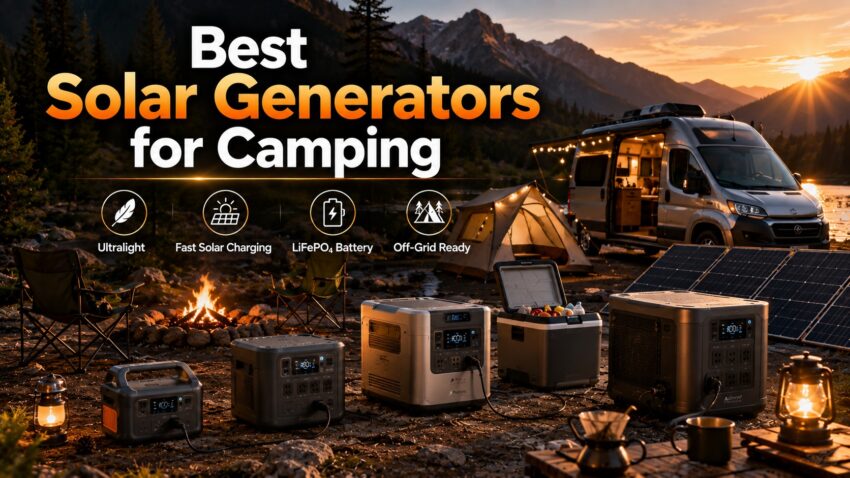
This post contains affiliate links. If you buy through our links we may earn a small commission — at no extra cost to you. This never influences our recommendations.
Camping puts different demands on a solar generator than home backup does. Weight matters — you’re carrying or hauling this thing to a site. Solar recharge speed matters — at a campsite with no hookups, what the sun can put back in during the day determines how much you can use at night. And output needs to be matched to what you’re actually running, because a 2,000W inverter on a 288Wh battery is pointless if you’re only charging phones and running a camp light.
This guide covers how to match capacity to camping style, what specs actually determine real-world performance in the field, and the best picks from weekend day-tripper to serious off-grid base camp setup.
How Much Power Do You Actually Need for Camping?
The honest answer is less than most guides suggest — and it depends entirely on what you’re running. A weekend trip covering phones, a laptop, a Bluetooth speaker, and some LED lights uses maybe 300–500Wh over two days. That’s a 300Wh unit’s sweet spot. Add a 12V compressor fridge and CPAP and you’re up to 800–1,200Wh per day — a 1kWh+ unit’s territory.
| Camping Style | Typical Daily Load | Minimum Capacity | Best Pick Size |
|---|---|---|---|
| Day trip / ultralight | 100–200Wh | 288Wh | 288–500Wh |
| Weekend car camping (no fridge) | 300–500Wh | 500Wh | 500–800Wh |
| Weekend camping with fridge | 700–1,000Wh | 1,000Wh | 1,000–1,200Wh |
| Multi-day boondocking with fridge + CPAP | 1,000–1,500Wh | 1,200Wh | 1,500–2,000Wh with solar |
| Base camp / group camping | 1,500–3,000Wh | 2,000Wh | 2,000Wh+ expandable |
The golden rule: size for one day’s needs without solar recharge, then let the solar panel handle the rest. A 1kWh unit with a 200W panel can run indefinitely in reasonable sun for most camping loads — you’re not depleting faster than the sun can replenish.
Weight vs Capacity — The Real Trade-Off for Camping
This is the tension that home backup guides don’t address. Every extra watt-hour adds weight. At camp, you’re loading and unloading this from a vehicle, potentially carrying it to a site, moving it to track the sun for charging. Weight matters.
Here’s how the current 1kWh-class units compare on weight:
| Unit | Capacity | Weight | Wh per lb |
|---|---|---|---|
| Jackery Explorer 1000 v2 | 1,070Wh | 23.8 lbs | 45 Wh/lb |
| EcoFlow DELTA 2 | 1,024Wh | 27 lbs | 38 Wh/lb |
| Anker SOLIX C1000 Gen 2 | 1,024Wh | 28.7 lbs | 36 Wh/lb |
The Jackery 1000 v2’s 23.8 lbs is the lightest in the class — and at 45 Wh per pound, it packs more energy per unit of weight than any competitor at this capacity. For camping specifically, that edge matters more than it does on a shelf at home.
Solar Recharge Speed — The Spec That Determines Off-Grid Viability
At a campsite with no hookups, how fast your solar generator recharges from panels is the constraint that determines whether you can run sustainably or will eventually go flat. Two numbers matter: maximum solar input (watts) and how many peak sun hours you realistically get at your campsite.
In 4 peak sun hours (typical for most US locations in summer), a unit accepting 200W of solar gets back 800Wh — enough to cover most camping loads for the next night. A unit accepting only 88W in the same conditions gets back 352Wh — significantly less than a full camping day’s worth.
Quick solar recharge reference for 4 peak sun hours:
| Solar Input | Daily Recovery (4 hrs sun) | Can sustain… |
|---|---|---|
| 88W (entry units) | ~352Wh | Phones + lighting only |
| 200W | ~800Wh | Phones + laptop + lighting, no fridge |
| 500W (EcoFlow DELTA 2) | ~2,000Wh | Fridge + all devices + fridge overnight buffer |
| 800W (Jackery 1000 v2) | ~3,200Wh | Fridge + CPAP + full device load — indefinitely |
This table is why high solar input matters for multi-day camping — not just the capacity number on the label.
Best Solar Generators for Camping — Verified Picks
| Model | Capacity | Weight | Max Solar Input | Best For |
|---|---|---|---|---|
| Jackery Explorer 300 | 292Wh | 7.1 lbs | 88W | Weekend trips, device charging, ultralight |
| EcoFlow DELTA 2 | 1,024Wh | 27 lbs | 500W | Best overall — fridge + devices + fast solar |
| Jackery Explorer 1000 v2 | 1,070Wh | 23.8 lbs | 800W | Best lightweight 1kWh, highest solar input |
| Anker SOLIX C1000 Gen 2 | 1,024Wh | 28.7 lbs | 600W | Fastest AC recharge, best output at this capacity |
Best for Weekend Trips and Ultralight Camping: Jackery Explorer 300
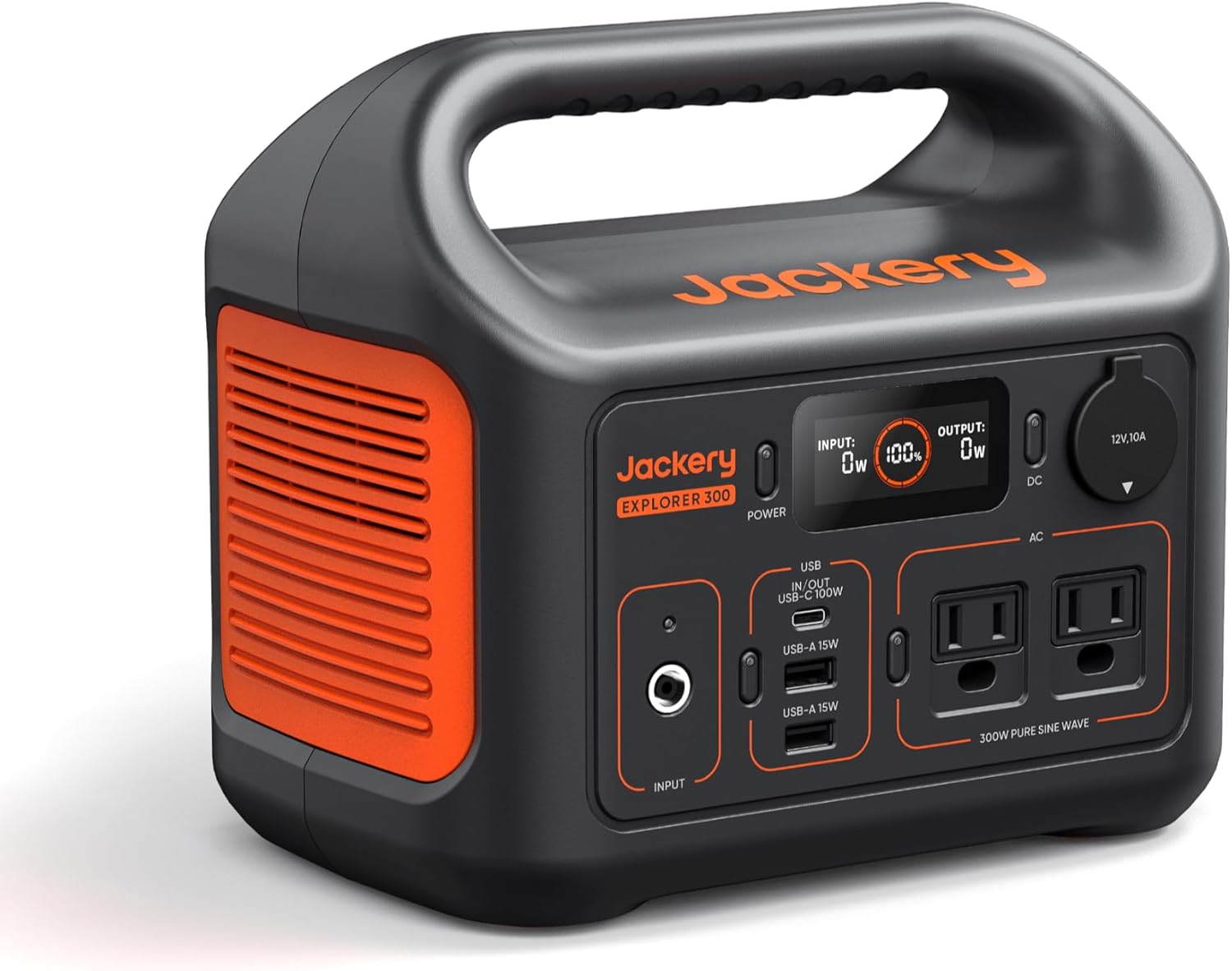
At 7.1 lbs, the Explorer 300 is in a completely different portability category from every other unit in this guide. You can carry it in one hand, tuck it under a camp seat, or slip it into a large daypack. For a weekend camping trip covering phones, a small Bluetooth speaker, LED camp lights, and GoPro charging — this is the perfectly sized, perfectly priced unit.
Two AC outlets, two USB-A, one USB-C, and one car outlet cover every real camping device need. The LiFePO4 battery means 3,000 cycles of reliable use. It won’t run a fridge, a CPAP, or anything power-hungry — but for the majority of casual campers who need device charging and camp lighting, it’s the cleanest, most portable entry point in the category. For a full breakdown of this unit, see our Jackery Explorer 300 review.
Pros: 7.1 lbs — lightest practical camping power station, two AC outlets, LFP battery, lowest price point, easy one-hand carry
Cons: 292Wh limits multi-day use; 88W max solar input means slow recharge; no fridge or CPAP capability
Best for: Weekend car camping, day trips, ultralight use, anyone who needs clean portable power for devices and lighting only
Best Overall: EcoFlow DELTA 2
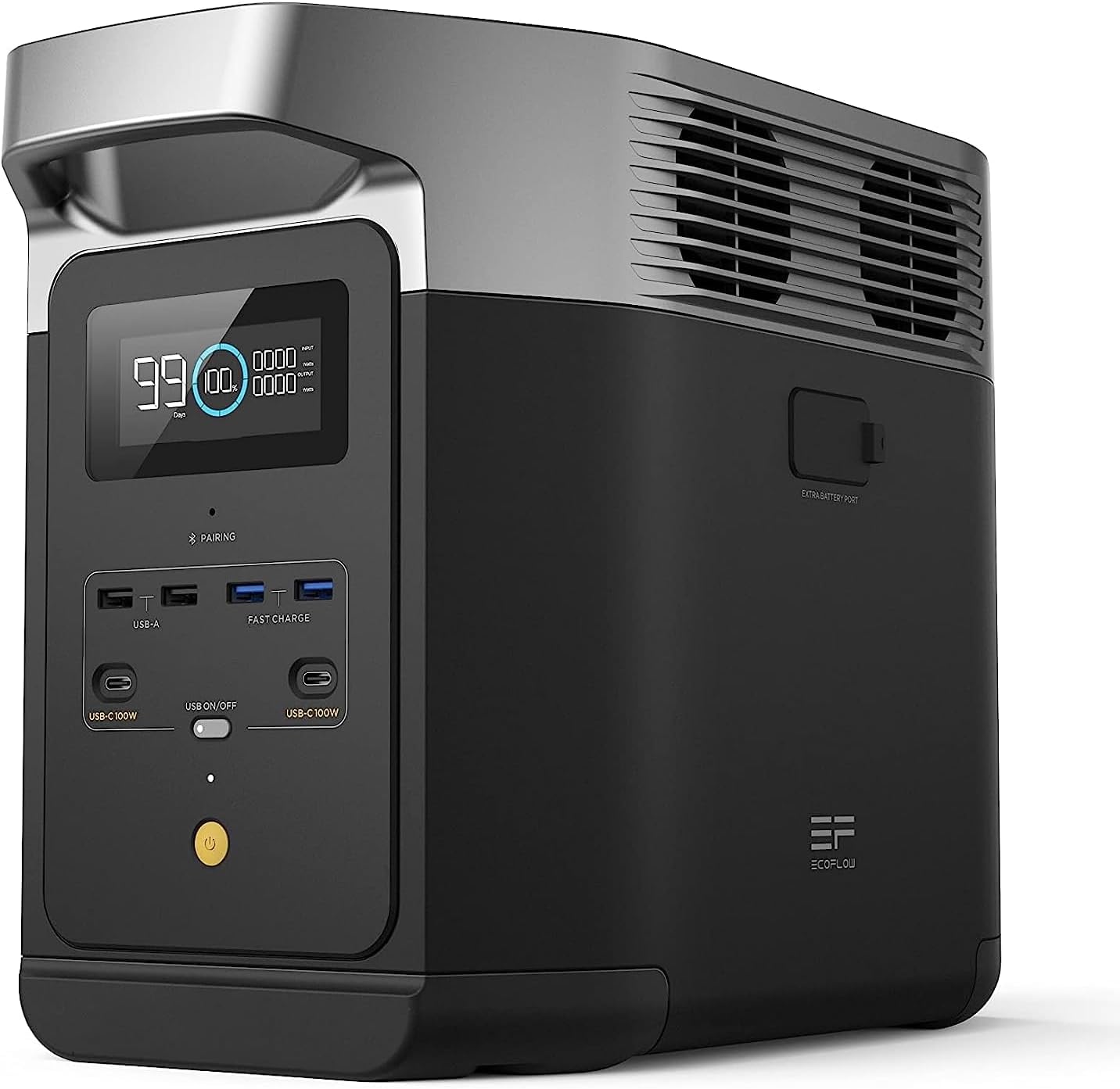
The DELTA 2 is the most consistently recommended camping power station in its class, and the reasons are straightforward. It accepts up to 500W of solar input — the highest of any sub-30 lb unit — which means in 4 hours of decent sun it recovers enough energy to cover a full camping day’s load including a 12V fridge. At 27 lbs it’s manageable for car camping, and the 1,800W pure sine wave output handles anything you’d realistically run at a campsite.
The 80-minute AC charge (to 100%) means a quick top-up at a campground or trailhead power outlet before heading into the wild. App control via Wi-Fi or Bluetooth lets you monitor charge state, set charge limits to extend battery life, and enable quiet charging mode at night. Expandable to 3kWh with additional battery packs for extended trips. 3,000 LFP cycles. Five-year warranty.
For campers with a fridge — the load that separates adequate from underpowered — the DELTA 2’s combination of 1kWh capacity and 500W solar input is the sweet spot. You start the day with a full battery, the fridge uses roughly 480–600Wh through the day, the 500W panel puts back 1,500–2,000Wh over 3–4 hours of good sun, and you end the day ahead. That’s sustainable indefinite camping from solar alone.
Pros: 500W max solar input (highest in class at this weight), 1,800W output, 80-min AC charge, app control, quiet charging mode, expandable to 3kWh, 5-year warranty
Cons: AC ports on the back — slightly awkward placement; 30ms UPS (not relevant for camping, but worth knowing); Jackery solar panel adapter required for Jackery panel owners
Best for: Car camping with a compressor fridge, multi-day boondocking, anyone who wants the best solar recharge capability in a sub-30 lb unit
Best Lightweight 1kWh: Jackery Explorer 1000 v2
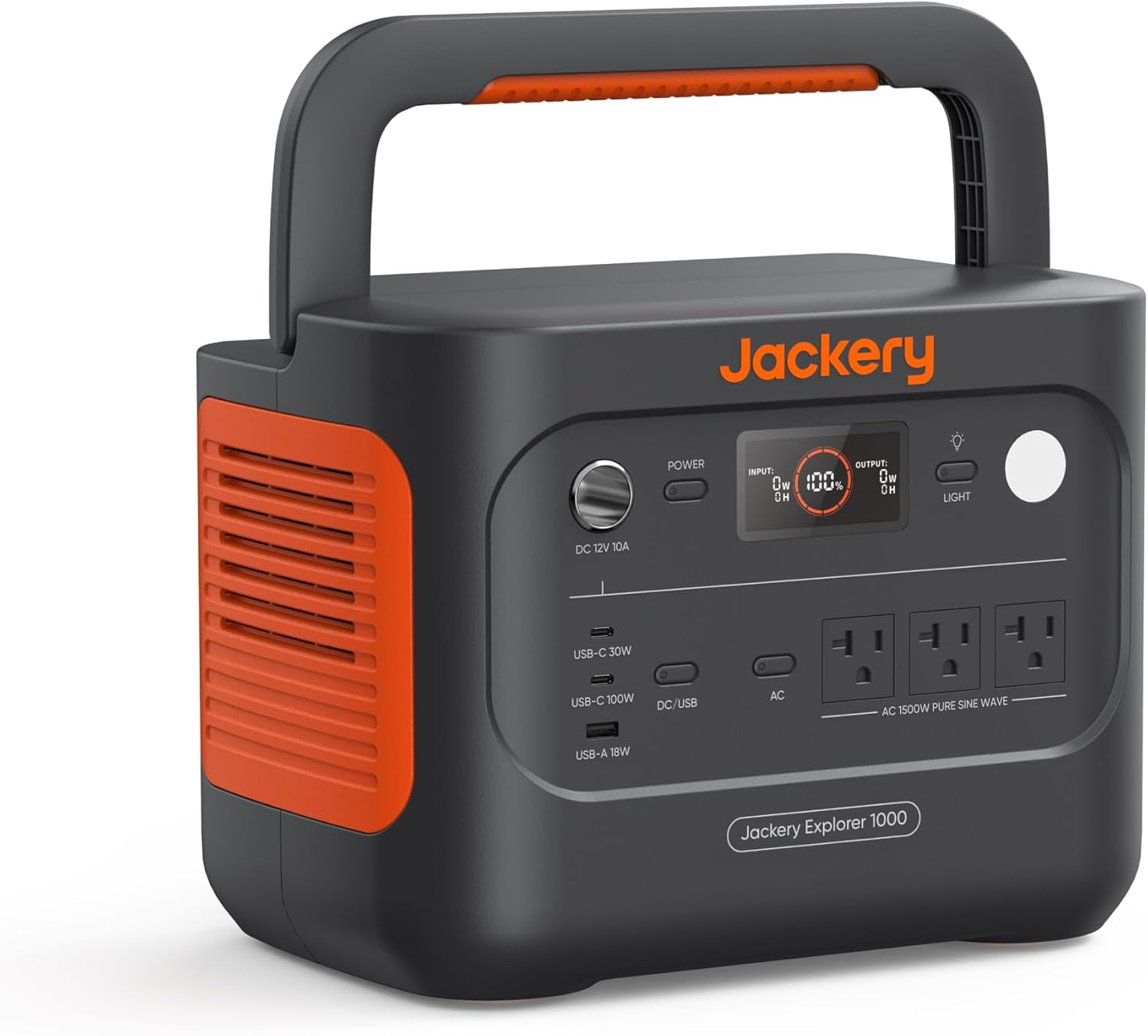
The Explorer 1000 v2 earns its place for two reasons: it’s the lightest 1kWh solar generator available at 23.8 lbs, and it accepts the highest solar input of any unit in this comparison at 800W. That combination — minimum weight, maximum solar intake — is exactly what multi-day off-grid camping demands.
The 4,000-cycle LFP battery (rated to 70% capacity) outlasts the EcoFlow DELTA 2’s 3,000 cycles at the same depth of discharge, making it the longer-lived unit for daily use. Three AC outlets, 1,500W continuous output with 3,000W surge, and 100W USB-C PD cover every practical camping load. Quiet charging mode at 30dB makes overnight camp charging genuinely unobtrusive.
One important caveat: the Explorer 1000 v2 is only compatible with Jackery’s own solar panels for solar charging without an adapter. If you’re buying panels alongside this unit, factor that into your decision. If you already own Jackery panels, this is the cleanest pairing in the lineup.
Pros: Lightest 1kWh unit at 23.8 lbs, 800W max solar input, 4,000 LFP cycles, 1-hour emergency charge via app, 3 AC outlets, 30dB quiet mode
Cons: Requires Jackery solar panels for plug-and-play solar charging; 1-hour charge requires enabling emergency mode in app (default is 1.7 hours)
Best for: Multi-day off-grid camping where weight and solar recharge speed are the priority, Jackery solar panel owners
Best Fast-Charge Pick: Anker SOLIX C1000 Gen 2
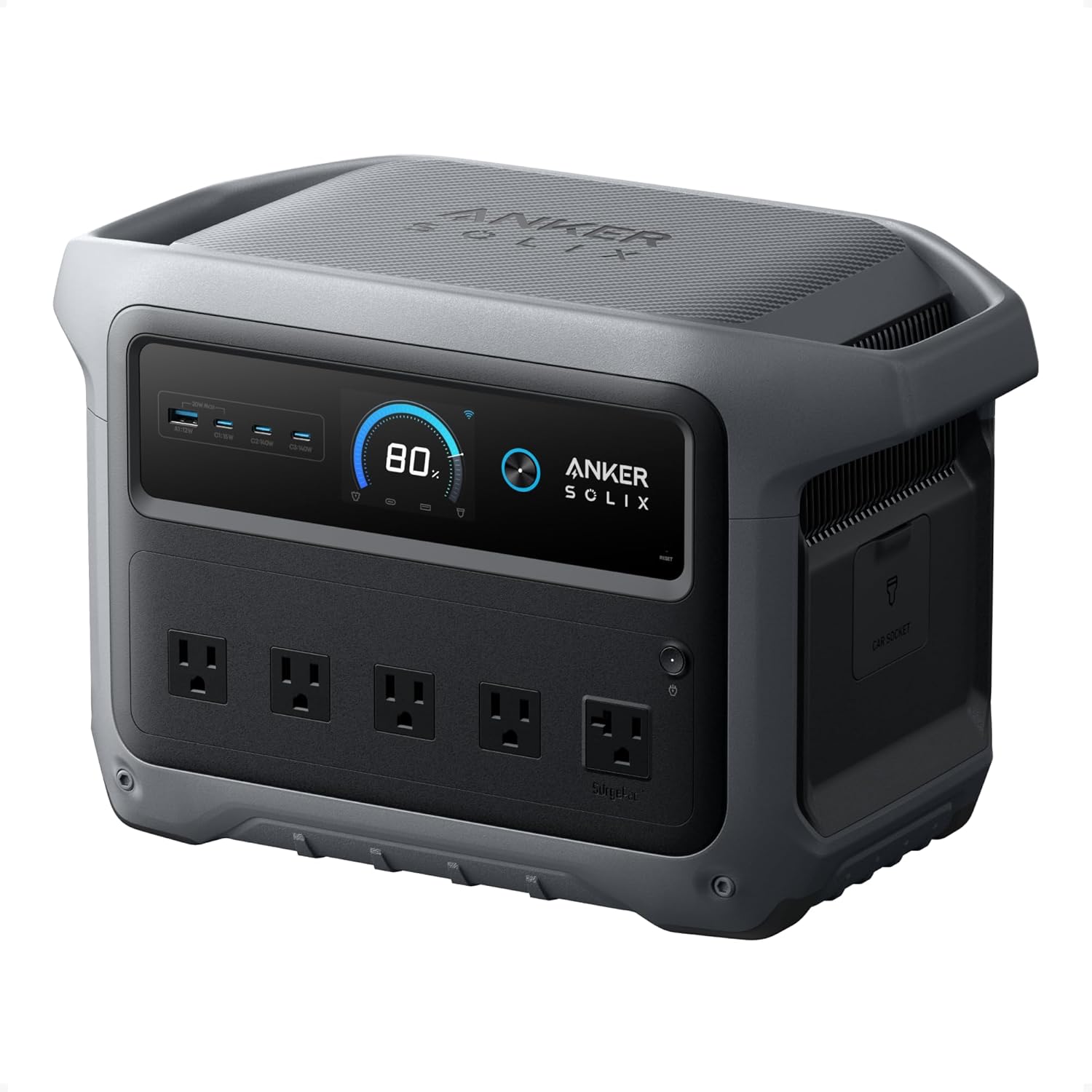
The C1000 Gen 2’s defining feature is its 49-minute full AC charge — Guinness World Record verified as the fastest full recharge of any power station in its class. For campers who make regular stops at campgrounds with hookups, a gas station with an outdoor outlet, or a trailhead charging station, this speed difference is genuinely meaningful. Top up in under an hour, head back out.
At 2,000W continuous output (3,000W peak), it delivers the highest power output of any 1kWh unit in this guide — useful if you’re running an induction cooktop, power tools, or any appliance that pushes the upper limits of what a 1kWh unit can handle. 4,000-cycle LFP battery. 28.7 lbs. For a full breakdown of the C1000 Gen 2 alongside the rest of the Anker lineup, see our Anker SOLIX guide.
Pros: 49-min AC full charge, 2,000W output (highest in class), 4,000 LFP cycles, compact build, 5-year warranty
Cons: 600W max solar input — lower than Jackery 1000 v2’s 800W and EcoFlow DELTA 2’s 500W (though still strong); no expandability
Best for: Campers who regularly stop at hookup sites or outlets for quick top-ups, anyone who wants the highest output at this capacity
Which Solar Panel to Pair With Your Camping Generator
For camping use, foldable portable panels are almost always the right choice over rigid panels — they pack flat, don’t require a fixed mount, and can be angled toward the sun throughout the day for maximum output.
For the Jackery Explorer 300: The SolarSaga 100W is the plug-and-play pairing. One panel charges the 300 in about 3 hours of direct sun.
For the EcoFlow DELTA 2: Two 200W EcoFlow panels pushed toward the 500W input ceiling is the optimal setup. One 220W panel is a practical single-panel option that charges the unit in about 5 hours of direct sun. Third-party panels work with an XT60 adapter.
For the Jackery 1000 v2: Two 400W SolarSaga panels reach near the 800W maximum solar input. One 200W SolarSaga is the practical starting point, with a second panel added later if daily recharge is insufficient. Jackery panels only — no adapter compatibility.
For the Anker SOLIX C1000 Gen 2: Two 300W Anker PS300 panels hit close to the 600W input ceiling. Third-party panels work with an XT60 connector — no adapter needed. See our 200W solar panel guide for compatible third-party options.
What a Solar Generator Won’t Run at Camp
Setting expectations correctly saves frustration. At the 1kWh capacity level, here’s what’s off the menu:
- Electric cooler (resistance heating type): draws 40–60W but generates huge heat — avoid. Use a compressor-type 12V fridge instead (40–50W, far more efficient)
- Hair dryer: 1,000–1,875W — depletes a 1kWh unit in under 30 minutes of actual use
- Electric kettle: 1,200–1,500W — a 1kWh unit boils 2–3 kettles before running flat. Use a camp stove instead
- Electric heater: 750–1,500W — not practical from a 1kWh unit for meaningful warmth. Gas or propane is the camping standard for heat
- Portable air conditioner: 300–700W — runs 1–3 hours on a 1kWh unit. Possible but consumes most of your daily capacity. Step up to 2kWh+ if AC is a priority
Frequently Asked Questions
What size solar generator do I need for camping?
For a weekend trip covering devices and lighting only, 300–500Wh is sufficient. Add a 12V compressor fridge and you need 1,000Wh minimum. Add a CPAP and plan to stay more than two nights without hookups, and 1,000–1,500Wh with a compatible solar panel is the practical baseline. Use the capacity table above to match your specific load to the right unit size.
Can a solar generator run a CPAP at camp?
Yes — a CPAP without humidifier draws 30–60W and runs for 8 hours per night. On a 1kWh unit, that’s 240–480Wh — leaving most of the battery for other loads. With a humidifier enabled, draw rises to 80W+, reducing the remaining capacity. A 500W solar panel recharges what the CPAP uses in under an hour of sun. For a dedicated breakdown, see our upcoming solar generator for CPAP guide.
Can I leave a solar generator in the sun to charge while camping?
The panel can be left in direct sun — that’s normal operation. The power station itself should not be left in direct sun or extreme heat. Lithium batteries and heat don’t mix well — high ambient temperatures reduce charging efficiency and accelerate cell degradation. Position the panel in full sun and run the charging cable to the power station in shade, or under a canopy. Most units have a thermal protection circuit that reduces charge rate in high temperatures — keeping the unit cool maximises your effective solar input.
How long does a solar generator last on a camping trip?
Entirely depends on your load. A 1kWh unit with a mini fridge (480Wh/day), CPAP (360Wh/night), and device charging (100Wh) uses roughly 940Wh per day — nearly the full battery. Without solar recharge, that’s one day. With a 200W panel in 4 hours of sun (800Wh recovery), you’re roughly at break-even with a small deficit each day. Add a second 200W panel and you’re in surplus — the camping trip can continue indefinitely.
Is a solar generator worth it for camping?
For car campers and overlanders who want clean, quiet power without a gas generator — yes, unambiguously. Solar generators are silent, require no fuel, emit no fumes, and can be used inside a tent or vehicle. The trade-off is cost versus a gas generator at the same capacity, and the dependency on sunlight for recharge. For most summer camping in the US, that trade-off strongly favours the solar generator.
Final Verdict
| Your Situation | Best Pick |
|---|---|
| Ultralight / weekend device charging only | Jackery Explorer 300 (B082TMBYR6) |
| Best overall — fridge + devices + solar recharge | EcoFlow DELTA 2 (B0B9XB57XM) |
| Lightest 1kWh, highest solar input | Jackery Explorer 1000 v2 (B0D7PPG25F) |
| Fastest AC charge, highest output | Anker SOLIX C1000 Gen 2 (B0FN7MSY4L) |
For most car campers who want to run a fridge and charge devices without worrying about running flat, the EcoFlow DELTA 2 remains the class benchmark — its 500W solar input is the feature that makes multi-day off-grid camping genuinely viable. If weight is your priority and you’re already in the Jackery ecosystem, the Explorer 1000 v2 is the lightest 1kWh option available at 23.8 lbs with the best solar input ceiling in this comparison. For weekend trips with no fridge, the Jackery Explorer 300 is the clean, light, right-sized solution.
For a larger RV where you need 2kWh+ and a TT-30R hookup, see our solar generator for RV guide. For home backup sizing and whole-home coverage, see our solar generator for home backup guide.