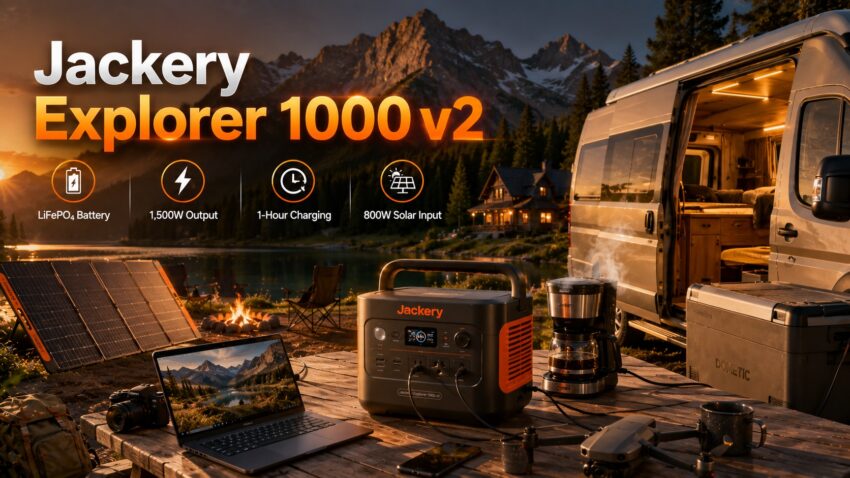
This post contains affiliate links. If you buy through our links we may earn a small commission — at no extra cost to you. This never influences our recommendations.
The original Jackery Explorer 1000 had one glaring weakness that kept coming up in every review: a 7-hour wall charge time that forced you to plan your entire day around topping it up. The Explorer 1000 v2 exists specifically to fix that, along with switching to a longer-lasting battery chemistry and modernizing the port selection. This review covers the full spec sheet, what actually changed from the original, and where it sits against 2026’s competition.
Full Specifications
| Spec | Jackery Explorer 1000 v2 |
|---|---|
| Capacity | 1,070Wh |
| Battery chemistry | LiFePO4 (LFP) |
| Cycle life | 4,000 cycles to 70% capacity |
| AC output | 1,500W continuous |
| Surge output | 3,000W |
| AC charge (Emergency Mode) | ~1 hour to full via app |
| AC charge (standard) | ~1.7 hours to full |
| Solar input (max) | 800W |
| Solar/car input connector | DC8020 (8mm) |
| Car charging | ~12–14 hours full charge (12V outlet) |
| USB-C output | 2× 100W PD (236W combined USB total) |
| Weight | 23.8 lbs |
| Expandability | None — fixed capacity |
| App control | Yes — monitoring, Emergency Charge Mode |
| Built-in light | Yes — integrated flashlight |
| Warranty | 5 years |
What Changed From the Original Explorer 1000
Side by side, the v2 looks nearly identical to the original — same form factor, same weight, same color scheme. The changes are almost entirely internal, but they address the exact complaints that dogged the first-generation unit.
Battery chemistry: The original used NMC lithium-ion, rated for roughly 500–800 cycles. The v2 switches to LiFePO4, rated for 4,000 cycles to 70% capacity — at one cycle per week, that’s over 10 years of use, and even with daily cycling it comfortably outlasts a decade. This is the single most important upgrade, since it directly extends the unit’s usable lifespan by roughly 5–8x.
Charging speed: The original’s 7-hour AC charge time was its most consistently criticized flaw. The v2 cuts that to under 2 hours standard, and as fast as 1 hour using the app’s Emergency Charge Mode. This single change is what most reviewers point to as transforming the unit from “plan your day around it” to “charge during dinner, ready by evening.”
Output power: The jump from 1,000W to 1,500W continuous (with 3,000W surge, up from the original’s lower surge ceiling) means the v2 handles standard kitchen appliances — coffee makers, blenders, microwaves — that would have tripped the original’s overload protection.
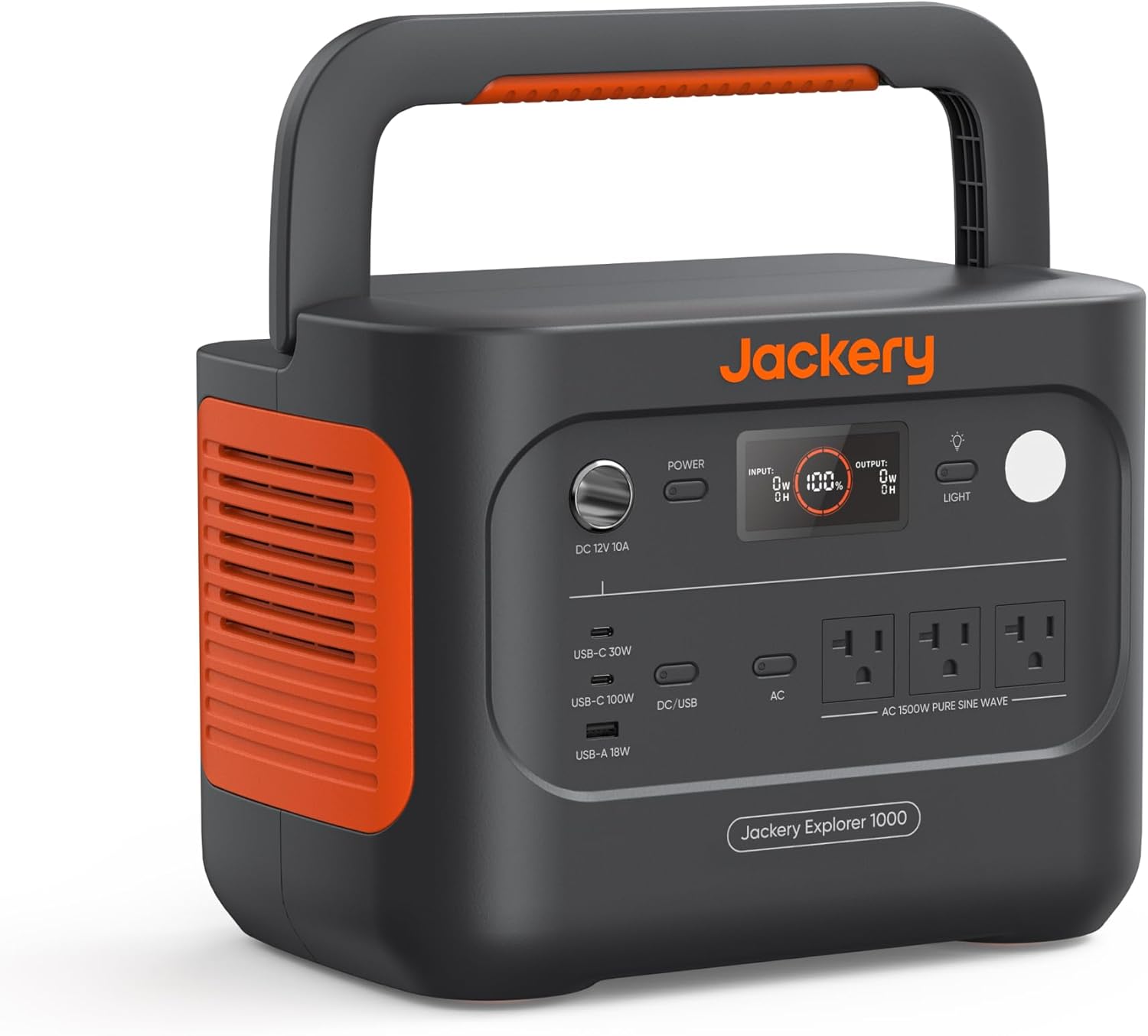
Ports: USB-C output improved from a single lower-wattage port to dual 100W PD ports, letting you fast-charge two laptops simultaneously. The new folding handle also lies completely flat, letting you stack gear on top in a car trunk — a small but frequently mentioned real-world improvement.
Real-World Output: What 1,500W Actually Handles
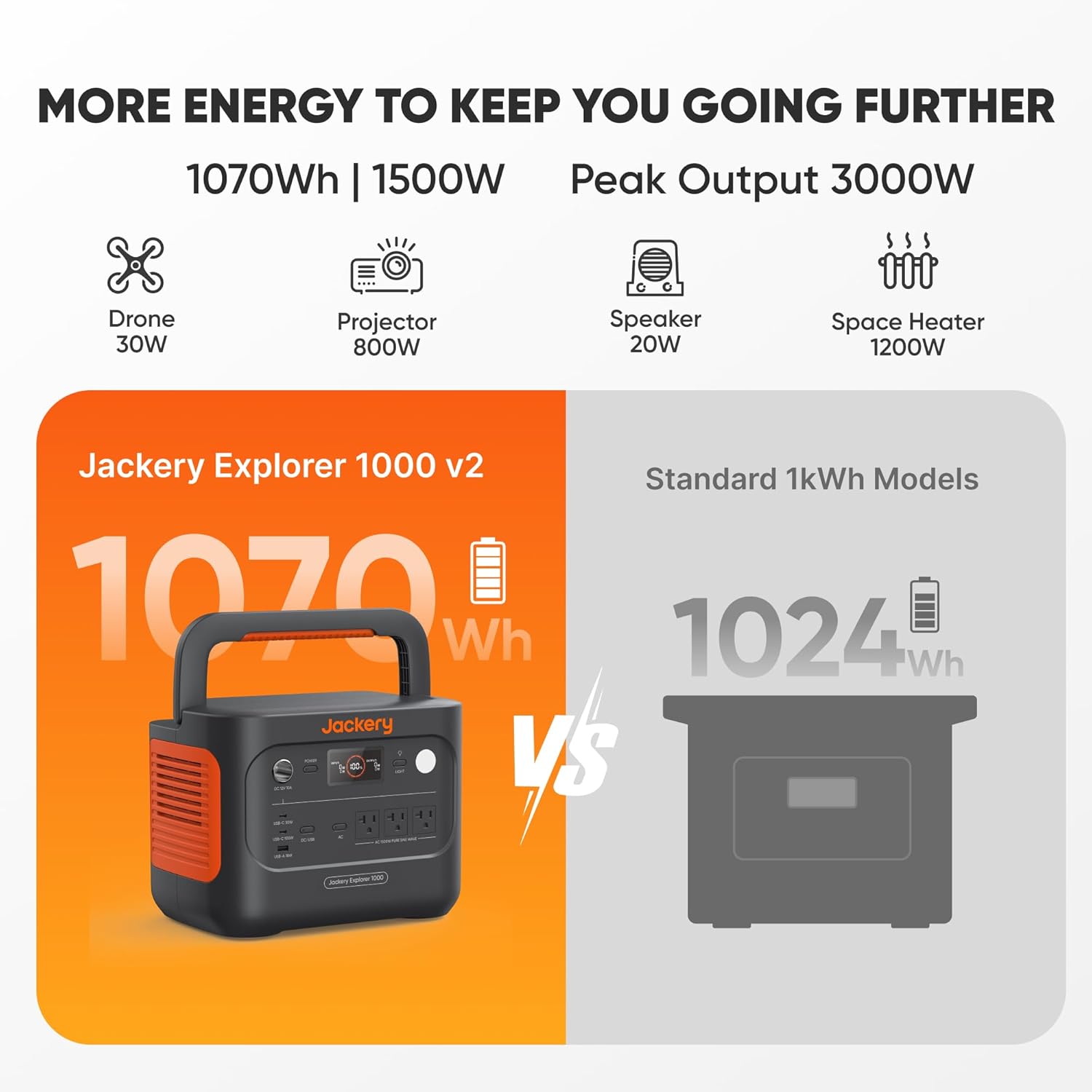
In independent testing, the v2’s 1,500W continuous rating with 3,000W surge handled an electric kettle, a 1,000W microwave, and a heavy-duty blender without tripping overload protection — appliances that genuinely stressed the original 1,000W unit. Jackery states the unit can power roughly 90% of standard household appliances, and real-world testing generally supports that claim for anything short of space heaters or high-draw induction cooktops running continuously.
One consistent finding across reviewers: pass-through charging (using the unit while it charges) works, but the charging input drops significantly under heavy inverter load. Testing at a 1,400W draw while charging showed minimal input acceptance; at a lighter ~100W draw, the unit accepted close to full charging input. This is worth knowing if you plan to run the unit and charge it simultaneously under heavy load — it will charge far more slowly than expected.
Charging Speed — The Headline Improvement
Via AC wall outlet, the v2 reaches a full charge in roughly 1.7 hours under standard charging, or as fast as 1 hour using Emergency Charge Mode enabled through the Jackery app. This is the fix for the original unit’s single biggest complaint, and it’s a genuine, easily verified improvement rather than a marketing exaggeration.
Solar charging accepts up to 800W across the input, though real-world solar performance is — as with any solar charging setup — highly dependent on panel angle, cloud cover, and shade. Expect roughly 3–4 hours for a full charge in strong, direct sun with an appropriately sized panel array; partial shade or cloud cover extends this considerably. Car charging via 12V outlet takes 12–14 hours for a full charge — impractical as a primary charging method, but useful for topping up 30–40% during a multi-hour drive.
Important connector note: The v2 uses a DC8020 (8mm) input port for solar and car charging — different from the DC7909 (7.9mm) connector used on older Jackery panels and generic 12V cables. If you’re upgrading from an original Explorer 1000 and want to reuse existing solar panels, confirm connector compatibility or budget for an adapter before assuming plug-and-play compatibility.
CPAP and Refrigerator Runtime — Real Numbers
For CPAP users specifically, independent testing with a ResMed AirSense 11 (without heated humidification) delivered approximately 3–4 nights of use per full charge. With the heated humidifier enabled, expect roughly 2–2.5 nights. These figures vary meaningfully by specific CPAP model, pressure setting, and whether heated tubing is in use — testing your specific setup at home before relying on it for a trip or emergency is the safest approach.
For refrigeration, the 1,070Wh capacity runs a 12V mini-fridge for approximately 20 hours continuous, or provides roughly 15–20 full laptop charges. A standard household refrigerator’s compressor cycling means real-world runtime varies with the fridge’s efficiency and how often the door opens — door discipline and understanding your fridge’s average draw meaningfully extend how far a 1kWh-class unit stretches.
No Expandability — The Main Structural Limitation
Unlike Jackery’s own Explorer 1000 Plus (a different, LiFePO4-based product line expandable up to 5kWh with additional battery packs), the Explorer 1000 v2 has fixed capacity with no expansion option. If your needs might grow beyond 1,070Wh — adding a second CPAP, a larger fridge, or wanting multi-day autonomy without recharge — this is worth planning for before buying, since there’s no path to add capacity later without buying an entirely separate unit.
Jackery Explorer 1000 v2 vs the Competition
Independent testers consistently note that on pure spec sheets, the v2 falls slightly behind the Anker SOLIX C1000 Gen 2 on charging speed (49 minutes vs. the v2’s ~1 hour with Emergency Mode enabled) and behind EcoFlow’s DELTA 2 on maximum solar input (800W is still strong, but EcoFlow and some competitors push further at this capacity). Where the Jackery consistently wins in hands-on testing is thermal management — staying cooler under sustained load with less frequent fan cycling than EcoFlow and Anker units — and overall build quality and brand support reputation.
The practical breakdown: choose Jackery for proven reliability, strong customer service, and the lightest weight in this capacity class at 23.8 lbs. Choose Anker SOLIX C1000 Gen 2 if maximum charging speed and output are the priority. Choose EcoFlow if expandability and the highest solar input ceiling matter most. For the full Anker lineup comparison, see our Anker solar generator guide; for EcoFlow, see our best EcoFlow solar generator guide.
Who Should Buy the Explorer 1000 v2
Best for:
- Van lifers and RV travelers who charge daily and want fast USB-C PD charging for laptops
- Weekend campers wanting 1–2 days of power for essentials — fridge, lights, phones, CPAP
- Home backup covering 1–2 critical devices (router/modem, medical equipment) during shorter outages
- Content creators needing portable power for cameras, drones, and laptops on location
- Existing Explorer 1000 owners upgrading specifically for the LiFePO4 longevity improvement
Consider alternatives if:
- You need battery expandability — look at the Jackery Explorer 1000 Plus instead
- You want the single fastest charging speed available at this capacity — the Anker SOLIX C1000 Gen 2 edges it out
- You need genuine whole-home backup for multi-day outages without recharge access — step up to a 2,000Wh+ unit like the Jackery Explorer 2000 Plus
- You need to run central AC or an electric dryer — no portable unit at this capacity handles that load
Frequently Asked Questions
Is the Jackery Explorer 1000 v2 worth upgrading from the original Explorer 1000?
Primarily if longevity or charging speed are your concerns. The shift to LiFePO4 extends expected battery lifespan roughly 5–8x over the original’s NMC chemistry, and the charge time drops from 7 hours to under 2 (or 1 hour in Emergency Mode). If your original unit still holds a good charge and you rarely need fast recharging, the upgrade isn’t urgent — but for daily users or anyone whose original unit is showing capacity degradation, it’s a worthwhile investment.
How many nights will the Explorer 1000 v2 run a CPAP machine?
Independent testing with a ResMed AirSense 11 showed approximately 3–4 nights without a heated humidifier, or 2–2.5 nights with one enabled. Actual results vary by specific CPAP model and pressure settings — test your own setup before relying on it for a trip or as a primary emergency backup plan.
Can the Explorer 1000 v2 run a coffee maker or microwave?
Yes — the 1,500W continuous output with 3,000W surge comfortably handles a coffee maker, 1,000W microwave, electric kettle, and similar kitchen appliances that would have overwhelmed the original 1,000W unit. Sustained high-draw appliances like space heaters or induction cooktops running continuously will drain the 1,070Wh capacity quickly, but short-duration use works well.
Does the Explorer 1000 v2 work with my old Jackery solar panels?
Check the connector type first. The v2 uses a DC8020 (8mm) input port, while older Jackery panels and many generic 12V cables use the older DC7909 (7.9mm) connector. These aren’t directly compatible without an adapter — confirm your specific panel’s connector before assuming it will plug in directly.
Is the Explorer 1000 v2 expandable like the Explorer 1000 Plus?
No — the Explorer 1000 v2 has fixed 1,070Wh capacity with no expansion battery option. If you anticipate needing more capacity down the line, the Jackery Explorer 1000 Plus (a separate product line) offers expandability up to 5kWh, though at a higher starting price and heavier weight.
The Bottom Line
The Explorer 1000 v2 is a focused, effective upgrade that fixes the original Explorer 1000’s most legitimate complaint — slow charging — while modernizing the battery chemistry for a dramatically longer usable lifespan. It won’t win a spec sheet battle against the fastest-charging competitors, and the lack of expandability is a real limitation for anyone planning to grow their system. But for camping, RV use, and light home backup — the situations most buyers actually face — it remains one of the most reliable, best-supported options in the 1kWh class.
Check the Jackery Explorer 1000 v2 on Amazon →
For the full Jackery lineup, see our Jackery 500 review for the smaller capacity tier, or our solar generator for RV guide for the higher-capacity Explorer 2000 Plus. For a direct comparison against Anker and EcoFlow at this exact capacity, our best 1000W solar generators for the money guide covers all the leading options side by side.