This post contains affiliate links. If you buy through our links we may earn a small commission — at no extra cost to you. This never influences our recommendations.
BioLite built its reputation on stoves and camp lighting before entering the power station market, and the BaseCharge 600+ reflects that outdoor-gear pedigree — genuinely distinctive industrial design, real-world durability testing, and a form factor that multiple independent reviewers specifically praised for looking good rather than merely functional. This review covers the full spec sheet, what six months of independent field testing found, and one honest trade-off worth knowing about the battery chemistry before you buy.
Full Specifications
| Spec | BioLite BaseCharge 600+ |
|---|---|
| Capacity | 622Wh |
| Battery chemistry | NMC lithium-ion (not LiFePO4) |
| Cycle life | ~500 cycles to 80% capacity (per manufacturer’s own German market data) |
| AC output | 600W continuous |
| Surge output | 1,000W |
| Fast Charging Plus (AC+USB-C combined) | 0–80% in as little as 3.5 hours |
| Standard AC charge | Reported as slow by at least one verified purchaser — up to 13 hours without the combined fast-charge method |
| Solar input (max) | 400W |
| Weight | 13–14 lbs |
| Output ports | 2× AC, 2× USB-C (one at 100W PD), 2× USB-A, 12V car socket, 2× DC barrel, wireless charging deck (10W) |
| Display | Large, plain-English smart dashboard with time-to-empty and resettable energy odometer |
| Durability testing | Drop-tested from 1 meter, surge tested, vibration tested, thermal shock tested |
Real-World Performance — What Independent Testing Found
One reviewer ran the BaseCharge 600+ for six months of car and van camping plus mobile office use, deliberately stress-testing it with high-draw appliances. A hot water kettle typically pulling around 800W — a load that has caused problems on other tested power stations — ran without issue on the BaseCharge 600+’s 600W continuous rating (1,000W surge), with the display oddly reporting only 500W output despite the kettle heating normally. Across temperature extremes from over 100°F summer heat to nights in the teens, the unit reportedly kept functioning without failure — a genuinely demanding six-month test that most spec-sheet reviews never attempt.
Multiple independent testers specifically called out the industrial design as a standout — one described it as looking like it “belonged in an upscale downtown condo,” a notable departure from the utilitarian look of most competing power stations. At 13–14 lbs with an integrated carry handle, it’s genuinely easy to move with one hand between a vehicle and a campsite.
The Honest Battery Chemistry Trade-Off
This is the most important thing to understand before buying, and it’s worth stating plainly: the BaseCharge 600+ uses NMC lithium-ion battery chemistry, not LiFePO4 (LFP). German manufacturer documentation states the cells retain over 80% capacity after 500 full charge cycles — a real number, but meaningfully lower than the 3,000 to 6,000+ cycle ratings typical of current LiFePO4 power stations from Jackery, Anker, EcoFlow, and Bluetti, all covered elsewhere on this site.
In practical terms, at roughly one full cycle per week, 500 cycles works out to under 10 years before meaningful degradation — a reasonable lifespan for occasional camping use, but a real disadvantage against LFP competitors for anyone planning frequent or daily use over many years. If cycle life and long-term battery longevity are a priority, this is the single biggest factor to weigh against the BaseCharge 600+’s genuine strengths in design and build quality.
Charging Speed — A Genuine Mixed Picture
BioLite’s “Fast Charging Plus” feature — combining the wall AC adapter with the USB-C port simultaneously — reaches 0–80% in as little as 3.5 hours, a figure independent testing corroborated. However, at least one verified purchaser reported standard AC-only charging (without using the combined method) taking up to 13 hours — dramatically slower than competing power stations in this capacity class, some of which charge fully via AC alone in under an hour.
The practical takeaway: if you consistently use the Fast Charging Plus combined method, charging speed is reasonable. If you rely on the wall adapter alone out of habit or convenience, expect a meaningfully slower recharge than most current LiFePO4 competitors at this capacity.
Solar Charging — Adequate but Not Class-Leading
The 400W maximum solar input is workable for typical camping panel setups, and BioLite’s own SolarPanel 100 units can be chained (up to 4 in parallel via an optional adapter) to approach that ceiling. That said, at least one owner specifically flagged the 400W input as “too low for its price range” compared to competitors offering higher solar input ceilings at similar or lower prices — worth factoring in if fast off-grid solar recharging is a priority for your use case.
A Note on Unverified “2026 Refresh” Claims
During research for this review, one source — a cross-border shopping and freight-forwarding site — claimed a “2026 series” refresh of the BaseCharge 600+ featuring 4x faster charging, an added MPPT solar charge controller, and a reduced 13 lb weight. This claim could not be corroborated by BioLite’s own product documentation, established outdoor gear review outlets, or major retailers, and the source itself reads more like promotional affiliate content than an independent technical review. Readers should treat this specific “2026 refresh” claim with skepticism until confirmed directly through BioLite’s official specifications or a credible independent test.
Honest Pros and Cons
Pros: Genuinely distinctive, well-built industrial design confirmed durable under real six-month field testing, handles high-draw appliances (kettles, blenders) reliably, lightweight at 13–14 lbs with integrated handle, wireless charging deck is a nice inclusion, plain-English dashboard with time-to-empty display
Cons: NMC battery chemistry rated for only ~500 cycles — meaningfully lower than LiFePO4 competitors’ 3,000–6,000+ cycle ratings, standard AC-only charging reported as slow (up to 13 hours) without using the combined Fast Charging Plus method, 400W solar input trails some competitors at similar price points, at least one owner noted no handle or tie-down option for secure vehicle mounting
Who Should Buy the BaseCharge 600+
Best for:
- Weekend car campers and van lifers who value distinctive design and proven durability over maximum cycle life
- Buyers who consistently use fast-charging methods and won’t rely on slow standard AC charging
- Anyone running moderate-to-high draw appliances (kettles, small blenders) occasionally rather than daily
- Mobile office use where portability and a clean aesthetic matter alongside function
Consider alternatives if:
- You want the longest possible battery lifespan — LiFePO4 competitors offer 6–12x the cycle life; see our best Jackery solar generator guide or best Bluetti solar generator guide for LFP-based alternatives at similar capacity
- Fast standard AC charging without a special combined-charging method matters to you
- Maximum solar input for rapid off-grid recharging is a priority — see our Anker solar generator guide for higher solar input options at this capacity
Frequently Asked Questions
Does the BioLite BaseCharge 600+ use LiFePO4 batteries?
No — it uses NMC lithium-ion chemistry, rated for approximately 500 full charge cycles to 80% capacity retention per manufacturer documentation. This is meaningfully lower than the 3,000–6,000+ cycle ratings common on current LiFePO4-based competitors, worth factoring into your decision if long-term battery lifespan under frequent use is a priority.
How long does the BioLite BaseCharge 600+ take to charge?
Using BioLite’s Fast Charging Plus method (combining the AC wall adapter and USB-C port simultaneously), it reaches 0–80% in as little as 3.5 hours. Using standard AC charging alone, at least one verified purchaser reported charging taking up to 13 hours — a significant difference worth planning around depending on which method you’ll actually use.
Can the BaseCharge 600+ handle high-draw appliances like a kettle or blender?
Yes — independent six-month field testing specifically stress-tested the unit with an ~800W hot water kettle and reported reliable performance within its 600W continuous / 1,000W surge rating, without failure across temperature extremes from over 100°F to freezing.
How much solar input does the BaseCharge 600+ support?
Up to 400W maximum. This is workable for standard camping solar setups using BioLite’s own chainable SolarPanel 100 units, though at least one owner specifically noted this ceiling as lower than some competitors offer at a similar price point.
Is the BioLite BaseCharge 600+ good for vehicle mounting?
One verified purchaser specifically noted the lack of a handle or tie-down point for securing the unit inside a vehicle, ultimately returning the product over this concern. If secure in-vehicle mounting is important to your use case, this is worth weighing against the unit’s other strengths.
The Bottom Line
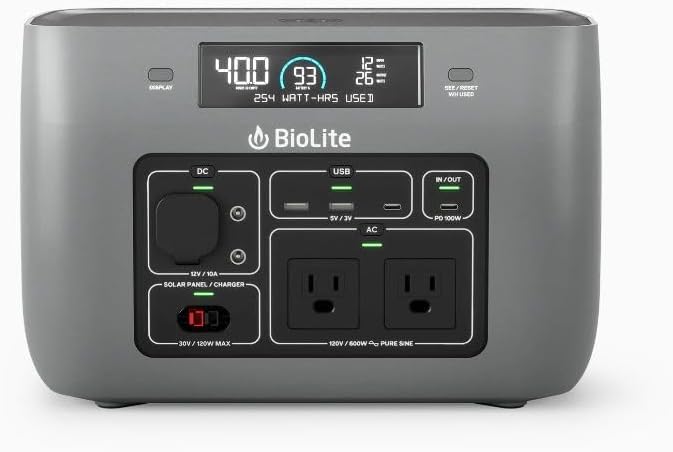
The BioLite BaseCharge 600+ earns genuine praise for its industrial design, real-world durability, and reliable performance under demanding loads — independent six-month field testing backs up the manufacturer’s claims on this front. The honest trade-off is battery chemistry: NMC cells rated for roughly 500 cycles fall well short of the LiFePO4 standard now common among competitors, and charging speed depends heavily on using the combined Fast Charging Plus method rather than standard AC alone. For occasional camping use where design and proven ruggedness matter most, it’s a solid choice. For frequent, long-term daily use where maximum battery lifespan is the priority, an LFP-based competitor is the safer long-term investment.
Check the BioLite BaseCharge 600+ on Amazon →
For LiFePO4-based alternatives at a similar capacity, see our best 1000W solar generators for the money guide. For the full picture across every major brand, our portable power station guide covers the complete landscape.