This post contains affiliate links. If you buy through our links we may earn a small commission — at no extra cost to you. This never influences our recommendations.
Here’s something most solar power bank listings won’t tell you upfront, but at least one manufacturer states directly on their own product page: the integrated solar panel is meant for emergency backup, not as your primary charging method. This guide covers what solar charging on a power bank honestly delivers, how to size capacity correctly for your trip length, and the best picks once you understand what you’re actually buying.
The Honest Truth About Solar Charging on a Power Bank
The solar panels built into backpacking power banks are small by necessity — anything bigger would defeat the purpose of a lightweight, pocketable charger. One manufacturer specifically discloses that their panel produces a maximum charging current of just 0.23A (1.15W), explicitly recommending customers “primarily utilize a charging cable to charge the power bank, while utilizing solar energy as a backup charging method for outdoor emergencies.” Independent trail testers report similarly modest results — one reviewer testing solar input during a full day of hiking in direct sun added roughly 30% to the bank’s charge, useful but far from a full recharge.
The practical takeaway: plan to charge your power bank fully before every trip via USB, and treat the solar panel as insurance for extending a multi-day trip slightly longer, not as a way to skip pre-trip charging entirely. Anyone expecting a power bank’s built-in solar panel to fully recharge from empty in a reasonable timeframe will be disappointed — some manufacturers themselves note it can take multiple days of perfect sun to fully charge from zero using solar alone.
How to Size Capacity to Your Trip
A simple formula works well: estimate your daily device usage in mAh, multiply by trip days, then add a 30% safety buffer. Most smartphones use 2,000-4,000mAh per full charge.
| Trip Length | Recommended Capacity | Typical Use Case |
|---|---|---|
| Weekend (2-3 days) | 10,000mAh | Phone only, moderate use |
| 3-4 day trip | 20,000mAh | Phone + occasional GPS/camera charging |
| Week-long or group trip | 25,000mAh+ | Multiple devices, satellite communicator, sharing with a partner |
A 20,000mAh bank recharges a typical phone roughly 4-5 times — enough for a solid 3-4 day trip with moderate use. Don’t oversize by default: extra capacity always means extra weight, and every added 1,000-5,000mAh typically tacks on 100-300g to what you’re carrying.
Best Solar Power Banks — Verified Picks
| Product | Capacity | Weight Class | Best For |
|---|---|---|---|
| BLAVOR 10,000mAh | 10,000mAh | Ultralight | Weekend trips, minimalist packing |
| Hiluckey 26,800mAh | 26,800mAh | Mid-size | Week-long trips, multiple devices |
Best Ultralight Pick: BLAVOR 10,000mAh Solar Power Bank
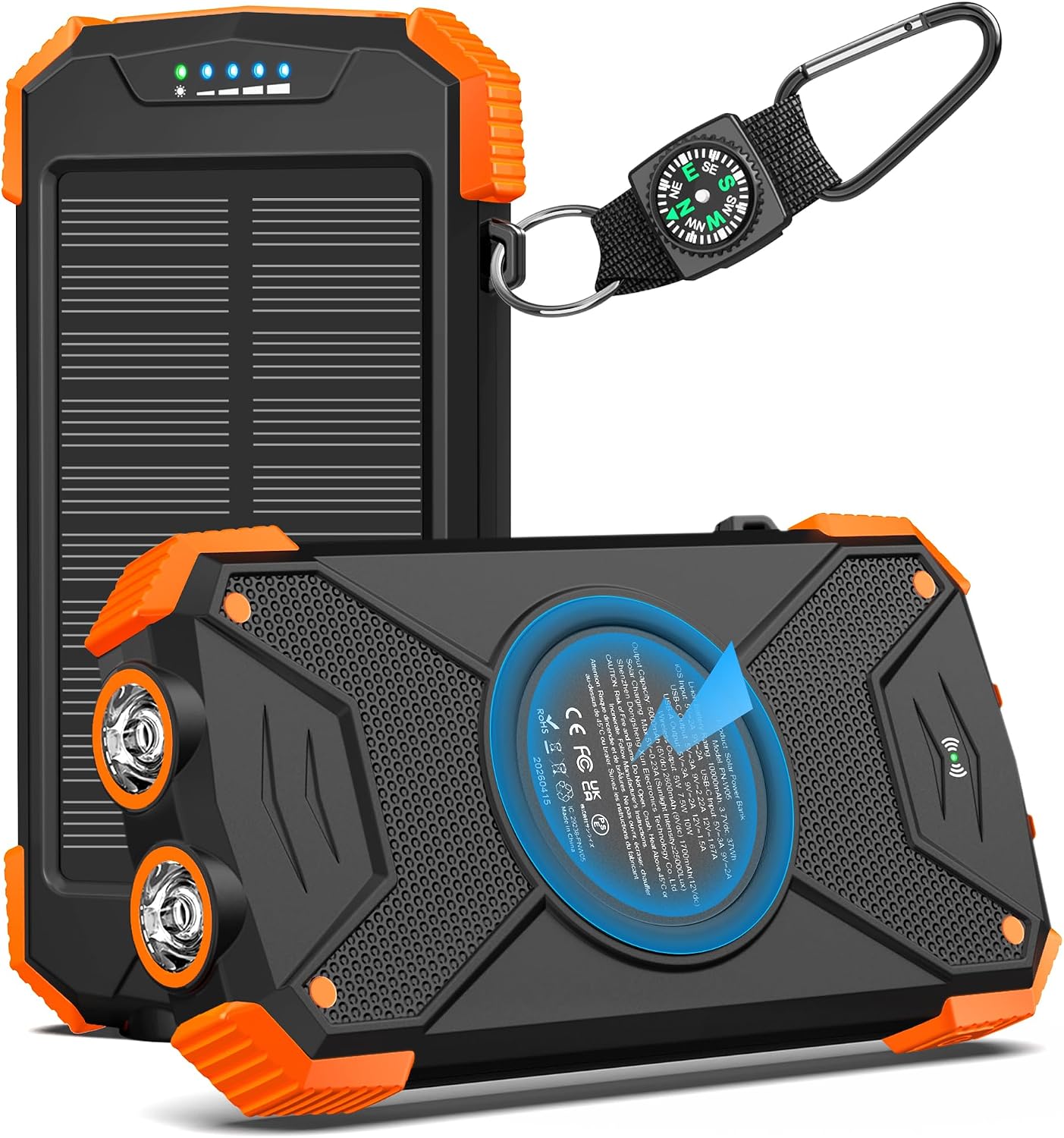
For weekend trips and minimalist packing, the BLAVOR 10,000mAh strikes a genuinely useful balance — enough capacity for 2-3 days of moderate phone use, in a compact package that won’t weigh down an already-light pack. IPX5 waterproof, dustproof, and shockproof construction handles real trail conditions, and the built-in dual flashlights plus included compass carabiner add genuine trail utility beyond just charging. 20W USB-C fast charging means quick top-ups when you do have access to a wall outlet or vehicle charger.
BLAVOR is direct about the solar panel’s real role — a backup for emergencies, not a primary charging method — which is exactly the honest framing worth applying to any solar power bank in this category, not just this one.
Best for Longer Trips: Hiluckey 26,800mAh Solar Power Bank
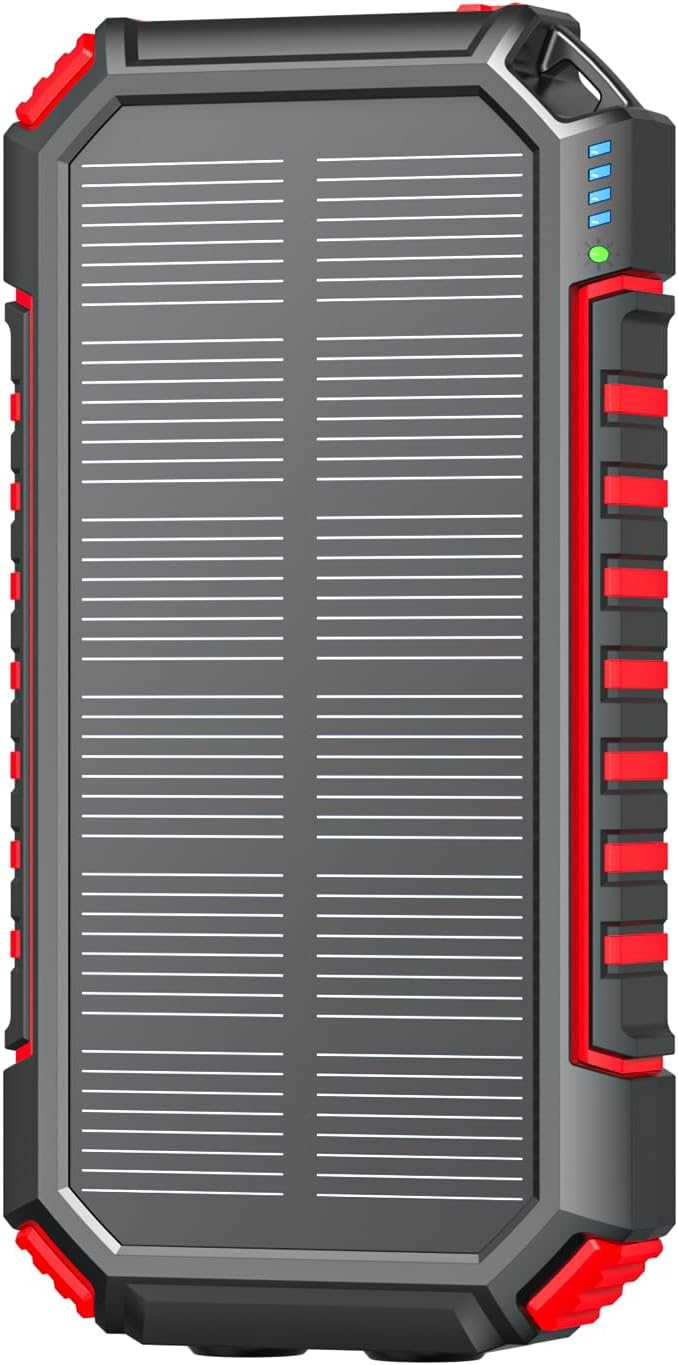
At 26,800mAh (99Wh — conveniently under the FAA’s 100Wh carry-on threshold), this is the right capacity tier for week-long treks, group trips where you’re sharing power, or anyone running a phone, GPS device, and camera simultaneously. The large integrated solar panel provides genuine trickle-charge backup, and the sturdy, corner-protected design is built for real outdoor abuse rather than just casual daily carry.
Hiluckey’s own product page includes the same honest disclosure found across quality brands in this category: the solar charging function is intended for emergency use, not as the primary charging method. Budget on charging this fully via USB before your trip, with solar providing a meaningful buffer if you’re out longer than planned.
Can I Bring a Solar Power Bank on a Plane?
Yes, with limitations. The FAA allows power banks under 100Wh in carry-on luggage — this covers virtually every solar power bank on the market, including both picks above. To convert mAh to Wh, multiply capacity by voltage (typically 3.7V for lithium batteries) and divide by 1,000; a 26,800mAh bank works out to roughly 99Wh, right at the practical ceiling. Always check your specific airline’s regulations and be prepared to remove the power bank from your bag during security screening — power banks above 100Wh may require airline approval or be prohibited outright.
Features Worth Considering — And Ones That Aren’t Essential
Genuinely useful: built-in cables (eliminates the classic “forgot my cord” panic), an accurate digital percentage battery indicator rather than a vague LED count, USB-C input/output for fast charging, and IPX5+ water resistance for real trail conditions.
Nice-to-have but not essential: integrated flashlights (useful in a pinch, but most backpackers already carry a dedicated headlamp), wireless charging (convenient but less power-efficient than a direct cable connection), and compass/carabiner extras (fun additions, but redundant if you already carry standalone trail navigation tools).
Frequently Asked Questions
Will a solar power bank fully recharge itself on the trail?
Realistically, no — not as a primary method. Manufacturers themselves are often direct about this: the built-in solar panels are small and produce limited charging current, intended as emergency backup rather than a reliable daily recharge source. Independent testing found roughly 30% added charge during a full day of direct sun exposure — useful, but nowhere near a full recharge from empty.
What size solar power bank do I need for a 4-day backpacking trip?
Roughly 20,000mAh covers a typical 3-4 day trip with moderate phone use, recharging a phone 4-5 times from empty. Add capacity if you’re also charging a GPS device, camera, or satellite communicator, or if you’re sharing the bank with a hiking partner.
Can I take a solar power bank on an airplane?
Yes, as long as it’s under 100Wh, which covers virtually all consumer solar power banks including both picks in this guide. Check your specific airline’s policy and be ready to remove it from your bag during security screening.
Is a bigger mAh rating always better for backpacking?
Not necessarily — every added 1,000-5,000mAh of capacity typically adds 100-300g of weight, which matters on a multi-day trip where every ounce counts. Match capacity to your actual trip length and device usage using the sizing table above rather than defaulting to the largest available option.
Do I need a separate solar panel instead of a power bank with a built-in panel?
For serious solar reliance — multi-week trips, or situations where recharging via wall outlet isn’t realistic — a larger standalone folding solar panel paired with a separate power bank can deliver meaningfully more charging than a small integrated panel. For most backpacking trips under a week, a power bank with a built-in panel used primarily via USB charging, with solar as backup, is the simpler and lighter solution.
Final Verdict
| Your Situation | Best Pick |
|---|---|
| Weekend trips, minimal weight priority | BLAVOR 10,000mAh Solar Power Bank |
| Week-long trips, multiple devices | Hiluckey 26,800mAh Solar Power Bank |
The Bottom Line
The honest framing for any solar power bank in this category: charge it fully via USB before your trip, and treat the built-in solar panel as backup insurance for extending your trip slightly longer than planned — not a way to skip charging altogether. For weekend trips where every ounce matters, the BLAVOR 10,000mAh delivers a solid, lightweight option. For week-long treks or group use, the Hiluckey 26,800mAh provides genuine multi-device coverage while staying under the FAA’s carry-on threshold.
For larger-scale solar charging at a campsite rather than on the trail, see our 100 watt solar panel guide. For a lantern that doubles as emergency phone charging, see our BioLite Luci Charge 360 review.