This post contains affiliate links. If you buy through our links we may earn a small commission — at no extra cost to you. This never influences our recommendations.
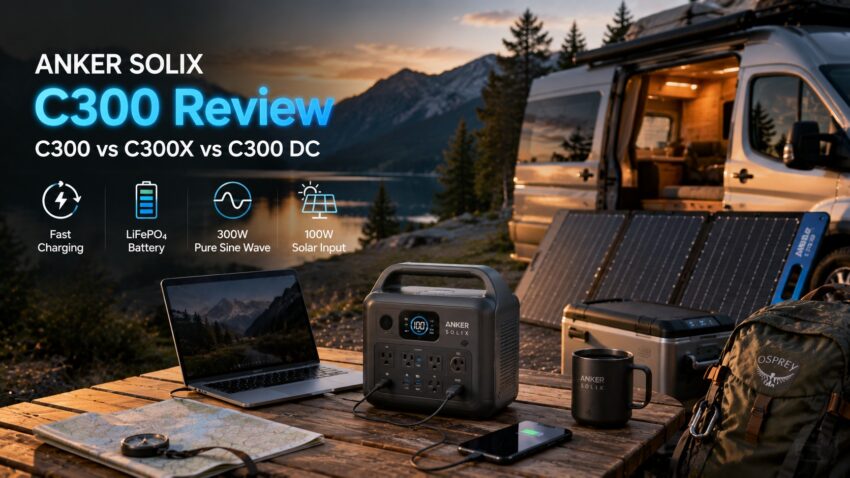
The SOLIX C300 consistently ranks among the best-selling portable power stations on Amazon, moving over 1,000 units a month by some estimates. It’s also part of a genuinely confusing three-model family — C300, C300X, and C300 DC — where the naming differences hide real functional differences worth understanding before you buy. This review covers the full spec sheet, what independent testing confirms, and clears up exactly which variant does what.
C300 vs C300X vs C300 DC — Clearing Up the Confusion First
| Spec | C300 DC | C300 | C300X |
|---|---|---|---|
| Capacity | 288Wh | 288Wh | 288Wh |
| AC outlets | None — USB only | Yes | Yes |
| UPS function | No | No | Yes — 10ms switchover |
| Weight | ~30% lighter than C300 | ~9 lbs | ~9.1 lbs |
| Typical price | Lowest in the series | Same as C300X | Same as C300 |
The practical takeaway: if the C300 and C300X are priced the same — which is common — the C300X is the strictly better choice, since it adds genuine UPS backup functionality for no additional cost. The base C300 mainly makes sense if the C300X happens to be out of stock. The C300 DC trades away AC outlets entirely for maximum portability, right for minimalist trips where USB charging alone covers your needs. This review covers the base C300 specifically, which shares nearly identical core specs with the C300X minus the UPS function.
Full Specifications
| Spec | Anker SOLIX C300 |
|---|---|
| Capacity | 288Wh |
| Battery chemistry | LiFePO4 (LFP) |
| Cycle life | 3,000+ cycles to 80% capacity |
| AC output | 300W continuous, pure sine wave |
| Surge capacity | 600W |
| AC charge time (0-80%) | 50-60 minutes |
| USB-C charging | 140W bidirectional (charges the unit or charges devices from it) |
| Solar input (max) | 100W (60W panel commonly bundled) |
| Weight | ~9 lbs (4.1 kg) |
| Noise (light load) | ~25dB — rarely audible for small device charging |
| Ports | 6-8 total: 2× AC, 2× USB-C, 1× USB-A, 1× car port (varies by exact configuration) |
| Warranty | 5 years |
Real-World Battery Efficiency
Independent 30-day testing on the closely related C300X (sharing the same core battery architecture) measured 86% real-world efficiency — meaning roughly 248Wh of genuinely usable energy from the 288Wh rating, once inverter conversion losses are accounted for. This is a solid, unsurprising figure consistent with quality LiFePO4 power stations in this capacity class.
Charging Speed — Genuinely Fast
Multiple independent reviewers confirmed consistent results here: AC charging reaches 80% in 50-60 minutes from a standard wall outlet, using an integrated bidirectional charging circuit that doesn’t require an external power brick. The 140W USB-C ports work bidirectionally too — you can charge the unit itself via USB-C at similar speeds, or use those same ports to fast-charge a laptop or tablet from the power station, reaching 80% in about 60 minutes in testing with a 5A-rated cable.
Solar Charging — Honest Real-World Numbers
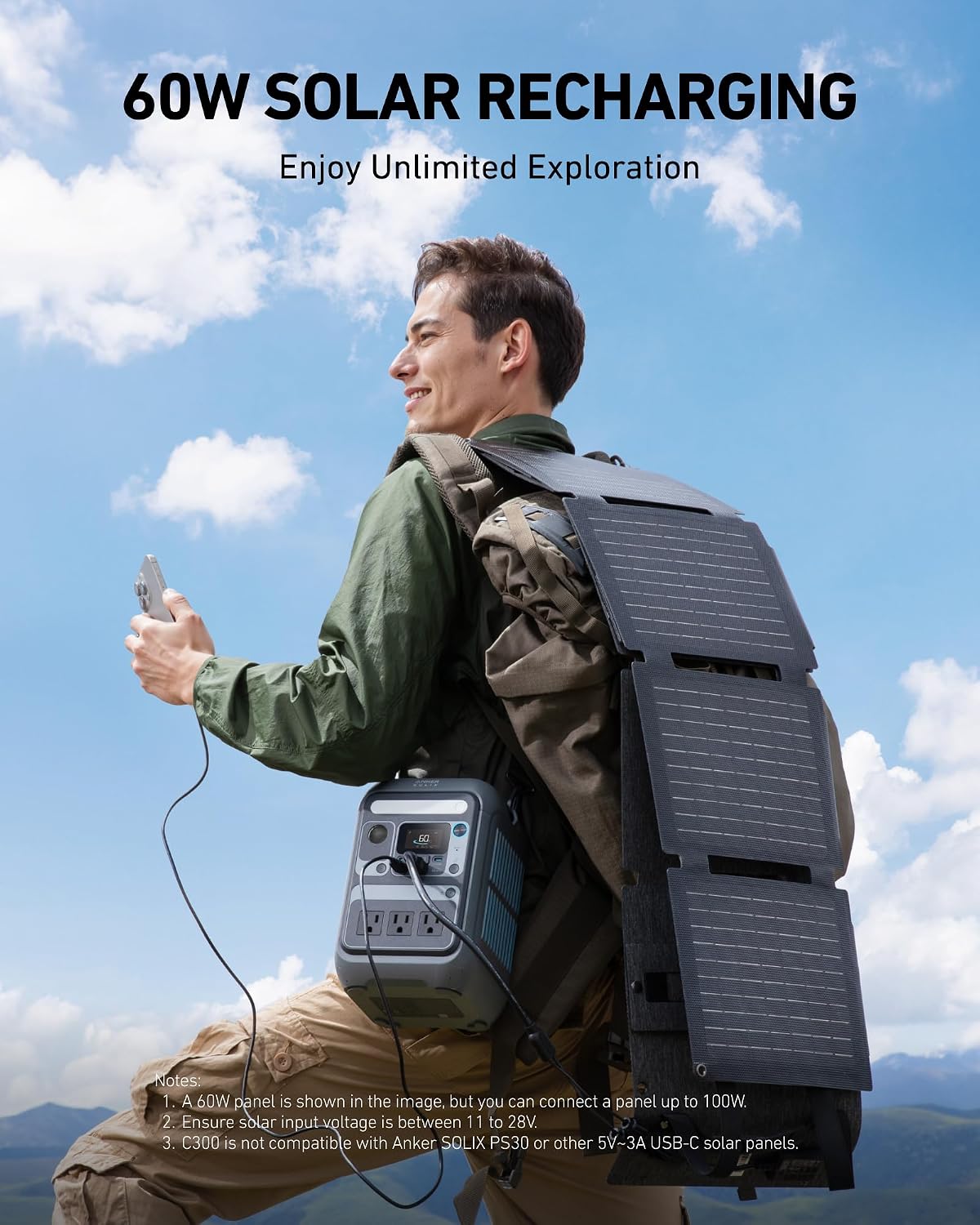
This is worth knowing before you buy the panel bundle specifically. One detailed test using the included 60W solar panel under optimal midday sun (1,000W/m² irradiance) measured real-world input of 45-55W — meaningfully below the panel’s 60W rating, which is normal and expected given real-world losses, but worth factoring into your expectations. Under those conditions, a full charge took 5-6 hours. Cloudy conditions stretched this to 8-10 hours, a substantial difference worth planning around if you’re relying on solar as your primary recharge method during an extended trip.
Real-World Runtime
| Device | Draw | Tested Runtime |
|---|---|---|
| Smartphone charging | ~10W | 30+ full charges |
| Mini-fridge (55W) | 55W | 5+ hours |
| Desk fan (40W) + LCD monitor (55W) combined | ~95W | Measured directly in independent testing |
The 600W surge capacity means the C300 briefly handles startup loads well above its 300W continuous rating — one detailed test specifically verified this by successfully starting a coffee maker with a 550W startup surge, a load that would trip many similarly-rated competitors.
Build Quality and Portability
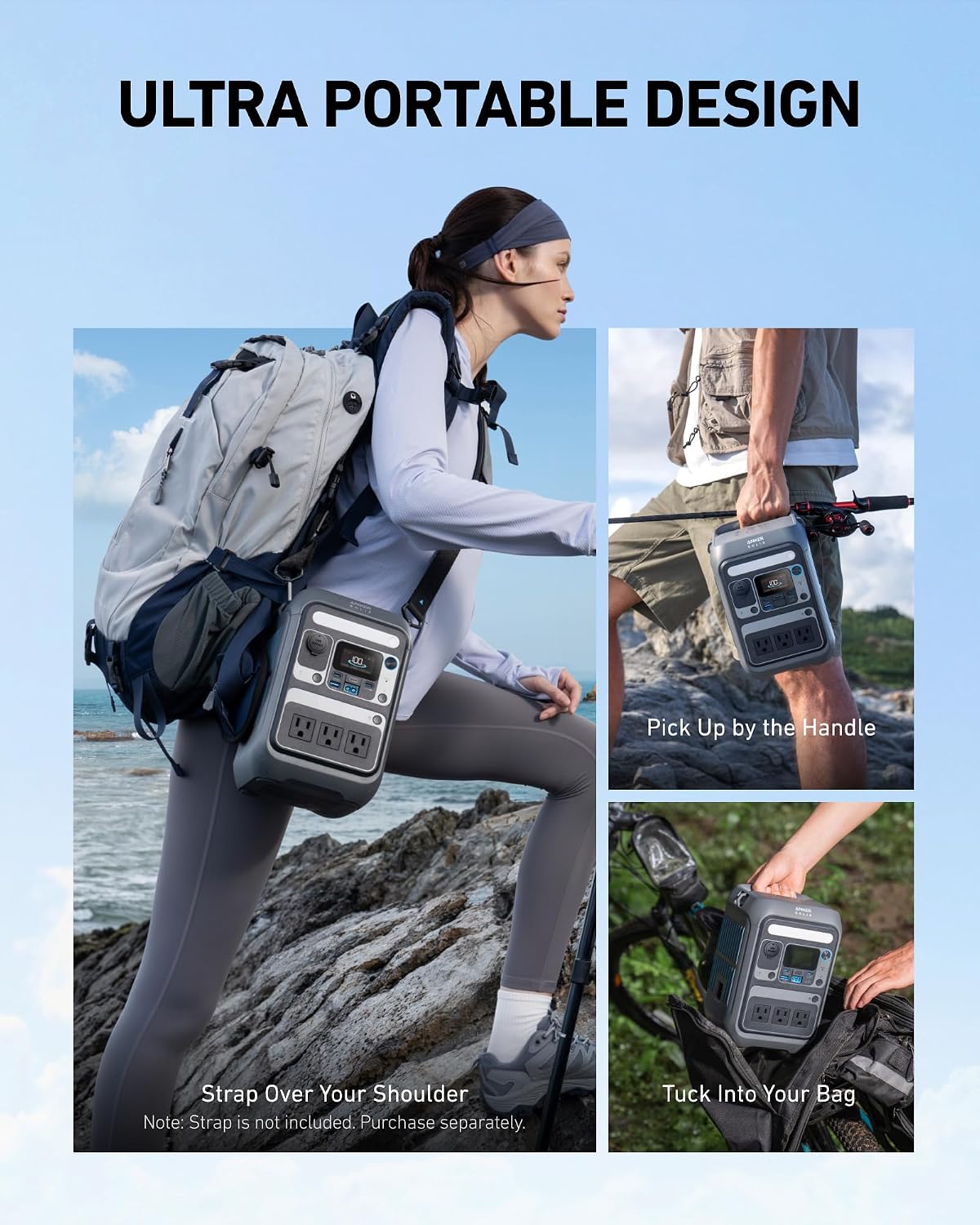
At roughly 9 lbs and 15% smaller than many competitors in the 300W class according to one detailed review, the C300 slides easily into a backpack or car trunk. The compact, smooth-edged design reflects genuine attention to portability rather than just shrinking a larger unit’s shell. At light loads, internal cooling fans rarely activate at all — LiFePO4 chemistry doesn’t generate the heat that would require aggressive fan cycling for small device charging, making this a genuinely quiet nightstand or bedside companion, including for CPAP use. See our solar generator for CPAP guide for sizing guidance specific to that use case.
Honest Pros and Cons
Pros: Genuinely fast AC and USB-C charging (50-60 min to 80%), 86% real-world battery efficiency, quiet operation at light loads, 600W surge handles demanding startup loads, 5-year warranty, compact and lightweight at ~9 lbs, 3,000+ cycle LFP battery
Cons: Lacks the UPS function that the identically-priced C300X includes — check pricing before choosing between the two, real-world solar input with the bundled 60W panel runs 45-55W rather than the full 60W rating, 288Wh capacity limits multi-day use without recharging
Who Should Buy the C300
Best for:
- Weekend campers and day-trippers wanting fast, reliable charging in a compact package
- Buyers who don’t specifically need UPS backup functionality (or who find the C300X out of stock)
- Anyone prioritizing quiet operation for bedside or medical device use
- Light emergency preparedness — phone charging, small device backup during brief outages
Consider the C300X instead if:
- It’s priced the same as the base C300 — the added 10ms UPS function is essentially free at that point
- You want guaranteed uptime for a router, modem, or medical device during a power interruption
Consider a larger unit if:
- You need to run a fridge for a full day or power multiple devices simultaneously — see our best 1000W solar generators for the money guide for the next capacity tier up
Frequently Asked Questions
What’s the difference between the Anker SOLIX C300 and C300X?
The core specs — 288Wh capacity, 300W output, LiFePO4 battery — are essentially identical. The C300X adds a 10ms UPS switchover function that keeps sensitive devices like routers or medical equipment running seamlessly through a power interruption, a feature the base C300 lacks. When both are priced the same, the C300X is the better choice.
How fast does the Anker SOLIX C300 charge?
Via AC wall outlet, it reaches 80% in 50-60 minutes using an integrated bidirectional charging circuit. The 140W USB-C ports charge at similar speeds. Solar charging with the bundled 60W panel takes 5-6 hours in optimal midday sun, extending to 8-10 hours under cloudy conditions.
Can the Anker SOLIX C300 run a mini-fridge?
Yes — independent testing confirmed it running a 55W mini-fridge for 5+ hours on a single charge, well within the unit’s 300W continuous output rating.
What’s the difference between the C300 and C300 DC?
The C300 DC drops AC outlets entirely, offering USB charging only, in exchange for roughly 30% less weight and the lowest price in the series. It’s the right choice for minimalist trips where you only need to charge USB devices; the standard C300 or C300X is the better fit if you need to power AC-plug devices like a mini-fridge or laptop charger.
Is the Anker SOLIX C300 quiet enough for bedside use?
Yes — at light loads, the internal cooling fans rarely activate at all, since LiFePO4 chemistry doesn’t generate significant heat from small device charging. This makes it a genuinely quiet option for nightstand use, including CPAP machines.
The Bottom Line
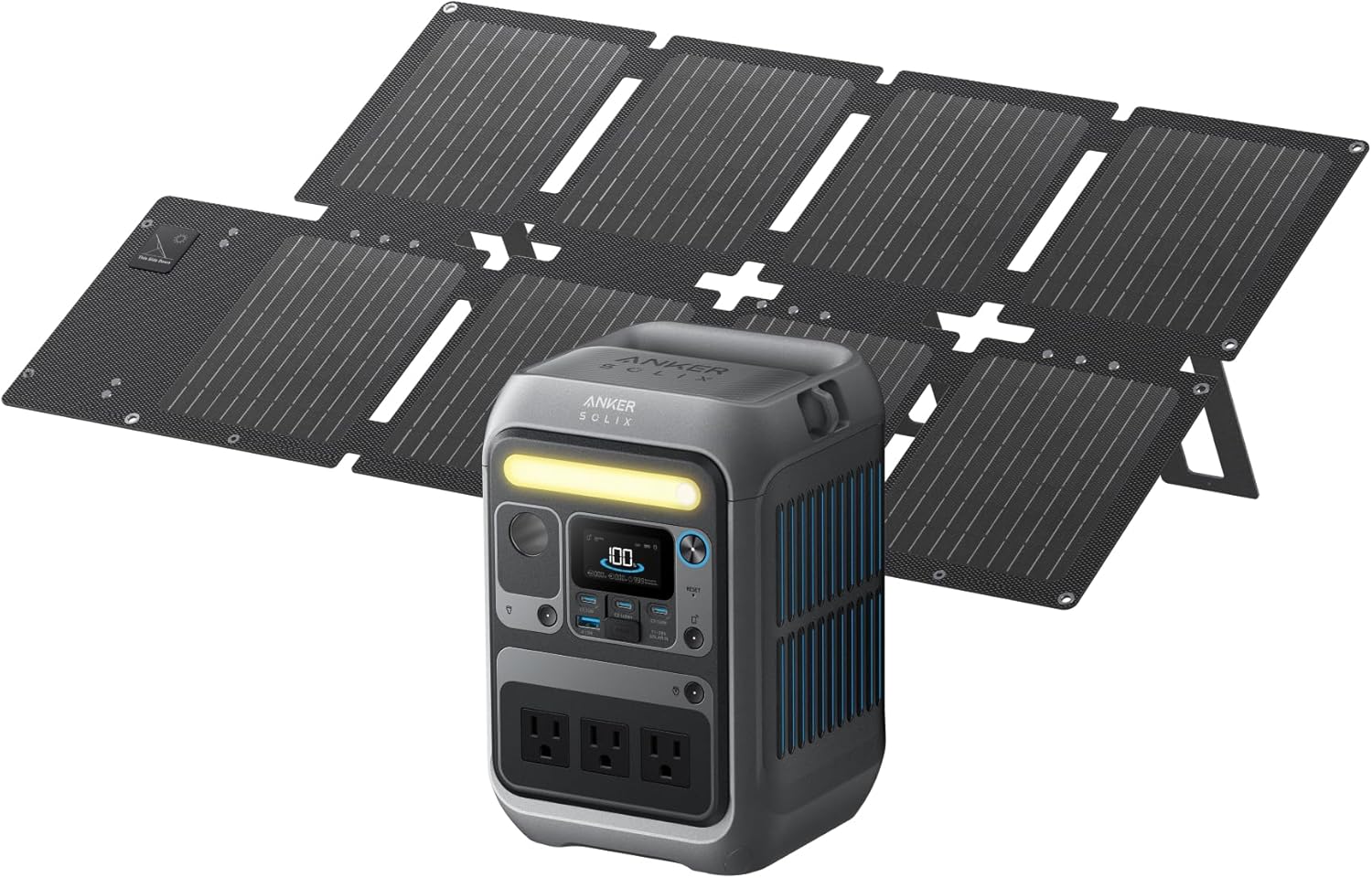
The Anker SOLIX C300 delivers genuinely fast charging, solid real-world efficiency, and quiet reliable operation in a compact package — the reasons it consistently ranks among Amazon’s bestselling power stations. Before buying, check current pricing against the C300X specifically, since the added UPS function often comes at no extra cost and makes it the objectively better pick when available at the same price.
Check the Anker SOLIX C300 + 60W Solar Panel on Amazon →
For the full Anker SOLIX lineup, see our Anker solar generator guide. For camping-specific sizing, see our solar generator for camping guide.