This post contains affiliate links. If you buy through our links we may earn a small commission — at no extra cost to you. This never influences our recommendations.
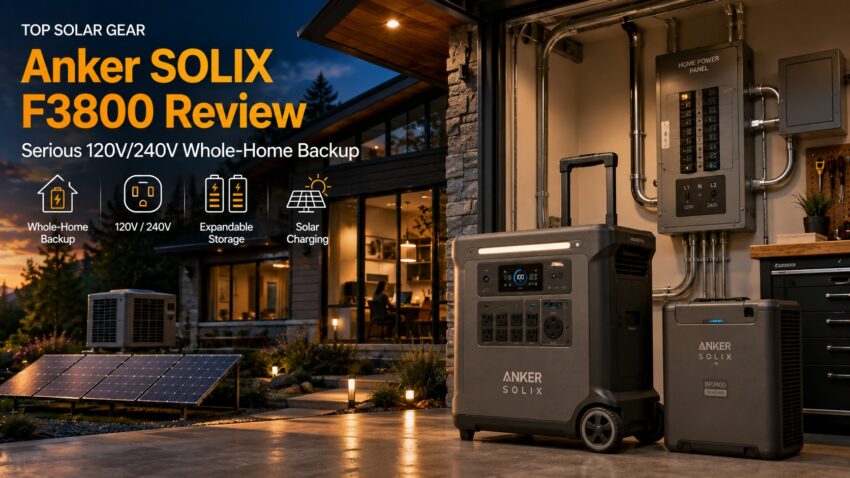
The F3800 is Anker’s clearest statement of intent in the whole-home backup category — not a camping accessory scaled up, but a purpose-built 132-lb system with genuine 120V/240V split-phase output from a single unit. This review covers the full spec sheet, what independent testing confirms, and an honest look at a cycle-life claim that varies meaningfully across sources.
Full Specifications
| Spec | Anker SOLIX F3800 |
|---|---|
| Capacity | 3,840Wh |
| Battery chemistry | LiFePO4 (LFP), EV-grade cells |
| Cycle life | Claims vary by source — see note below |
| AC output | 6,000W continuous, native 120V/240V split-phase |
| Surge output | 9,000W |
| Full AC charge | ~2.8 hours at 240V input |
| Solar input (max) | 2,400-3,200W (varies by specific listing/bundle) |
| Weight | 132-135 lbs |
| Expandability | Up to 26.9kWh with 6 battery packs; up to two F3800 units paired for 12,000W max output |
| RV/EV ports | Native NEMA 14-50 and L14-30 — no adapters needed |
| Weatherproofing | Not waterproof — indoor/dry, temperature-controlled location required |
| Warranty | 5 years, stated 10-year lifespan |
An Honest Note on Cycle Life Claims
This is worth flagging directly rather than repeating a single figure with false confidence. Independent sources cite genuinely different cycle-life numbers for the F3800 — one detailed review states 3,000 cycles to 80% capacity, translating to a stated 10-year lifespan at daily use, while another cites 6,000 cycles. Anker’s own product listings consistently promote “10+ year lifespan” language without always specifying an exact cycle count on every listing. Given this inconsistency, treat the specific cycle number with some caution and confirm directly with Anker’s current official specifications before making a purchase decision based on that number alone — the 10-year lifespan claim itself is the more consistently repeated figure across sources.
Split-Phase 120V/240V Output — The Feature That Sets It Apart
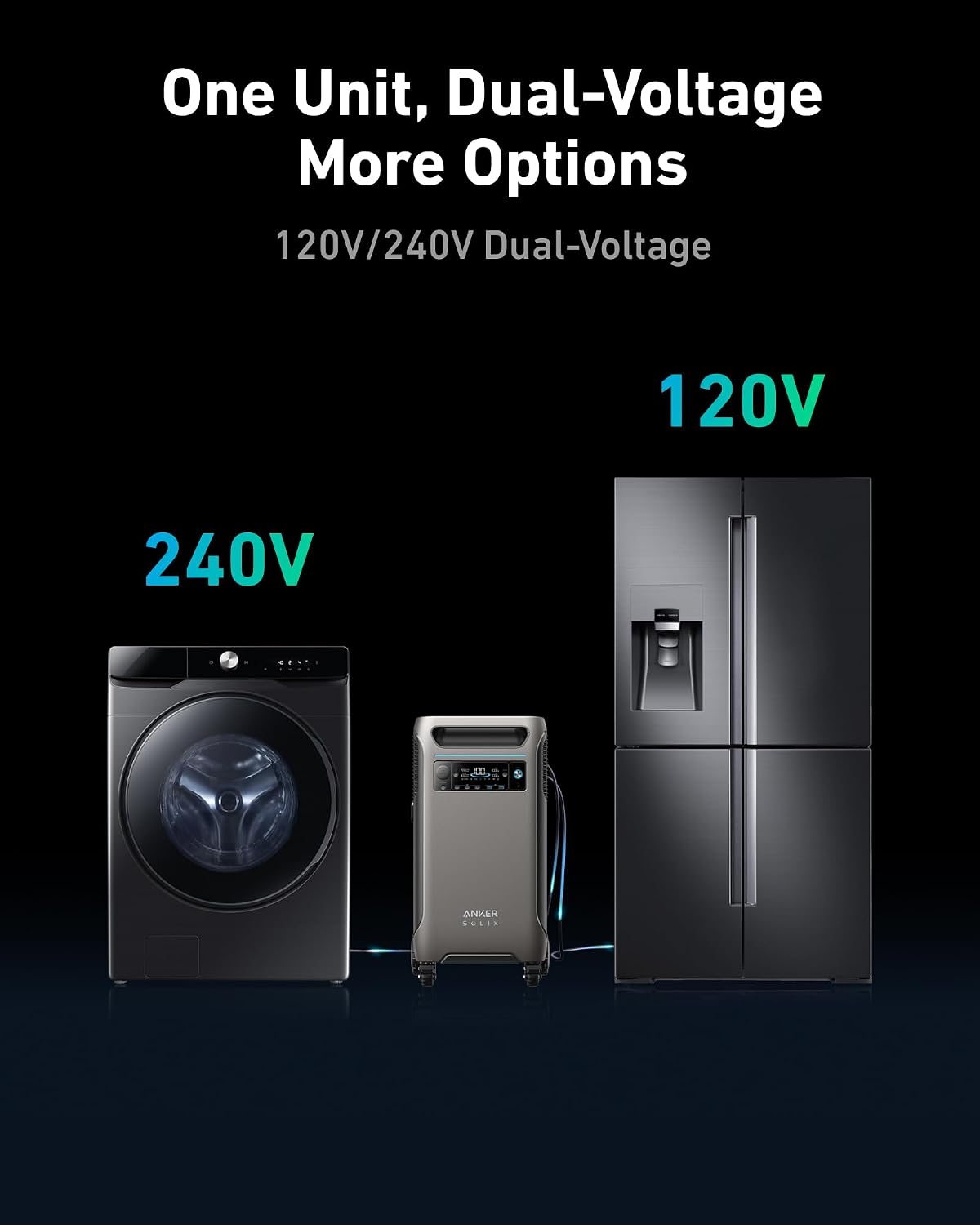
This is the F3800’s genuine differentiator. Most portable power stations output 120V only, meaning 240V appliances — central AC, an electric dryer, a well pump — require either a separate step-up device or simply can’t run at all. The F3800 outputs native 120V/240V split-phase from a single unit, and one independent reviewer specifically confirmed this in practice by simultaneously starting a 5-ton AC unit, a well pump, and a table saw to verify surge capacity — a genuinely demanding real-world test that few portable units could pass.
Real-World Home Backup Testing
One detailed two-week field test connected the F3800’s Home Power Panel to six essential circuits (refrigerator, kitchen outlets, HVAC fan, office equipment, and lighting) in a 2,500 sq ft home, running a full home load of approximately 3,500W for over two hours to simulate a real outage. The system handled this load without issue, and solar recharge testing with two 400W panels under optimal midday conditions confirmed the unit’s solar charging capability under real conditions rather than just spec-sheet claims.
Solar Charging — Real Efficiency Numbers
One independent test measured real-world solar recharge efficiency averaging around 23.5% relative to theoretical maximum under the specific test conditions, translating to roughly 5-8 hours for a meaningful recharge with a properly sized panel array — a useful reality check against the headline 2,400-3,200W solar input specs, which represent a ceiling rather than a guaranteed real-world result. This gap between rated and real-world solar performance is normal across the portable power station category broadly, not unique to the F3800.
Expandability — Built for Serious Scale
The F3800’s expansion path is genuinely aggressive: add up to 6 BP3800 battery packs (3,840Wh each) to reach 26.9kWh total from a single unit, or pair two complete F3800 units with 12 battery packs for what Anker describes as enough capacity for roughly two weeks of power in extreme situations, plus a doubled 12,000W max AC output. This puts the F3800 in genuine competition with fixed home battery systems for households willing to invest in the full buildout, while retaining the portability of starting with just the base unit.
Native RV and EV Charging
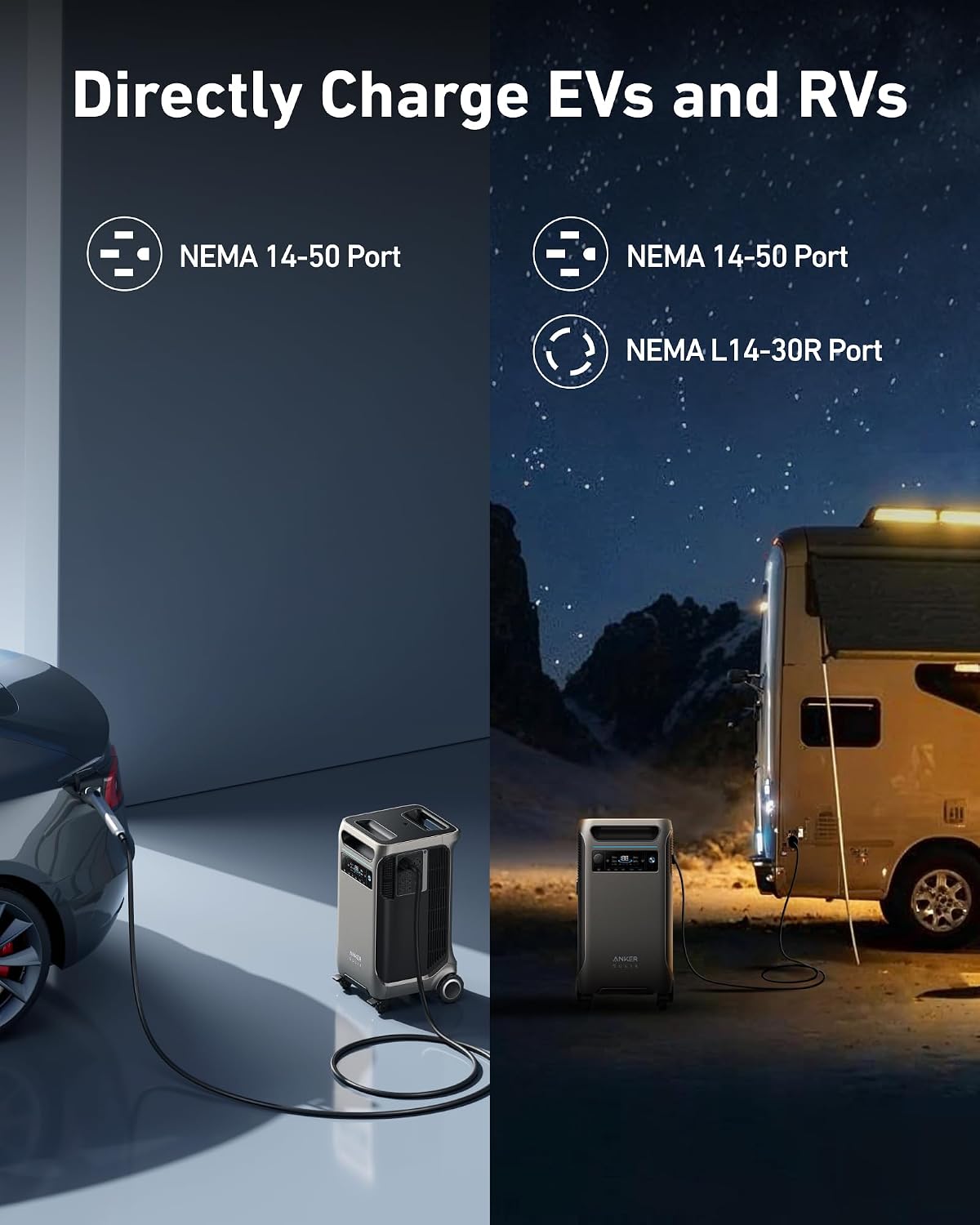
The F3800 includes native NEMA 14-50 and L14-30 ports, letting you plug directly into an EV charging cable or an RV’s power inlet without sourcing adapter hardware — a genuine convenience over competitors that require separate adapters for this functionality. Anker states the unit can charge an EV at up to 6,000W through the NEMA 14-50 port.
Honest Limitations
Not waterproof. The F3800 must be installed in a dry, temperature-controlled location — a garage or outbuilding works only if genuinely protected from moisture and direct weather exposure, unlike some ruggedized competitors rated for harsher conditions.
No grid export capability. Confirmed directly in Anker’s own product documentation — the F3800 cannot send excess stored electricity back to the grid, a relevant limitation if you were considering it for any grid-interactive use case rather than pure backup.
Installation documentation could be more detailed. At least one review specifically noted that panel and transfer switch integration documentation is less thorough than some competitors like EcoFlow or Bluetti provide — potentially a real friction point for non-DIY users attempting a full home panel integration without professional help.
Genuine ecosystem lock-in. Expansion batteries and accessories are specific to the F3800 series — a real consideration if you’re weighing long-term flexibility against Anker’s specific ecosystem.
Honest Pros and Cons
Pros: Genuine 120V/240V split-phase output from a single unit — rare in this price category, confirmed handling a 5-ton AC unit plus well pump plus table saw simultaneously in independent testing, native NEMA 14-50/L14-30 ports for EV and RV charging with no adapters needed, aggressive expansion path to 26.9kWh, 5-year warranty with a stated 10-year lifespan
Cons: Cycle life claims are genuinely inconsistent across sources (3,000 vs 6,000 cited), not waterproof — requires dry indoor installation, no grid export capability, installation/panel integration documentation less detailed than some competitors, real ecosystem lock-in for expansion components
Who Should Buy the F3800
Best for:
- Households with hardwired 240V loads — central AC, well pump, electric dryer — where native split-phase output genuinely matters
- Full-time RVers or EV owners wanting native charging ports without adapter hardware
- Buyers planning to build toward serious whole-home backup capacity over time via the expansion path
- Anyone specifically comparing this against fixed home battery systems and wanting portable flexibility instead
Consider alternatives if:
- Your loads are entirely 120V — a less expensive unit without split-phase output may be the more rational choice; see the EcoFlow DELTA Pro 3 review for a comparable-tier alternative
- You need genuinely detailed, hand-held installation guidance for a full panel integration and aren’t comfortable working with less documentation
- Outdoor or wet-location installation is a requirement — the F3800 isn’t rated for this
Frequently Asked Questions
Can the Anker SOLIX F3800 power a whole house?
For essential circuits and even some demanding simultaneous loads, yes — independent testing confirmed it starting a 5-ton AC unit, a well pump, and a table saw together, and running a real 3,500W home load (fridge, kitchen outlets, HVAC fan, office equipment, lighting) for over two hours without issue. True whole-home coverage of every circuit simultaneously would require the expanded multi-battery configuration.
How many charge cycles does the F3800 battery last?
This is genuinely unclear from available sources — cited figures range from 3,000 to 6,000 cycles across different independent reviews, with Anker’s own listings more consistently emphasizing a “10+ year lifespan” claim than a specific cycle number. Confirm the current official specification directly with Anker before relying on a specific cycle count.
Can I install the F3800 outdoors or in a garage?
Not directly outdoors — it’s not waterproof. A garage or outbuilding works only if genuinely protected from moisture and direct weather exposure; Anker recommends a dry, temperature-controlled location.
How much can the F3800 expand to?
Up to 26.9kWh with 6 additional BP3800 battery packs from a single unit — confirmed consistently across multiple official Anker product listings. Pairing two complete F3800 units with 12 battery packs reaches roughly two weeks of stated backup capacity in extreme scenarios, plus doubled 12,000W max output.
Does the F3800 include solar panels?
It depends on the specific bundle — some listings include a 400W solar panel, while the standalone unit does not include one. Check the specific listing carefully, since panel inclusion varies across the F3800’s several bundle configurations.
The Bottom Line
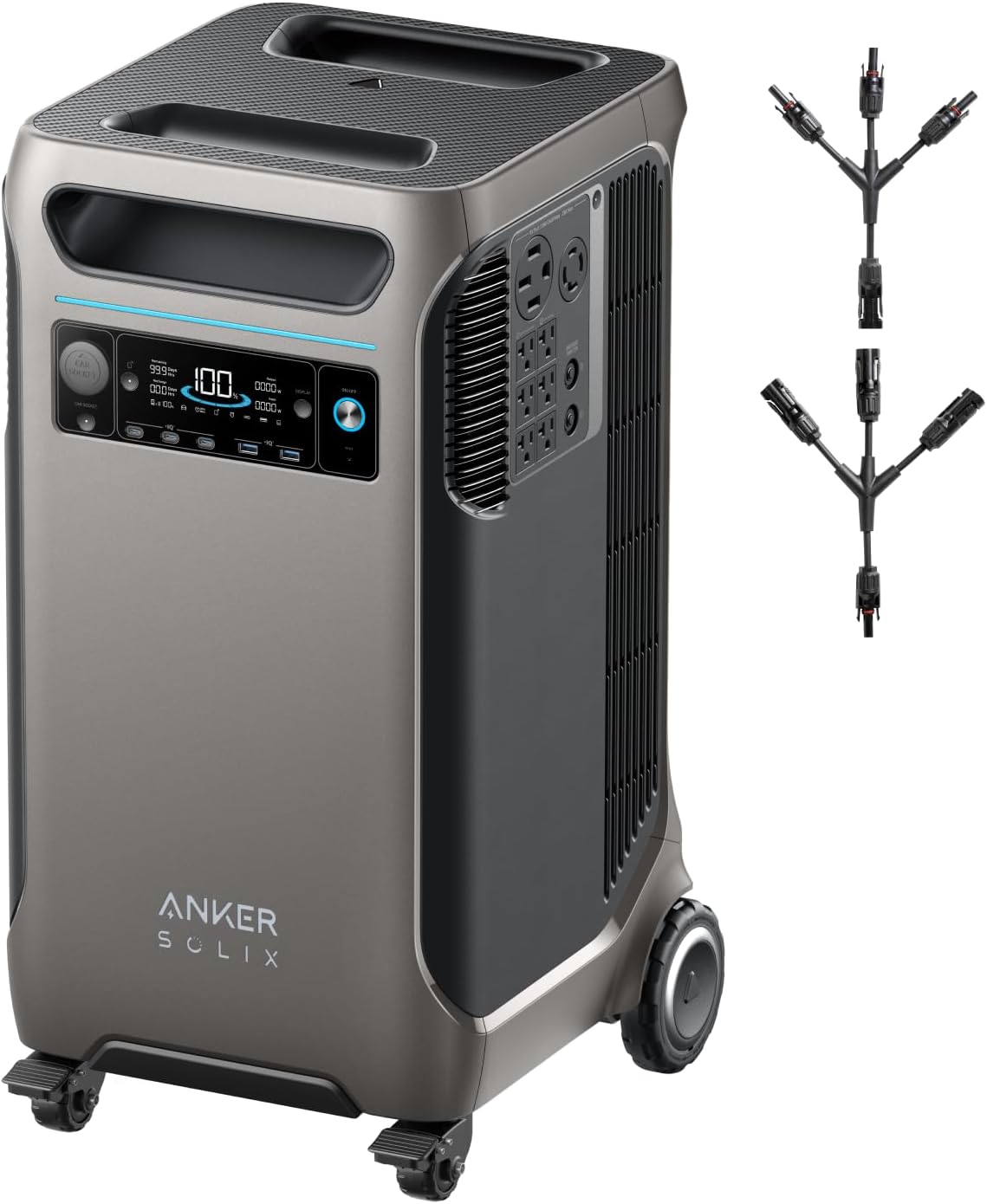
The F3800 delivers genuinely rare capability in the portable power station category — native 120V/240V split-phase output confirmed handling serious real-world loads, aggressive expansion to 26.9kWh, and direct EV/RV charging with no adapters. The honest caveats are real: cycle-life claims are inconsistent across sources, it’s not rated for outdoor or wet installation, and full panel integration documentation could be more thorough. For households with genuine 240V needs or anyone building toward serious whole-home backup capacity, it remains one of the more capable options in this category.
Check the Anker SOLIX F3800 on Amazon →
For the full Anker SOLIX lineup, see our Anker solar generator guide. For a comparable-tier alternative, see our EcoFlow DELTA Pro 3 review. For sizing guidance around off-grid or hurricane-prone use, see our solar generator for off-grid cabin guide and solar generator for hurricane preparedness guide.