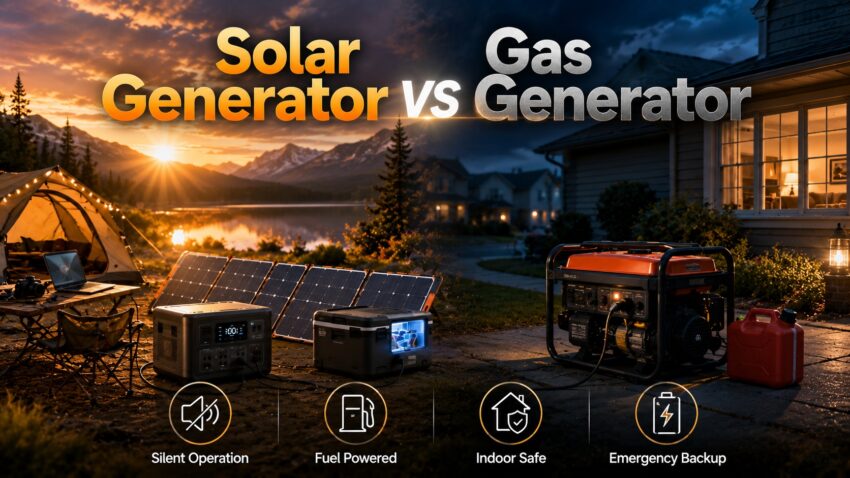
Despite the name, a “solar generator” doesn’t actually generate power — it’s a battery with an inverter that stores energy, charged by solar panels, a wall outlet, or a car port. A gas generator burns fuel to produce electricity on demand. That single difference — stored energy vs. on-demand energy — is the root of every other tradeoff between them.
This guide breaks down the real differences across cost, noise, safety, runtime, and maintenance, and gives an honest answer for which one fits your specific situation — including when the right answer is both.
How Each One Actually Works
Gas generators burn gasoline, propane, or diesel to spin an alternator that produces electricity in real time. As long as fuel keeps flowing, power keeps flowing — there’s no upper limit on runtime beyond your fuel supply. Small gas generators run at roughly 20–30% fuel efficiency; most of the energy in the fuel becomes heat and noise rather than usable electricity, which is part of why they’re loud and why fuel consumption adds up quickly under real loads.
Solar generators (portable power stations) store energy in a lithium battery, most commonly LiFePO4 in current models. They charge from solar panels, a wall outlet, or a 12V car port, then discharge that stored energy through an inverter to power AC and DC devices. Once the battery is empty, that’s it — no output until it’s recharged. Runtime depends entirely on battery capacity and how fast you can put energy back in.
Noise — The Difference You’ll Notice Immediately
This is the most immediate, visceral difference between the two categories, and it’s not close.
| Type | Typical Noise Level | Comparable To |
|---|---|---|
| Conventional gas generator | 65–75 dB | Lawnmower |
| Quiet inverter gas generator (Honda EU2200i) | ~57 dB at rated load | Dishwasher / vacuum cleaner |
| Solar generator, idle | 0 dB | Silent |
| Solar generator, under heavy load | 30–45 dB | Whisper to quiet library |
Even the quietest premium gas generators on the market run at dishwasher volume continuously. A solar generator under load is a fan whisper at most, and silent at idle. This matters most in specific contexts: campgrounds with quiet hours or generator bans, residential neighborhoods during a nighttime power outage, RV parks, tailgates, or any situation where you don’t want to explain to a neighbor at 3am why your generator is running.
Safety — Carbon Monoxide Is the Non-Negotiable Factor
Gas generators produce carbon monoxide — an odorless, colorless, lethal gas. CO poisoning from improperly used generators kills people every year during power outages, almost always from running a unit too close to a home, in a garage, or through an open window. Gas generators must run outdoors, at least 20 feet from any building, with exhaust directed away from windows and doors.
Solar generators produce zero emissions. There’s no combustion happening — just a battery discharging through an inverter. They’re safe to run indoors, in a tent, in an RV, or in a closed garage with no ventilation requirement whatsoever. For anyone using backup power near sleeping areas, in an apartment, or in any enclosed space, this isn’t a minor convenience — it’s the deciding factor.
Runtime — Where Gas Still Wins, and Why It Matters Less Than It Sounds
A gas generator with a few spare fuel containers can outlast a solar generator by 5–10x in raw available energy. If you need 3,000W running continuously for 8 hours straight with zero sun, a solar generator physically cannot do that — a gas generator with enough fuel handles it easily.
But this comparison misses how each is actually used. Solar generators aren’t meant to run continuously at maximum output — they’re sized for a daily energy budget, recharged by solar or grid power between uses. If your solar panel input can keep pace with your daily consumption, a solar generator can sustain moderate, intermittent loads (fridge, lights, devices, CPAP, Wi-Fi) indefinitely. The constraint isn’t total energy available — it’s whether your recharge rate matches your discharge rate.
For high, continuous loads — power tools, an AC unit running all day, a well pump, cooking appliances for extended periods — gas still has a clear advantage. For moderate loads spread across a day with solar recharge available, solar generators can run indefinitely with zero fuel cost.
Cost — Upfront vs. Long-Term
Gas generators are cheaper upfront, especially at higher capacity. A quality 3,000W+ gas inverter generator can run a few hundred dollars less than a comparable-output solar generator with panels. At the low end, the gap narrows — a 1,800W-class solar setup and a comparable Honda inverter generator can land within a couple hundred dollars of each other.
The reversal happens over time. Gas generators carry ongoing costs: fuel (increasingly expensive and volatile — gas prices can jump 30–40 cents in a single week during supply disruptions), engine oil, air filters, spark plugs, and fuel stabilizer for storage. A solar generator’s energy is free once the panels are paid for — sunlight costs nothing, and a quality LiFePO4 battery is rated for 3,000–6,000 charge cycles, translating to 8–15 years of regular use with essentially zero operating cost.
For occasional use (a few outages a year, occasional camping trips), gas often stays cheaper overall due to low fuel usage. For frequent use — regular camping, frequent outages, daily RV life — solar typically becomes the better financial choice within 1–3 years as fuel and maintenance costs accumulate on the gas side.
Maintenance
Gas generators are mechanical engines and need to be treated like one: regular oil changes, air filter cleaning, spark plug replacement, and fuel stabilizer if stored for any length of time. Neglect this and you risk a no-start situation exactly when you need power most — a carburetor gummed up with stale fuel is one of the most common reasons a backup generator fails during an actual emergency.
Solar generators have no moving parts beyond an internal cooling fan. There’s no oil to change, no spark plug to replace, no carburetor to gum up. Maintenance amounts to charging the battery every few months during storage to keep it in a healthy state of charge — that’s essentially the entire maintenance requirement.
Weather and Reliability
Gas generators work in any weather, day or night, rain or shine, as long as fuel is available — this is their single biggest structural advantage. Solar generators depend on solar input for recharging; extended cloudy periods or winter’s shorter days reduce how much energy you can put back in. A solar generator with a depleted battery and no sun for several days is limited to whatever’s left in the tank, unless it’s also charged via wall outlet or car port as backup.
This is where oversizing matters for solar setups — a battery and panel array sized generously above your daily needs handles a run of cloudy days without leaving you flat. It’s also why many serious off-grid users pair solar generators with a backup charging method rather than relying on solar input alone.
Which One Should You Buy? — By Use Case
| Use Case | Better Choice | Why |
|---|---|---|
| Weekend camping, tent or car camping | Solar generator | Silent, no fumes, campground-friendly, handles device/lighting/fridge loads well |
| RV/boondocking, moderate loads | Solar generator | Handles fridge, CPAP, devices sustainably with solar recharge |
| Construction site, power tools all day | Gas generator | High continuous output, unlimited runtime with fuel on hand |
| Home backup — essentials during outages | Solar generator | Indoor-safe, silent, zero fuel storage risk, handles fridge/lights/Wi-Fi/medical devices |
| Home backup — whole-house, multi-day outage, AC/heat | Gas generator (or large expandable solar system) | Higher sustained output without a very large and expensive battery bank |
| Apartment / residential neighborhood use | Solar generator | No CO risk, no noise complaints, safe indoors |
| Serious off-grid living, unpredictable sun | Both — hybrid setup | Solar for daily use, gas as backup for extended low-sun periods |
The Hybrid Approach — What Serious Users Actually Do
Many experienced RVers, off-grid homesteaders, and frequent campers don’t choose one or the other — they use both, deployed for what each does best. A solar generator handles the daily 90% of situations quietly and cleanly: device charging, lighting, a fridge, a CPAP, Wi-Fi. A gas generator sits in reserve for the worst-case scenario — extended cloudy weather, a multi-day outage, or a load that genuinely exceeds what the battery and panels can sustain.
This combination also solves solar’s weather-dependency problem directly: running a compact gas generator for an hour or two to recharge a depleted solar generator’s battery stretches fuel usage dramatically compared to running the gas generator continuously to power devices directly. You get the quiet, clean operation of solar for 90%+ of your usage, with the gas generator as an occasional, short-duration backup recharge tool rather than your primary power source.
Frequently Asked Questions
Is a solar generator as powerful as a gas generator?
At the same price point, gas generators typically deliver more continuous output and unlimited runtime as long as fuel is available. Modern solar generators in the 2,000–3,000W output range handle most household and camping loads, including some AC units and power tools, but for sustained heavy loads over many hours with no recharge opportunity, gas still has the edge. At higher capacities (3,000W+), gas generators are also significantly cheaper per watt of output.
Can a solar generator run a refrigerator?
Yes — a 12V compressor fridge (40–50W) or standard household fridge (100–400W) runs comfortably on most mid-size solar generators (1,000Wh+). The question is duration: without solar recharge, a 1,000Wh unit runs a standard fridge for roughly 4–8 hours depending on the fridge’s efficiency and cycling pattern. With adequate solar panel input, a fridge can run indefinitely. For detailed runtime breakdowns, see our guide on solar generators for refrigerators.
How long do solar generators last compared to gas generators?
Quality LiFePO4 solar generators are rated for 3,000–6,000 charge cycles, translating to roughly 8–15 years of regular daily use before capacity noticeably degrades. Gas generators, with proper maintenance (oil changes, filter replacement, periodic exercise runs), can last a decade or more of engine life, but neglected maintenance is the most common cause of premature failure — a generator that sat unused with stale fuel for two years often won’t start when needed.
Is it cheaper to run a solar generator or a gas generator?
Gas generators are cheaper upfront but carry ongoing fuel and maintenance costs that add up significantly over time — fuel prices are also volatile and can spike sharply during supply disruptions. Solar generators cost more initially but have near-zero operating costs once purchased — sunlight is free, and the primary ongoing cost is simply the electricity used if occasionally topped up via wall outlet. For frequent users, solar typically becomes the cheaper option within 1–3 years.
Can I use a solar generator and gas generator together?
Yes, and it’s a genuinely effective strategy for serious off-grid or backup power needs. Use the solar generator for daily, quiet, moderate-load power, and keep the gas generator as backup for extended low-sun periods or loads that exceed the battery’s capacity — running it briefly to recharge the solar generator’s battery rather than powering devices directly. Some hybrid power stations, like EcoFlow’s Smart Generator series, are specifically designed to pair a fuel generator with a battery-based power station in one integrated system.
The Bottom Line
For most people — weekend campers, apartment dwellers, homeowners wanting quiet backup for essentials, and RVers with moderate power needs — a solar generator is the better fit in 2026. It’s silent, safe indoors, requires no fuel storage, and has all but eliminated the maintenance burden that makes gas generators unreliable when you actually need them.
Gas generators still make sense for construction sites, workshops, high continuous power draws like whole-home AC and heating, and situations where extended runtime with no recharge opportunity is the priority. For most other situations, and especially for anyone weighing noise, safety, or long-term cost, solar has become the more practical default.
If you’re deciding on a solar generator for a specific use case, see our guides on the best solar generator for camping, best solar generator for RV, and best solar generator for home backup — each covers sizing and specific product recommendations for that scenario.