You Want Real Power. The CellPowa 2500 Delivers It.
Most people shopping in the 2,000–2,500W portable power station category have the same frustration: the specs look great on paper, but the unit can’t handle a microwave, the solar input is laughably slow, or the battery degrades after 500 cycles. BigBlue built the CellPowa 2500 to answer every one of those complaints directly.
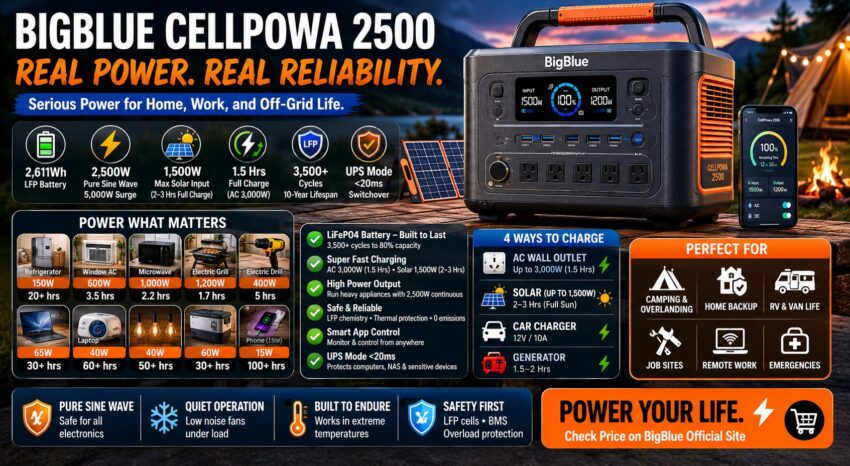
This isn’t a beginner unit. It’s a serious off-grid power station with a 2,500W pure sine wave inverter, a LiFePO4 battery rated for 3,500+ cycles, and solar input that can push up to 1,500W — one of the highest in its class. If you’re running a camp kitchen, powering a job site, or keeping your home alive during an outage, this machine was built for you.
I’ve dug into every spec, real-world use case, and use limitation so you don’t have to guess. Here’s the full breakdown.
BigBlue CellPowa 2500: Quick Overview
The CellPowa 2500 is BigBlue’s flagship portable power station. It sits at the top of their lineup and targets users who need more than what a 1,000W or 1,500W station can offer — but who aren’t ready for a whole-home generator.
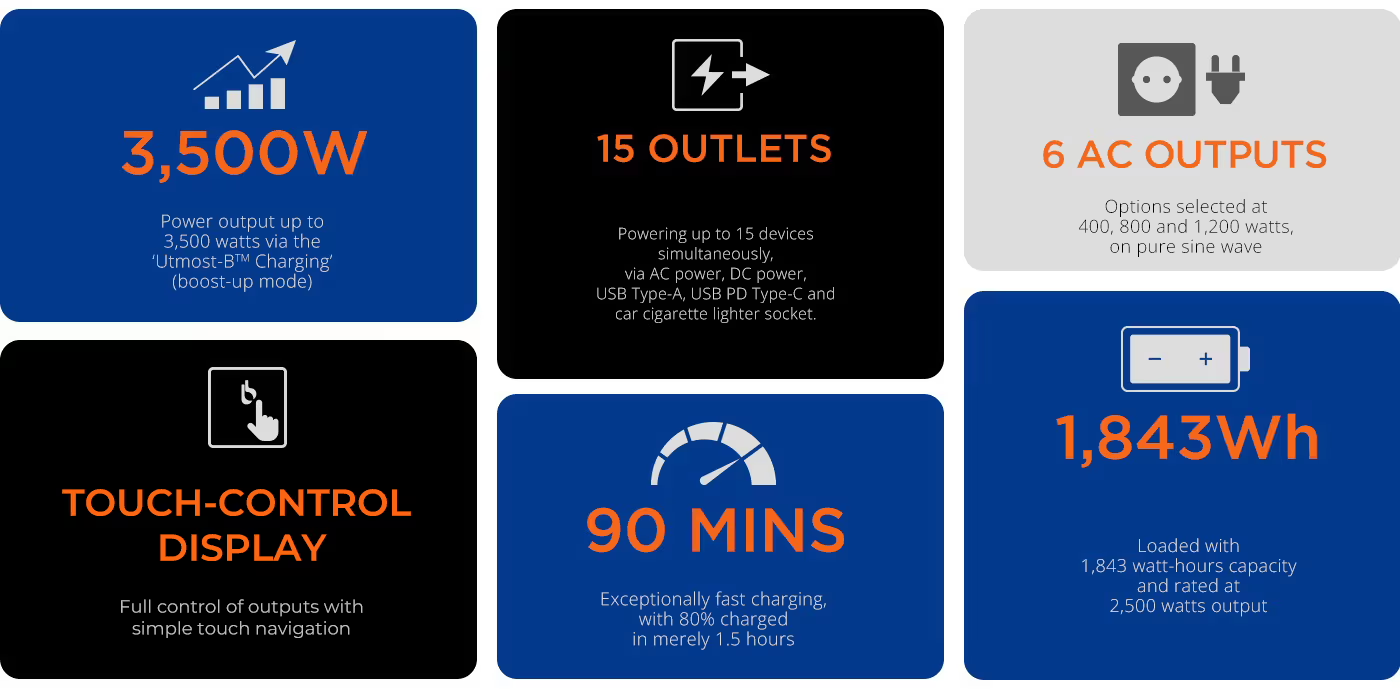
The headline numbers: 2,611Wh usable capacity, 2,500W continuous AC output (with a 5,000W surge), and the ability to recharge from 0 to 80% in under 90 minutes using the AC fast-charge mode. That last point alone separates it from most competitors.
BigBlue also built a solid solar story into this unit. With support for up to 1,500W of solar input, you can realistically refill the battery in roughly 2–3 hours on a clear day with enough panels. If you want to understand how to pair panels effectively with a unit like this, our guide on 400-watt solar panels covers the math in detail.
| Spec | Detail |
|---|---|
| Capacity | 2,611Wh |
| AC Output | 2,500W continuous / 5,000W surge |
| Battery Chemistry | LiFePO4 (LFP) |
| Cycle Life | 3,500+ cycles to 80% capacity |
| AC Inputs | Up to 3,000W wall charging |
| Solar Input | Up to 1,500W (12–150V, 15A max) |
| AC Outlets | 4× AC outlets (standard) |
| USB-A Ports | 2× USB-A (12W each) |
| USB-C Ports | 2× USB-C (100W each) |
| DC Output | 12V/10A car port |
| Weight | ~57 lbs (26 kg) |
| Dimensions | ~19.5 × 12.6 × 14.2 in |
| App Control | Yes (Bluetooth) |
| UPS Mode | Yes (<20ms switchover) |
| MPPT Charge Controller | Built-in |
Key Features Explained
LiFePO4 Battery Chemistry
The CellPowa 2500 uses lithium iron phosphate (LFP) cells — not NMC. That matters more than most buyers realize. LFP chemistry runs cooler, doesn’t risk thermal runaway the way NMC can, and holds capacity far longer. BigBlue rates this battery at 3,500+ full cycles before dropping to 80% capacity.
Do the math: if you cycle it once a day, that’s nearly a decade of daily use. Most power stations in this price range are rated at 500–800 cycles. This battery is in a completely different league for longevity.
2,500W Pure Sine Wave Inverter
Pure sine wave output isn’t a marketing phrase — it’s a requirement if you’re running sensitive electronics, medical equipment, or motors. The CellPowa 2500’s 2,500W continuous / 5,000W surge inverter handles appliances that cheap modified sine wave units destroy over time.
In practical terms, that means you can run a portable air conditioner, electric grill, circular saw, or coffee maker without the unit stuttering. The 5,000W surge handles the startup spike most motor-driven appliances demand in the first few seconds.
Fast Charging — Both Directions
BigBlue packed two critical fast-charge features into this unit. First, the wall-to-unit charging pushes up to 3,000W input, which gets you from zero to full in about 1.5 hours. Second, the two 100W USB-C ports can fast-charge laptops and phones simultaneously without slowing each other down.
The solar side is equally strong. The built-in MPPT controller accepts 12–150V at up to 15A. If you’re pairing this with a larger solar array — or want to understand how MPPT controllers maximize panel efficiency — the MPPT solar charge controller guide explains exactly how that process works.
UPS Functionality
The UPS (uninterruptible power supply) mode switches from grid to battery power in under 20 milliseconds. That’s fast enough to protect computers and NAS drives from unexpected outages. Most home UPS devices top out at 30ms. At under 20ms, the CellPowa 2500 is genuinely competitive with standalone UPS units — while also being a fully functional portable power station.
App Control via Bluetooth
The companion app lets you monitor state of charge, input/output wattage, estimated run time, and control charging settings remotely. It’s not required to use the unit — the front panel display handles everything — but it adds convenience for people who want to monitor energy consumption from across the room or campsite.
Real-World Performance
What Can It Actually Run?
This is where the CellPowa 2500 earns its reputation. With 2,611Wh of capacity and 2,500W of continuous output, you’re not making compromises the way you do with smaller units.
- Window AC unit (600W): ~3.5 hours continuous
- Portable fridge (60W): 30+ hours
- Electric drill (400W): ~5 hours of actual use
- Laptop (65W): 30+ hours
- LED lights (10W × 4): 50+ hours
- Microwave (1,000W): ~2.2 hours
- Electric kettle (1,200W): ~50 boils
- CPAP machine (30–60W): 40–80 hours
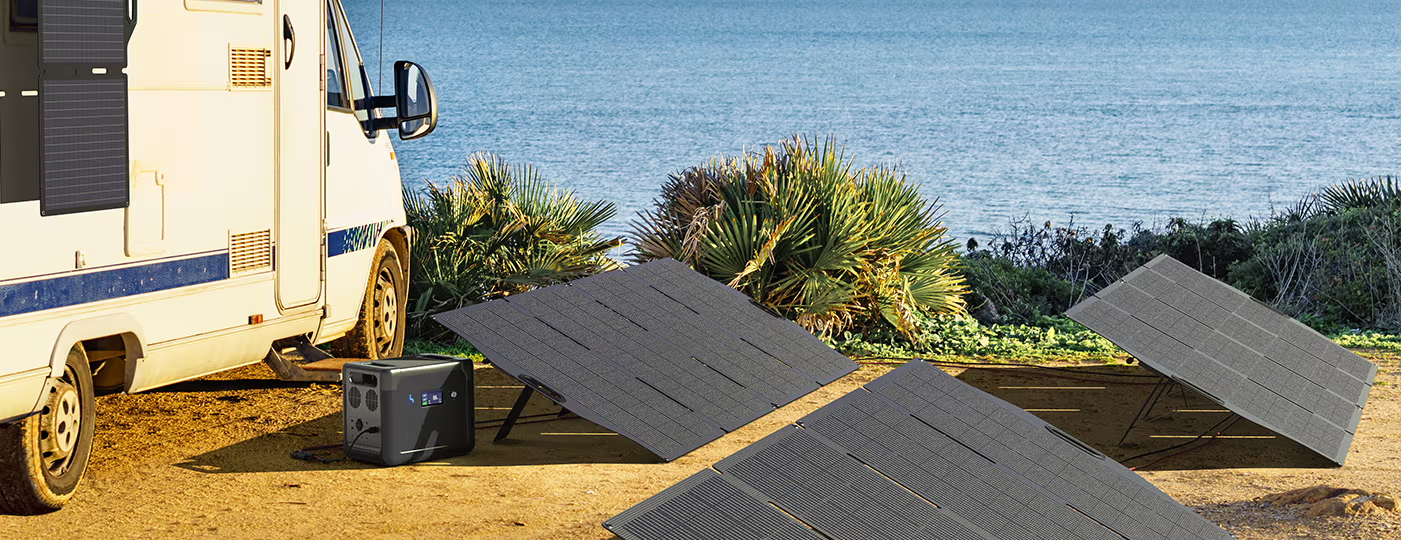
For camping, this unit is essentially a camp power grid. For solar power camping setups, pairing it with a 800W–1,200W portable solar array means you’re largely grid-independent even on multi-day trips.
Solar Recharge Speed
The 1,500W solar input ceiling is the most impressive spec on this unit. Very few power stations in this price bracket allow more than 800–1,000W of solar input. With four 400W panels wired correctly, you can push close to the 1,500W ceiling and refill the battery in roughly 2 hours of peak sun.
Even with a more modest two-panel setup (say, 2× 400W = 800W input), you’re looking at a full recharge in about 3.5–4 hours — which is perfectly usable for a full day at camp or a weekend off-grid.
Wall Charging Speed
The 3,000W wall input is among the fastest in the portable power station market. That 0–80% in 90 minutes claim is real. For home backup scenarios — where you want to top off before a storm — that speed is genuinely useful. You’re not nursing a 12-hour charge cycle before the weather turns.
Noise and Heat
The cooling fans activate under load. Under moderate loads (under ~1,000W), the unit runs quietly. Push it hard with a 2,000W+ draw and the fans spin up noticeably, but it’s comparable to other units in this class — nothing unusual. Heat dissipation is well-managed thanks to the LFP chemistry running cooler than NMC alternatives.
Who the BigBlue CellPowa 2500 Is For
This isn’t a unit for someone who wants to charge a phone and run a lamp. The CellPowa 2500 is built for people with real power demands and a plan to use solar.
Best fits include:
- Overlanders and van lifers who want a full camp power system
- Homeowners setting up emergency backup power without a fixed generator
- Remote workers who need to run laptops, monitors, and networking gear for full days
- Contractors working on job sites without grid access
- RV owners supplementing or replacing shore power — pairing well with a solid RV solar panel kit
- Anyone serious about energy independence who wants a setup that lasts a decade
If you’ve been comparing it to other large-format power stations like the Bluetti AC200MAX — which is a strong unit in its own right — the CellPowa 2500 offers more capacity, higher solar input, and a longer cycle life at a competitive price point.
Pros and Cons
| Pros | Cons |
|---|---|
| ✅ 3,500+ cycle LFP battery — built to last 10 years | ❌ ~57 lbs — not something you carry with one hand |
| ✅ 2,500W continuous output with 5,000W surge | ❌ No expandable battery option (fixed capacity) |
| ✅ 1,500W solar input — best in class for this price | ❌ Requires multiple large panels to hit solar input ceiling |
| ✅ 3,000W wall charging — full charge in ~1.5 hours | ❌ Bluetooth only — no Wi-Fi app control |
| ✅ UPS mode under 20ms switchover | ❌ Larger footprint than 1,000–1,500W class units |
| ✅ Pure sine wave output — safe for sensitive electronics | |
| ✅ Bluetooth app monitoring and control |
BigBlue CellPowa 2500 vs. What You’d Expect at This Price
At this capacity and output level, you’d normally expect to pay a premium for either the battery longevity, the solar input ceiling, or the inverter quality — rarely all three. The CellPowa 2500 bundles all of it together.
The LFP chemistry alone justifies the investment over cheaper NMC-based competitors. Power stations with NMC batteries typically rate 500–800 cycles. Run one daily and you’re replacing it in 18 months. The CellPowa 2500’s 3,500-cycle rating changes the economics entirely.
For anyone researching the best solar generator options for home backup, this unit consistently comes up as one of the strongest value propositions. Our guide on the best solar generators for home backup puts units like this in context against the broader market.
Ready to see the current price? Check price directly on BigBlue’s site.
Setup and Ease of Use
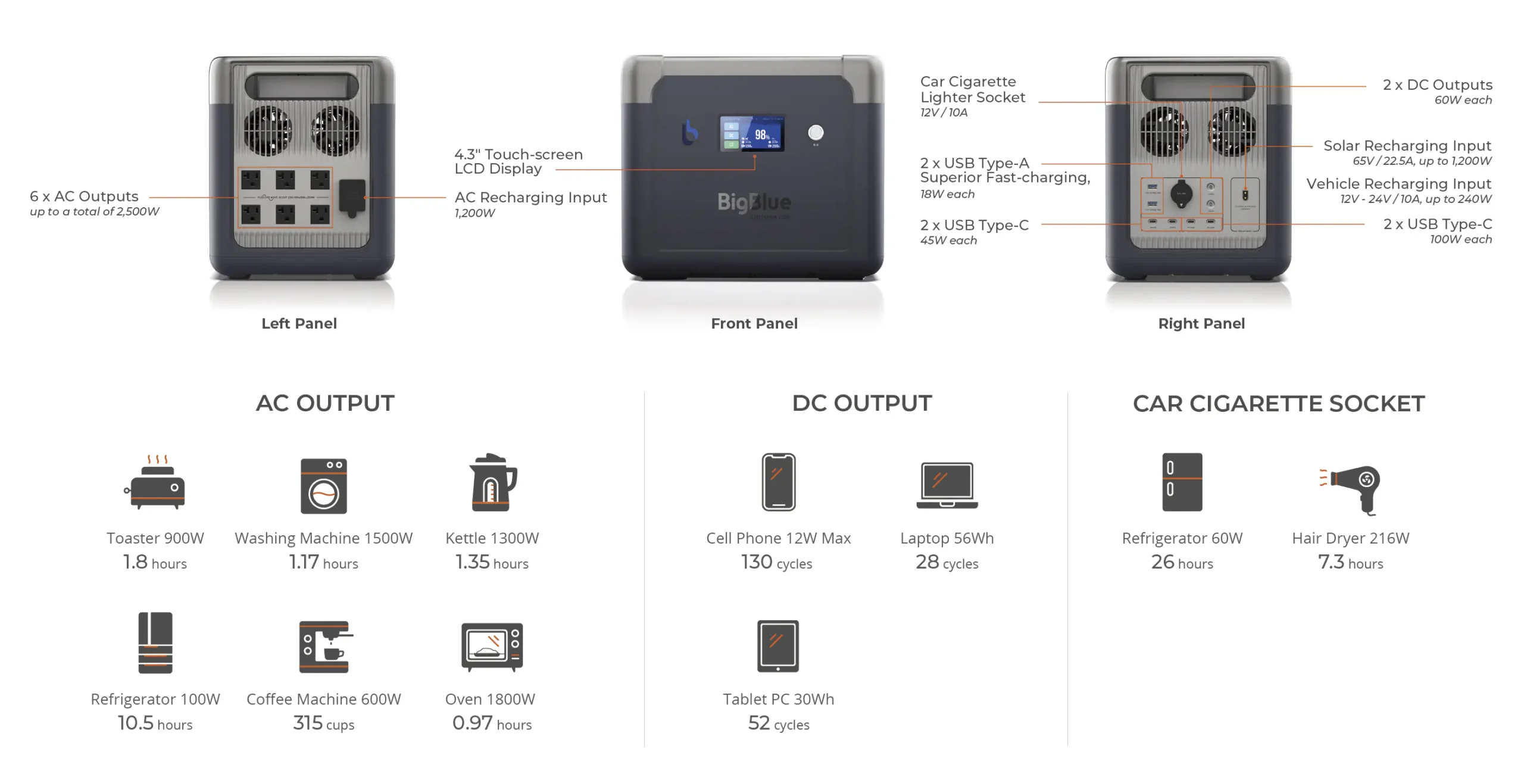
Out of the box, setup is straightforward. The front panel is clearly labeled — AC outputs, USB ports, DC port, display, and control buttons are all logically arranged. The display shows battery percentage, wattage in/out, and estimated run time simultaneously.
The Bluetooth app pairs quickly and adds live power monitoring. You can adjust charge limits (useful for battery health if you want to stay under 90% for daily use) and set input priorities. It’s not the most feature-rich app on the market, but it covers everything you actually need.
Wheel handles and a built-in carrying handle make repositioning easier given the 57-lb weight. It’s not a one-person lift for everyone, but it’s manageable for most adults.
Verdict
The BigBlue CellPowa 2500 is one of the most capable portable power stations at this output level. The combination of a 2,611Wh LFP battery, 2,500W pure sine wave inverter, 1,500W solar input, and 3,000W wall charging is genuinely hard to beat at this price point.
It’s not light. It’s not the right choice if you need something compact. But if you need serious, reliable, long-lasting power — for home backup, extended camping, van life, or job site use — this unit delivers without the compromises that define cheaper options.
The 3,500-cycle battery life is the clincher. This isn’t a power station you’ll replace in two years. It’s a 10-year tool.
Check price and pick up the BigBlue CellPowa 2500 on BigBlue’s official site.
Frequently Asked Questions
How long does the BigBlue CellPowa 2500 take to charge from a wall outlet?
Using the full 3,000W AC input, the CellPowa 2500 charges from 0% to 80% in approximately 90 minutes and reaches 100% in around 1.5–2 hours depending on conditions.
How many solar panels do I need to fully charge the CellPowa 2500?
The unit accepts up to 1,500W of solar input. Four 400W panels wired in the right configuration will push close to that ceiling. Two panels gives you roughly 700–800W of real-world input — enough for a full charge in 3.5–4 hours of peak sun.
Is the BigBlue CellPowa 2500 safe to use indoors?
Yes. Unlike gas generators, the CellPowa 2500 produces zero emissions. It’s safe to use indoors for home backup, in a garage, RV, van, or tent environment.
Can the CellPowa 2500 run a window air conditioner?
Yes. A standard 5,000–8,000 BTU window AC unit typically draws 450–700W. The CellPowa 2500 will run one for 3.5–5+ hours on a full charge, depending on the AC unit’s efficiency.
Does the CellPowa 2500 work as a UPS?
Yes. It has a built-in UPS mode with under 20ms switchover time — fast enough to protect most computers, NAS devices, and sensitive electronics from power interruptions.
What is the warranty on the BigBlue CellPowa 2500?
BigBlue offers a standard warranty on the CellPowa 2500. Check the current warranty terms directly on the Check price page, as terms may be updated.
How heavy is the CellPowa 2500?
It weighs approximately 57 lbs (26 kg). It has wheel handles and a carrying handle for repositioning, but it is not a unit designed for frequent one-person carries over long distances.
Can I expand the capacity with additional batteries?
No. The CellPowa 2500 does not currently support external battery expansion. The 2,611Wh capacity is fixed. If expandability is critical to your use case, factor that into your decision.