This post contains affiliate links. As an Amazon Associate I earn from qualifying purchases, at no extra cost to you.
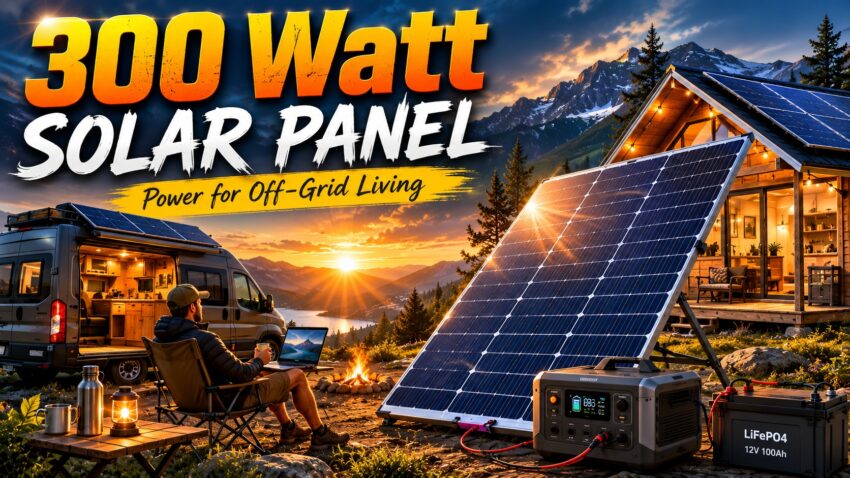
A 300 watt solar panel sits in an interesting spot in the market. It’s too large for basic trickle charging, too small for a whole-home system on its own — but for off-grid cabins, RV rooftops, van builds, and serious battery-based setups, it’s often the ideal single-panel solution. One 300W panel in good sunlight generates enough daily energy to run a 12V refrigerator around the clock, keep a laptop charged, power lights, and top off a 100Ah battery in a few hours.
This guide covers what a 300W panel actually produces in real conditions, what you can and can’t run with it, how to size your charge controller and battery, and which panels are worth buying on Amazon right now.
What Does a 300 Watt Solar Panel Actually Produce?
The 300W rating is measured under Standard Test Conditions — 1,000 W/m² irradiance, 25°C panel temperature, and ideal spectrum. Real-world output is always lower. A few factors explain why:
- Peak sun hours: Most US locations average 4–6 peak sun hours per day. That means a 300W panel produces roughly 1,200–1,800Wh (1.2–1.8 kWh) daily under good conditions.
- System losses: Wiring resistance, charge controller inefficiency, and battery acceptance losses typically reduce usable output by 15–20%. Plan on 1,000–1,500Wh delivered to your battery per day.
- Temperature: Panel output drops by roughly 0.35–0.45% for every degree Celsius above 25°C. A hot summer roof installation loses real watts — another reason N-Type panels with lower temperature coefficients are worth the premium.
The practical takeaway: budget for 1.0–1.4 kWh of usable energy per day from a single 300W panel in most US locations. If you’re in the Southwest, that ceiling rises. If you’re in the Pacific Northwest or running through cloudy winters, it drops.
What Can a 300W Solar Panel Power?
Here’s an honest breakdown by use case, based on average daily energy budget of 1.2 kWh:
What it handles comfortably
- 12V compressor fridge running 24 hours (draws ~40–50Ah/day from a 12V battery, or ~480–600Wh)
- LED lighting for a cabin or van interior (5–15Wh/hour)
- Phone, tablet, and laptop charging (60–100Wh per full charge cycle)
- 12V fans and ventilation
- CPAP machine without heated humidifier (~30–60Wh/night)
- Small water pump for off-grid sink systems
What it handles with careful use
- Starlink in RV/portable mode (~65–75Wh/hour — your biggest daily draw)
- Portable power station recharging (a 1,000Wh station refills in roughly 4–6 hours of strong sun)
- Electric blanket on low (30–50W)
What requires multiple panels
- Electric cooktop or induction burner (1,200–1,800W — far beyond a single panel’s instantaneous output)
- Air conditioning (even small 5,000 BTU window units pull 400–550W continuously)
- Water heater or electric kettle
- Full home backup power
A 300W panel is a capable off-grid workhorse for mobile and cabin applications. It’s not a home power solution on its own, but paired with a second panel and adequate battery storage, it covers nearly every essential load for full-time RV or van life.
Choosing the Right 300W Panel: Technology Explained
Monocrystalline vs Bifacial
Standard monocrystalline panels capture sunlight from one side only. Bifacial panels have a transparent backsheet and collect light from both sides — reflected sunlight from a white roof, gravel, or light-colored ground surface adds 10–25% more output in the right conditions. BougeRV claims up to 30% gain from bifacial gain on their 300W panels, though real-world gain depends heavily on what’s underneath the panel. For rooftop installs on white or aluminum RV roofs, bifacial is a genuine advantage. For ground mounts on dark soil, the rear-side gain shrinks significantly.
P-Type vs N-Type Cells
P-Type cells have been the industry standard for decades — reliable, well-proven, and slightly less expensive. N-Type cells (including TopCon technology) are the current performance leader: higher efficiency (25% vs ~22–23%), lower temperature coefficient (meaning less power loss on hot days), greater resistance to light-induced degradation, and a longer rated lifespan of 30 years vs 25 years for P-Type. If you’re buying a panel that will sit on an RV roof for the next decade, the efficiency gap and durability advantage of N-Type justify the modest premium.
Rigid vs Portable Suitcase
Rigid panels are the right choice for permanent roof installations — lower profile, higher wind resistance, and typically a lower price per watt. Portable suitcase panels fold down for storage and deploy with integrated kickstands, making them ideal for camping trips, power station charging, and situations where you want solar power without drilling into a roof. For a van build or RV where you move between campsites, a suitcase panel you can angle toward the sun often outperforms a fixed roof panel that’s stuck at whatever angle the vehicle happens to be parked.
What Size Charge Controller Do You Need?
For a 12V system with a single 300W panel, you need at minimum a 30A MPPT charge controller. Here’s the math:
300W ÷ 12V = 25A. MPPT controllers are sized with a 25% safety margin, so a 30A controller is the minimum — a 40A controller gives you room to add a second panel later without upgrading the controller.
Always use an MPPT controller (not PWM) with a 300W panel. PWM controllers waste 20–30% of the panel’s potential output, especially on cold mornings when Voc is highest. See our MPPT charge controller guide for a full breakdown of sizing and selection.
Battery Sizing for a 300W Panel
A 300W panel producing 1,200Wh per day needs adequate battery storage to absorb and store that energy. General rules:
- Lithium (LiFePO4) batteries: A 100Ah 12V lithium battery stores ~1,200Wh usable (100% depth of discharge is safe). One 100Ah lithium battery pairs well with a single 300W panel for same-day use. Add a second 100Ah battery if you’re in a cloudy climate or want overnight buffer.
- AGM/lead-acid batteries: Only 50% of rated capacity is safely usable. A 200Ah AGM battery stores ~1,200Wh usable — the equivalent of one 100Ah lithium. Lead-acid works but is heavier and less efficient.
For most 300W setups, a single 100Ah LiFePO4 battery is the practical starting point. Our solar battery guide covers LiFePO4 sizing in detail.
Best 300 Watt Solar Panels on Amazon
Best Portable: Renogy 300W Portable Suitcase N-Type
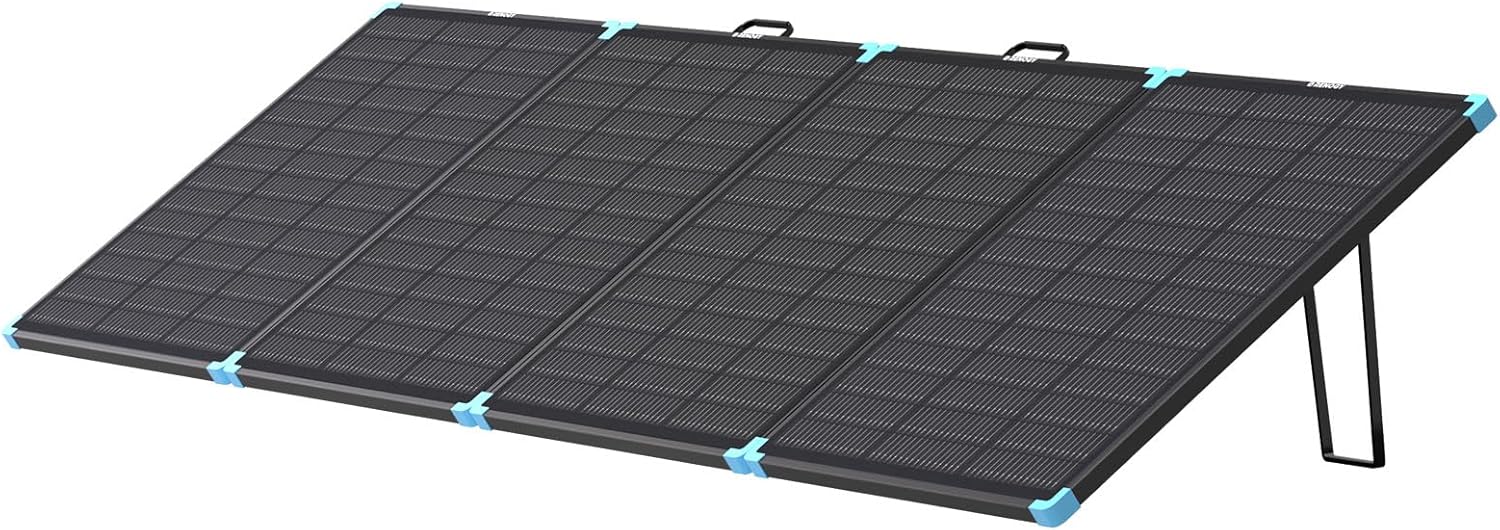
The Renogy 300W suitcase panel is the most capable portable solar panel at this wattage. Built on N-Type 16BB cell technology, it hits 25% conversion efficiency — about 2.5 percentage points above typical P-Type competitors at 300W. At just 18.74 lbs, it’s 17% lighter than standard 300W suitcase panels, which matters when you’re carrying it from a vehicle to a campsite. IP67 waterproof rating, hail-resistant ETFE coating, and integrated adjustable kickstands round out a package that’s genuinely ready for field use.
The parallel wiring on the folding panels means partial shade from a tree or building doesn’t collapse the whole panel’s output the way series wiring would. For charging an EcoFlow, Jackery, or Anker power station at camp, this is the cleanest option at 300W.
Best Rigid for Fixed Installs: BougeRV Bifacial 300W 12BB All-Black
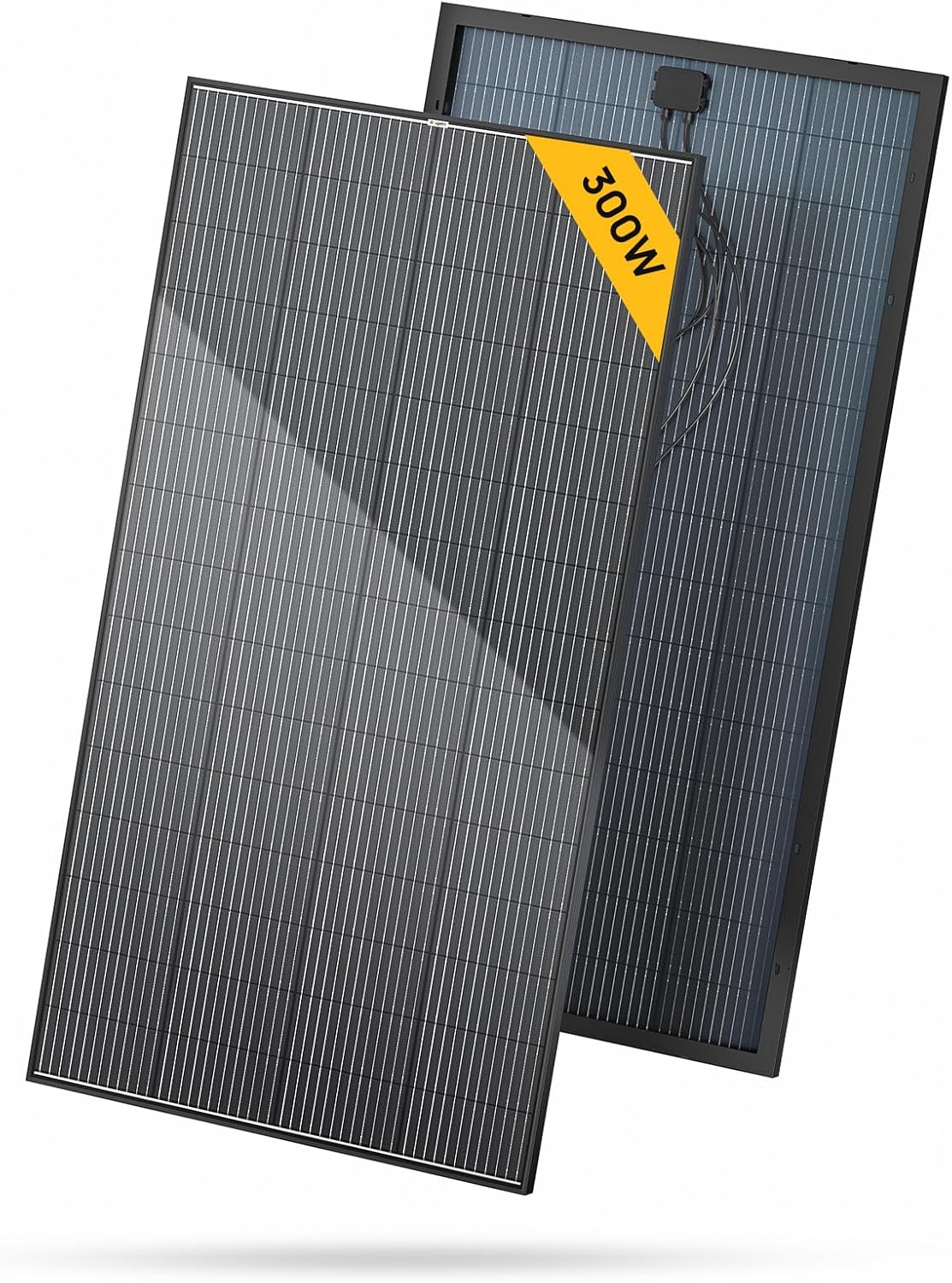
For RV rooftops, cabin ground mounts, or any permanent installation, the BougeRV Bifacial 300W is the pick. The transparent backsheet captures reflected and diffuse light from below, adding measurable output on white RV roofs or gravel ground mounts. At 23% efficiency with 12BB cell design, it outperforms standard 9BB panels on partially overcast days. The all-black aesthetic suits rooftop installs where looks matter, and the IP68-rated junction box handles genuine outdoor exposure.
At 35.3 lbs, it’s about 11% more compact than three separate 100W panels covering the same wattage — fewer mounting points, fewer connections, less complexity. Compatible with 12V, 24V, and 48V systems via series wiring.
Best Budget Rigid: BougeRV 300W 10BB Mono
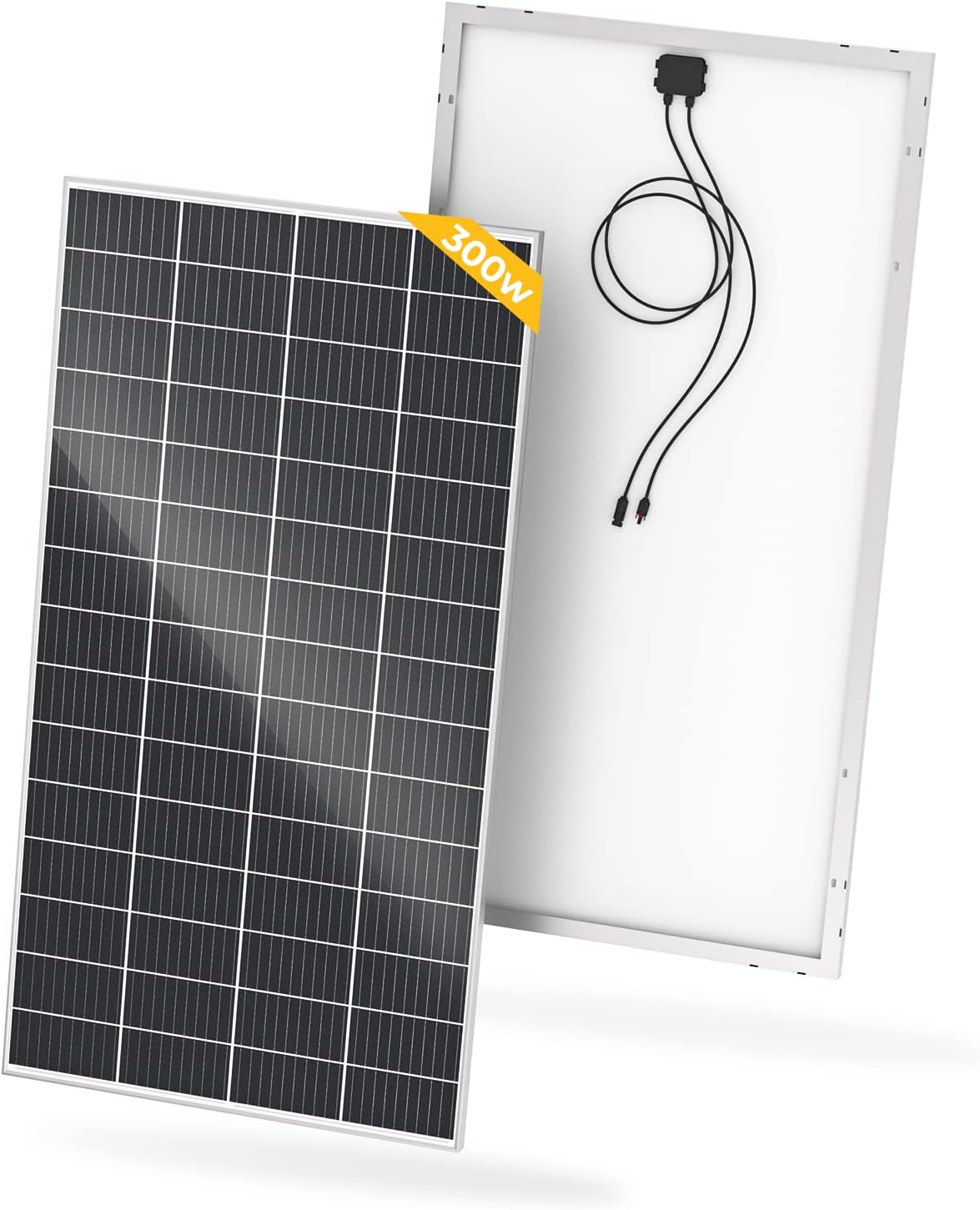
If you want a solid rigid 300W panel at the lowest realistic price point, BougeRV’s 10BB monofacial panel delivers. Still 23% efficiency with Class A cells (EL-tested, no microcracks), IP68 junction box, and the same 10-year product / 25-year power warranty as the bifacial version — just without the transparent backsheet. For installs on dark-colored roofs where bifacial rear gain is minimal anyway, this is the smarter value choice.
Best for Modular RV Builds: RICH SOLAR 300W (2×150W N-Type)
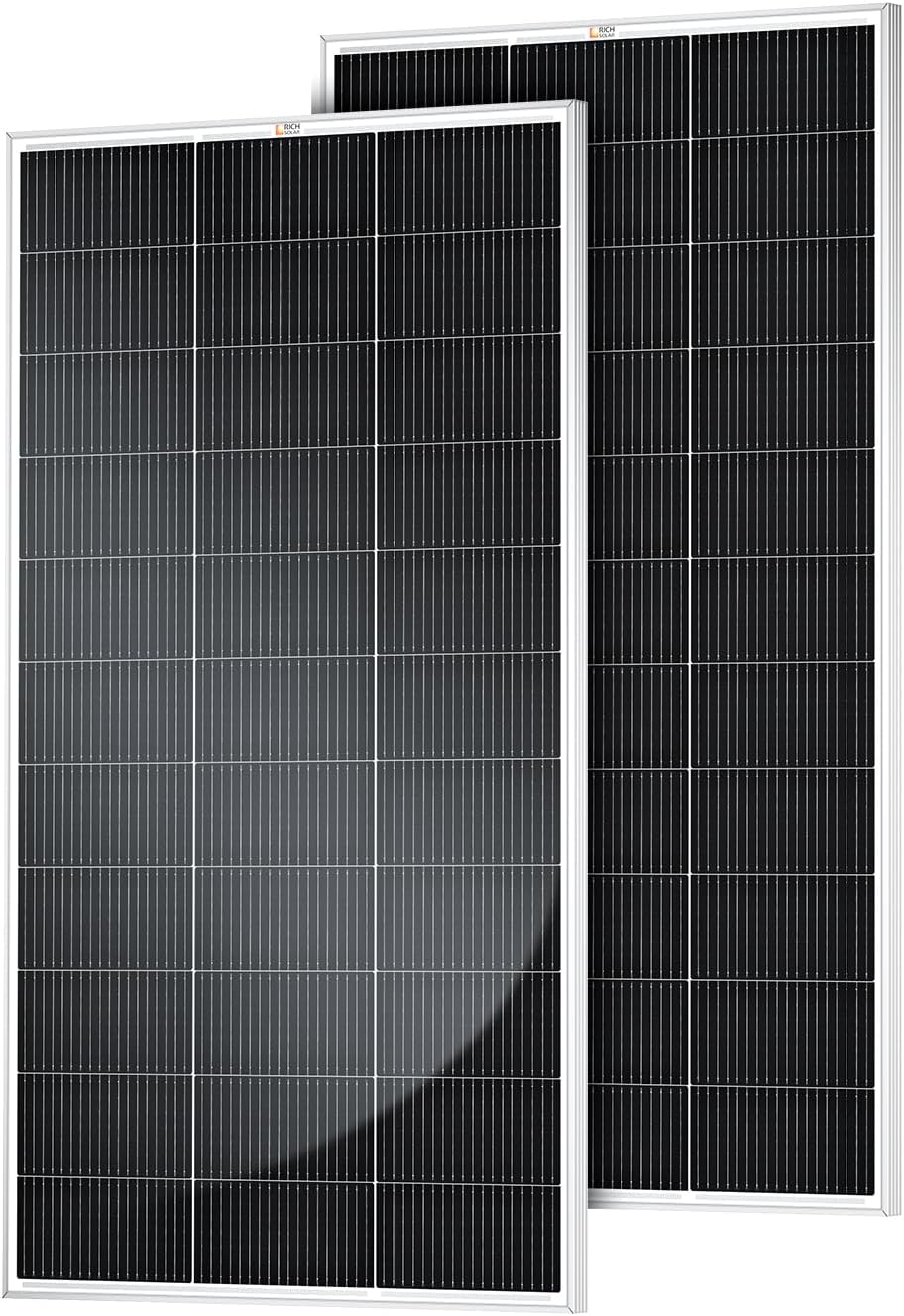
RICH SOLAR’s approach here is smart: instead of a single 300W rigid panel, this is two 150W N-Type 18BB panels sold together. That gives you more installation flexibility on an RV roof — you can fit two narrower panels around vents, AC units, and antennas where a single wide 300W panel won’t go. N-Type cells with 18BB design push efficiency into the high range, and the 12V compatibility makes them straightforward to wire for most RV battery systems.
How Many 300W Panels Do You Need?
A quick reference by use case:
- Weekend camping / power station charging: 1 panel is plenty
- Full-time van life basics (fridge, lighting, devices): 1 panel works, 2 gives comfortable headroom
- RV full hookup replacement (fridge, devices, fans, some cooking): 2–3 panels + 200Ah+ lithium storage
- Off-grid cabin (full daily living without high-draw appliances): 4–6 panels + substantial battery bank
- Home backup power: 300W panels aren’t the right format — residential systems use 400W+ panels in large arrays
Frequently Asked Questions
How much power does a 300W solar panel produce per day?
In real-world conditions with 4–5 peak sun hours, a 300W panel produces roughly 1,000–1,500Wh (1–1.5 kWh) of usable energy per day after accounting for system losses. Output varies significantly by location, season, and panel angle.
Will a 300W solar panel charge a 12V battery?
Yes — a 300W panel is well-matched to charging 12V battery systems. Pair it with a 30A or 40A MPPT charge controller for maximum efficiency. A single 100Ah LiFePO4 battery can be fully charged from 50% in roughly 2–3 hours of good sun.
Is a 300W panel enough for an RV?
For part-time RV use covering a fridge, lighting, and device charging, one 300W panel is workable. For full-time living or extended boondocking without hookups, two 300W panels paired with 200Ah of lithium storage is a more comfortable baseline.
What’s the difference between 300W and 400W solar panels?
A 400W panel produces roughly 33% more energy per day from the same footprint — the main difference is physical size and daily output ceiling. If your roof space allows it, a 400W panel is a better value per watt for fixed installations. See our 400 watt solar panel guide for a direct comparison.
Can I connect two 300W panels together?
Yes. Two 300W panels wired in series doubles the voltage (useful for 24V systems or longer wire runs). Wired in parallel, it doubles the current while keeping 12V. Your charge controller must be rated for the combined wattage — 600W on a 12V system means upgrading to a 60A MPPT controller. Our off-grid solar system guide covers array wiring in detail.
The Bottom Line
A 300W solar panel is the sweet spot for serious off-grid use without the complexity of a multi-panel array. It produces enough daily energy to run a compressor fridge, charge devices, and power lighting — the core load for van life, RV boondocking, or a simple off-grid cabin.
For portable use, the Renogy 300W N-Type Suitcase is the clear winner — 25% efficiency, genuinely light at 18.74 lbs, and IP67 rated for field conditions. For a permanent RV or cabin roof install, the BougeRV Bifacial 300W offers real bifacial output gains on reflective surfaces at a competitive price. If you’re building a modular RV system around vent and AC unit placement, the RICH SOLAR 2×150W gives you layout flexibility a single wide panel doesn’t.
For the next step up, see our 400 watt solar panel guide. To step down, our 200 watt solar panel guide covers the lighter-duty options. And for complete system design around any 300W setup — battery sizing, charge controller selection, inverter matching, and wiring — our off-grid solar system guide has everything you need.