
This post contains affiliate links. If you buy through our links we may earn a small commission — at no extra cost to you. This never influences our recommendations.
Jackery’s lineup has grown large enough that picking the right model has become its own research project — and it’s gotten more confusing recently, not less, since the Explorer 300 Plus has been discontinued and folded back into a single “Explorer 300” offering. This guide maps the current lineup clearly, explains the one distinction that matters most (battery chemistry), and tells you exactly which Jackery to buy for your situation.
The One Spec That Matters Most: LFP vs NMC Battery Chemistry
Jackery’s biggest lineup shift in recent years has been the move from NMC (nickel manganese cobalt) lithium-ion to LiFePO4 (LFP) battery chemistry. This single distinction affects lifespan more than any other spec on the page.
NMC batteries are rated for roughly 500–800 charge cycles before capacity drops to 80%. At daily use, that’s under 2 years before meaningful degradation.
LFP batteries — used across the “v2” and “Plus” generations, including the 1000 v2 and 2000 Plus — are rated for 4,000+ cycles to 70–80% capacity. At daily use, that’s over a decade.
A genuine complication worth flagging directly: the current Explorer 300 (which replaced the discontinued Explorer 300 Plus) has inconsistent battery chemistry across different Amazon listings — some state lithium-ion, others state LiFePO4, at the same 293Wh capacity. Always check the specific listing’s stated chemistry before buying if long-term cycle life matters to you, rather than assuming “Explorer 300” means one fixed thing.
The Current Jackery Lineup at a Glance
| Model | Capacity | Battery | Output | AC Charge | Best For |
|---|---|---|---|---|---|
| Explorer 300 | 293Wh | Varies by listing — confirm before buying | 300W / 500W surge | ~2-3 hrs | Tightest budget, lightest weight |
| Explorer 500 v2 | 512Wh | LFP (6,000 cycles) | 500W / 1,000W surge | 52 min | Multi-day trips, CPAP, small fridge |
| Explorer 1000 v2 | 1,070Wh | LFP (4,000 cycles) | 1,500W / 3,000W surge | ~1–1.7 hrs | Best overall — most buyers |
| Explorer 2000 Plus | 2,042Wh | LFP (4,000+ cycles) | 3,000W / 6,000W surge | ~2 hrs | Home backup, RV, expandable to 24kWh |
Best Jackery Models — Verified Picks
Best Budget Entry: Jackery Explorer 300

This spot in the lineup was previously filled by the Explorer 300 Plus, which Jackery has since discontinued. The current Explorer 300 (293Wh) takes its place as the lightest and most affordable unit in the lineup at 7.1 lbs — genuinely easy to carry for hiking, day trips, or anyone prioritizing minimal weight over capacity. It comfortably handles phone and laptop charging, LED lighting, and light device use across a weekend, though a fridge or CPAP will draw it down within a single night.
One important thing to check before buying: current listings for this model aren’t fully consistent on battery chemistry — some state lithium-ion, others state LiFePO4, at the same capacity. If long-term cycle life matters to you, confirm the specific chemistry on the listing you’re viewing rather than assuming. For the full breakdown, see our Jackery Explorer 300 review.
Best for: Occasional campers, tightest budget, buyers who prioritize minimal weight above all else
Best for Multi-Day Trips: Jackery Explorer 500 v2

At 512Wh with a 500W continuous output (1,000W surge), the Explorer 500 v2 is nearly double the capacity of the Explorer 300 — enough for a multi-day trip running a 12V fridge, CPAP, laptop, and lighting simultaneously. The standout spec is charging speed: 52 minutes to 80% via AC, dramatically faster than the Explorer 300’s roughly 2-3 hour charge time. LFP chemistry rated for 6,000 cycles is the highest cycle rating in Jackery’s current portable lineup, with no ambiguity about chemistry the way the Explorer 300 has. For a full breakdown, see our Jackery 500 review.
Best for: Multi-day camping, CPAP users wanting 2–3 nights of coverage, buyers who value the fastest charge speed at this capacity
Best Overall: Jackery Explorer 1000 v2
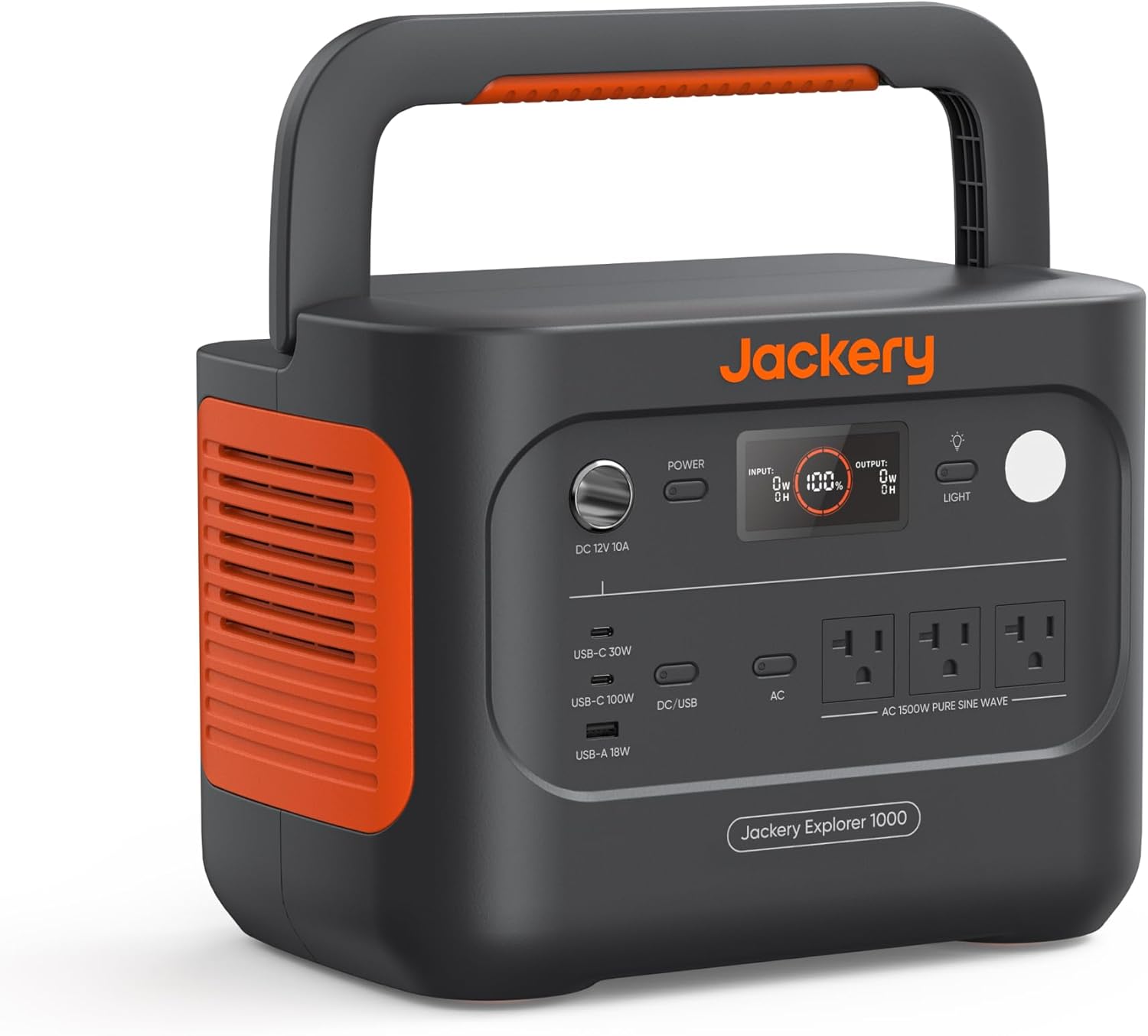
The Explorer 1000 v2 is Jackery’s best-selling model, and independent field testing consistently ranks it as the best all-around pick in the lineup. At 1,070Wh with 1,500W continuous output (3,000W surge), it handles 80% of common camping and emergency backup scenarios — a 12V or standard fridge, CPAP, coffee maker, laptop charging, and lighting, all simultaneously. The 4,000-cycle LFP battery and roughly 1-hour emergency AC charge mode (1.7 hours standard) close most of the charging-speed gap that used to separate Jackery from EcoFlow and Anker. At 23.8 lbs, it’s also the easiest unit in this capacity class to actually carry. For the full spec breakdown, see our Jackery Explorer 1000 v2 review.
Best for: Most buyers — camping, RV use, home office backup, CPAP, and general emergency preparedness
Best for Home Backup and Expandability: Jackery Explorer 2000 Plus
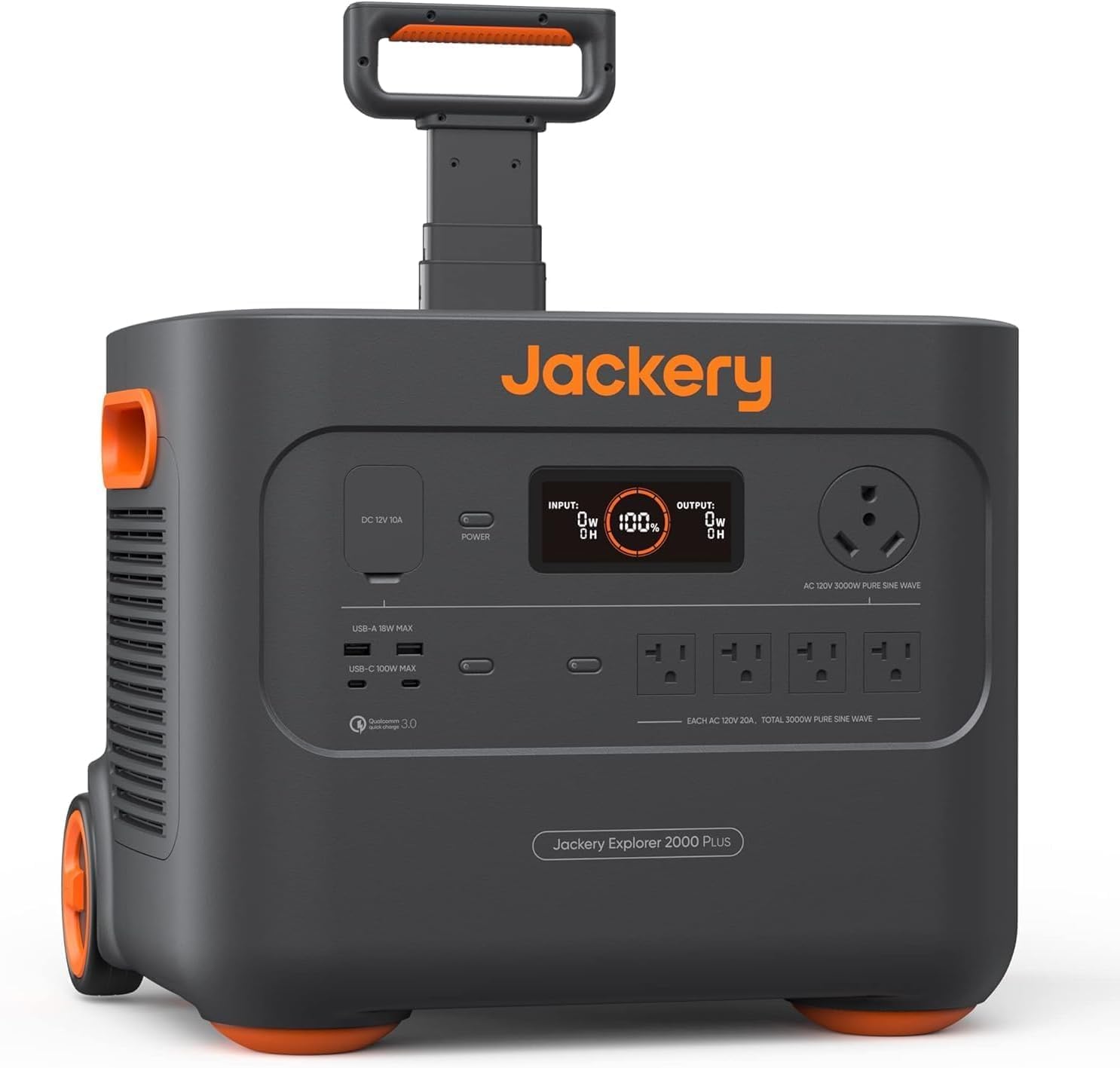
Stepping up to 2,042Wh with 3,000W continuous output (6,000W surge), the Explorer 2000 Plus is the pick for anyone who needs to cover a refrigerator, sump pump, or multiple appliances simultaneously through a longer outage. Its defining feature is expandability — add up to 5 additional battery packs to reach a 24kWh total system, transforming it from a portable unit into genuine whole-home backup infrastructure as your needs grow. LFP chemistry rated for 4,000+ cycles matches the reliability of the 1000 v2 at a much higher capacity ceiling. For sizing this unit against RV and off-grid use specifically, see our solar generator for RV guide.
Best for: Home backup for 2–3 day outages, RV and van life with heavier daily loads, buyers planning to expand capacity over time
Beyond the Explorer Line: HomePower and Higher-Capacity Models

For whole-home backup needs beyond what the Explorer 2000 Plus covers, Jackery’s HomePower line (starting with the HomePower 3000 at roughly 3,072Wh and 3,600W output) and the higher-capacity Explorer 3000 Pro and 5000 Plus target serious home integration — sump pumps, central AC circuits, and multi-day whole-house coverage. These are fundamentally different products from the portable Explorer line: heavier, often wheeled rather than carried, and priced accordingly. If your needs have grown past what the 2000 Plus’s 24kWh expansion ceiling covers, these are the next tier to research.
How to Choose the Right Jackery for Your Situation
| Your Situation | Recommended Model |
|---|---|
| Occasional camping, tightest budget, lightest weight | Explorer 300 |
| Multi-day trips, CPAP, fastest charge at mid-capacity | Explorer 500 v2 |
| One unit to cover most situations | Explorer 1000 v2 |
| Home backup, RV, room to expand later | Explorer 2000 Plus |
| Whole-home backup, central AC, sump pump | HomePower 3000 or higher |
Jackery vs Anker vs EcoFlow — How the Brands Compare
Charging speed: Jackery’s emergency charge mode (as fast as 1 hour on the 1000 v2, 52 minutes on the 500 v2) has closed most of the gap with Anker and EcoFlow, though Anker’s SOLIX C1000 Gen 2 still edges out the 1000 v2 slightly at 49 minutes standard.
Build quality and thermal management: Independent testing consistently notes Jackery units run cooler under sustained load with less frequent fan cycling than comparable EcoFlow and Anker units — a real-world advantage that doesn’t show up on a spec sheet.
Warranty and support: Jackery’s standard 3-year warranty extends to 5 years with product registration, and its retail presence at Costco, Home Depot, and Best Buy (in addition to Amazon) makes in-person purchases and returns simpler than brands sold primarily online.
Expandability: Jackery’s Explorer 2000 Plus expansion ceiling (24kWh) is competitive with Anker’s SOLIX F3800 and EcoFlow’s DELTA Pro 3, though EcoFlow’s Pro 3 pushes further at 48kWh.
For the full breakdown of the other two brands, see our Anker solar generator guide and best EcoFlow solar generator guide.
Frequently Asked Questions
What is the best Jackery solar generator overall?
For most buyers, the Explorer 1000 v2 offers the strongest all-around combination of capacity, output, charging speed, and portability. It’s Jackery’s best-selling model for good reason — it covers the majority of camping, RV, and home backup essentials in one unit.
What happened to the Jackery Explorer 300 Plus?
It’s been discontinued by Jackery. The current Explorer 300 takes its place as the budget entry point in the lineup, at 293Wh. Note that current listings for the Explorer 300 aren’t fully consistent on battery chemistry — check the specific listing before buying if long-term cycle life matters to you.
Which Jackery models use LFP vs NMC batteries?
The Explorer 500 v2, 1000 v2, 2000 Plus, and the HomePower line all use LFP (LiFePO4) chemistry rated for 4,000–6,000+ cycles. The current Explorer 300 has inconsistent chemistry across listings — always confirm the specific product’s stated battery type before buying.
Is the Jackery Explorer 2000 Plus worth it over the Explorer 1000 v2?
Only if you need the extra capacity or expandability. The 2000 Plus roughly doubles the 1000 v2’s capacity and output, and adds the ability to expand to 24kWh with battery packs — meaningful for whole-home backup or heavier RV/van life loads. For most camping and light home backup situations, the 1000 v2 is the better value and easier to carry at 23.8 lbs vs the 2000 Plus’s heavier build.
Can Jackery power stations run a refrigerator?
Yes — the Explorer 500 v2 and above comfortably run a 12V compressor fridge for extended periods, and the 1000 v2 and 2000 Plus handle standard household refrigerators as well. For detailed runtime math specific to refrigerators, see our solar generator for refrigerator guide.
Final Verdict
| Your Situation | Best Pick |
|---|---|
| Tightest budget, lightest weight | Explorer 300 |
| Multi-day trips, fastest charge at mid-capacity | Explorer 500 v2 |
| Best overall — most buyers | Explorer 1000 v2 |
| Home backup, expandable to 24kWh | Explorer 2000 Plus |
For most people shopping the Jackery lineup, the Explorer 1000 v2 is the easiest recommendation — it’s the brand’s best-selling model, and independent testing consistently confirms it covers the widest range of real-world use cases at a reasonable price. Buyers who know they need more should go straight to the Explorer 2000 Plus for its expandability, while anyone on a tighter budget or buying primarily for occasional trips will get solid value from the Explorer 300 — just confirm the battery chemistry on your specific listing first.
For a broader comparison across brands, see our Anker solar generator guide, best EcoFlow solar generator guide, and portable power station guide for the complete picture across every major brand.