This post contains affiliate links. If you buy through our links we may earn a small commission — at no extra cost to you. This never influences our recommendations.
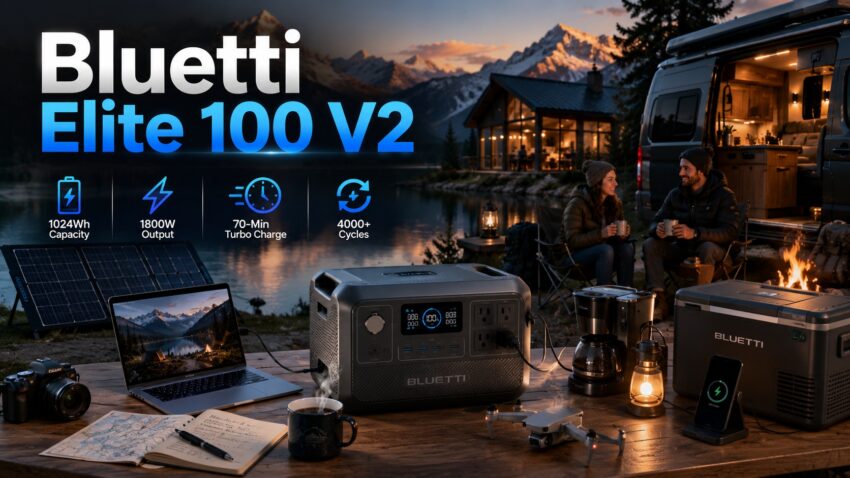
The Elite 100 V2 replaces Bluetti’s aging EB70S, and it’s not a minor refresh — 35% smaller, notably lighter, and independently measured to deliver more of its rated capacity than Bluetti’s own AC180. This review covers the full spec sheet, what multiple independent tests confirm, and a genuine discrepancy in charging speed claims worth understanding before you buy.
Full Specifications
| Spec | Bluetti Elite 100 V2 |
|---|---|
| Capacity | 1,024Wh (51.2V, 20Ah) |
| Battery chemistry | LiFePO4 (LFP) |
| Cycle life | 4,000+ cycles to 80% capacity |
| AC output | 1,800W continuous |
| Power Lifting mode | 2,700W (for resistive loads like kettles, hair dryers) |
| Surge output | 3,600W |
| Full charge time | ~70 minutes via 1200W TurboBoost AC or 1000W solar input |
| Solar input (max) | 1,000W |
| Weight | 25-25.3 lbs |
| Size | 35% smaller than the outgoing EB70S |
| Output ports | 11 total, including 4× AC outlets |
| UPS switchover | 10ms |
| Noise (silent mode) | 30dB — Bluetti states roughly 50% quieter than other 1kWh-class stations |
| Solar panel included | No on the base unit — sold as bundles with 100W or 200W panels separately |
| 240V output | Not available at this capacity tier |
| Expandability | Limited — connects to a B80 battery pack only in Power Bank Mode, at a reduced 448W charging rate |
Real-World Efficiency — Independently Measured
This is a genuinely strong data point. One established, professional testing lab measured actual delivered energy at 890Wh out of the advertised 1,024Wh rating during discharge testing — approximately 87% real-world efficiency. This is a meaningful improvement over the roughly 82% efficiency independently measured on Bluetti’s own AC180 (covered in our Bluetti AC180 review), suggesting genuine engineering improvement in the newer Elite series rather than just a smaller, lighter shell around the same internals.
Portability and Thermal Performance
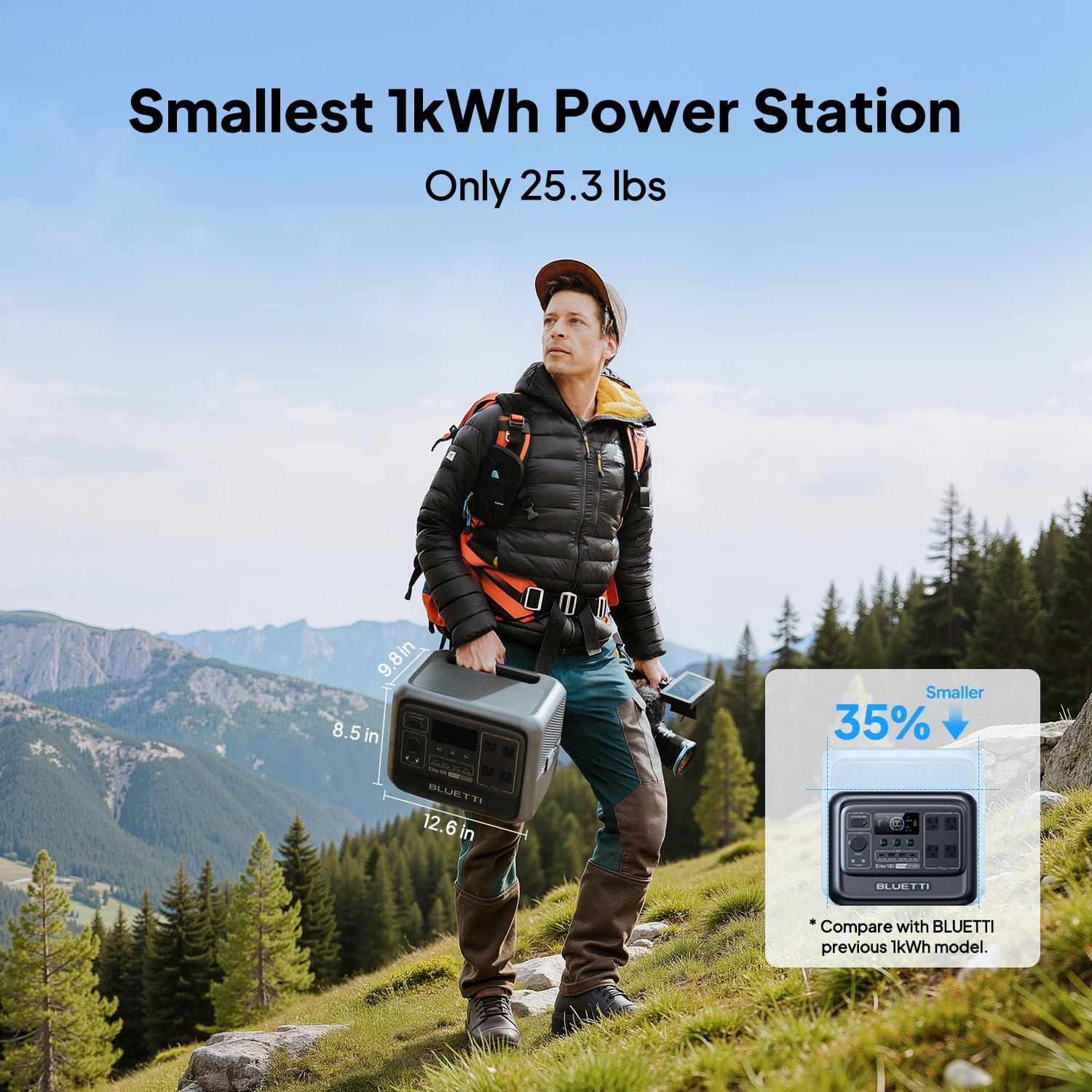
At 25-25.3 lbs and 35% smaller than the outgoing EB70S, the Elite 100 V2 is consistently praised across independent reviews for genuine one-handed portability — a real differentiator in a capacity class where many competitors are noticeably bulkier. One extended field test specifically measured thermal performance under a 1,500W sustained load using infrared imaging, finding the compact Elite 100 V2 actually ran cooler at the surface than larger competitors under the same load — a counterintuitive result that challenges the common assumption that more internal volume automatically means better heat dissipation.
Output — What 1,800W (and Power Lifting Mode) Actually Handles
Real-world testing across multiple independent reviewers confirmed the Elite 100 V2 comfortably runs high-wattage kitchen appliances like toaster ovens and coffee makers without issue, and Bluetti states it covers roughly 90% of everyday household appliances at its native 1,800W rating. Power Lifting mode extends this to 2,700W specifically for resistive heating loads — hair dryers, electric kettles — by adjusting voltage delivery, the same approach used across Bluetti’s broader lineup.
The Charging Speed Discrepancy — What’s Actually Going On
This is worth addressing directly rather than picking one claim to repeat. Bluetti’s own product listing and at least two independent reviews confirm a genuinely fast 70-minute full charge — but this figure specifically applies to 1200W TurboBoost AC charging or a full 1000W solar input, not standard charging methods. A separate, well-established testing lab specifically flagged “slow recharge” as a notable drawback in its review, without clarifying whether TurboBoost mode was engaged during that specific test.
The practical takeaway: the 70-minute figure is real and achievable, but only when using the TurboBoost AC charging mode or a properly sized 1000W solar array — standard, non-boosted charging methods will take meaningfully longer. If fast recharge is a priority for your use case, confirm you’re using the TurboBoost charging cable and mode specifically, rather than assuming any AC connection delivers the advertised speed.
UPS and Quiet Operation
The 10ms UPS switchover is fast enough to keep a Wi-Fi router or desktop PC running through a power interruption without a noticeable drop, a genuine practical benefit for anyone considering this as light home backup. In silent mode, Bluetti states 30dB operation — roughly 50% quieter than other 1kWh-class stations — making it a reasonable choice for overnight use in a bedroom or shared living space, though independent decibel verification of this specific claim wasn’t found across the sources reviewed for this piece.
What’s Missing — Genuine Limitations
No included solar panel on the base unit — unlike some competitors that bundle a panel by default, the standalone Elite 100 V2 requires purchasing solar panels separately, though Bluetti offers bundled kits with 100W or 200W panels if you’d rather buy them together.
No 240V output — this capacity tier doesn’t offer dual-voltage output at all, ruling it out for RV air conditioning or any appliance requiring 240V. If that’s a requirement, you need a larger unit entirely.
Limited expandability — the Elite 100 V2 can only connect to Bluetti’s B80 battery pack in a specific Power Bank Mode via a special adapter cable, and even then charges at a reduced 448W rate rather than full speed. This is not a true modular expansion system the way some larger Bluetti units offer — if you anticipate needing significantly more capacity later, consider starting with a more expandable model like the Bluetti AC200L instead.
Honest Pros and Cons
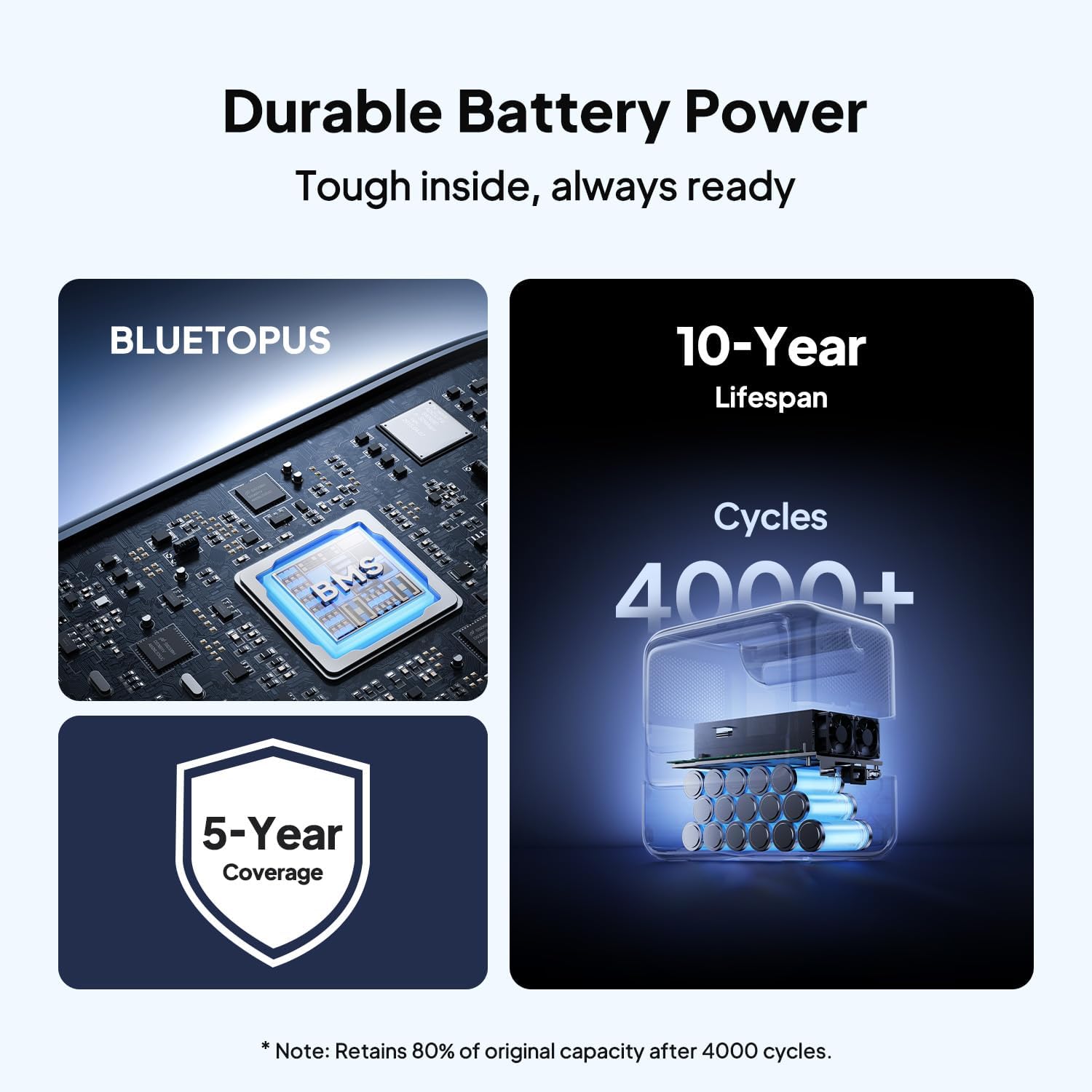
Pros: Independently measured 87% real-world efficiency (best among reviewed Bluetti models), genuinely excellent portability at 25-25.3 lbs, runs cooler than larger competitors under sustained load per infrared testing, fast 70-minute charge via TurboBoost mode, 10ms UPS switchover, 4,000+ cycle LFP battery
Cons: No solar panel included on the base unit, no 240V output, limited and inefficient expansion path via B80 power bank mode only, at least one established reviewer flagged recharge speed as a drawback — confirm you’re using TurboBoost mode specifically for the advertised 70-minute figure
Who Should Buy the Elite 100 V2
Best for:
- Buyers who prioritize genuine one-handed portability above all else in the 1kWh class
- Weekend camping and car camping where high-draw devices (coffee makers, toaster ovens) matter
- Light home office backup — routers, laptops, monitors — with reliable UPS switchover
- Anyone who will consistently use TurboBoost charging and wants the fastest recharge in this capacity tier
Consider alternatives if:
- You need expandable capacity — see the Bluetti AC200L for genuine modular expansion
- You need 240V output — no unit in this capacity class provides it regardless of brand
- You want a solar panel included by default rather than purchased as an add-on bundle
Frequently Asked Questions
How long does the Bluetti Elite 100 V2 actually take to charge?
Bluetti states 70 minutes for a full charge, but this specifically applies to 1200W TurboBoost AC charging or a full 1000W solar input — not standard charging methods, which take meaningfully longer. At least one independent reviewer flagged recharge speed as a drawback, which may reflect testing without TurboBoost mode engaged. Confirm you’re using the correct charging cable and mode for the advertised speed.
Does the Elite 100 V2 deliver its full rated 1,024Wh capacity?
Independent testing measured approximately 890Wh of genuinely usable energy — about 87% real-world efficiency, which is a notable improvement over the roughly 82% measured independently on Bluetti’s AC180 at a similar capacity tier.
Can the Elite 100 V2 be expanded with additional batteries?
Only in a limited way — it connects to Bluetti’s B80 battery pack via a specific adapter cable in Power Bank Mode, charging at a reduced 448W rate rather than full speed. This isn’t a true modular expansion system; if you anticipate needing significantly more capacity, a model like the Bluetti AC200L offers more genuine expandability.
Does the Elite 100 V2 include a solar panel?
Not on the base standalone unit — solar panels are sold separately or as part of specific bundle kits (with 100W or 200W panels) if you’d rather purchase them together with the power station.
Is the Elite 100 V2 good for home backup during outages?
For light backup needs — a router, a laptop, phone charging, some lighting — yes, aided by the fast 10ms UPS switchover. It doesn’t offer 240V output or the expandability needed for whole-home backup covering major appliances; for that, look at larger, more expandable units in Bluetti’s lineup.
The Bottom Line
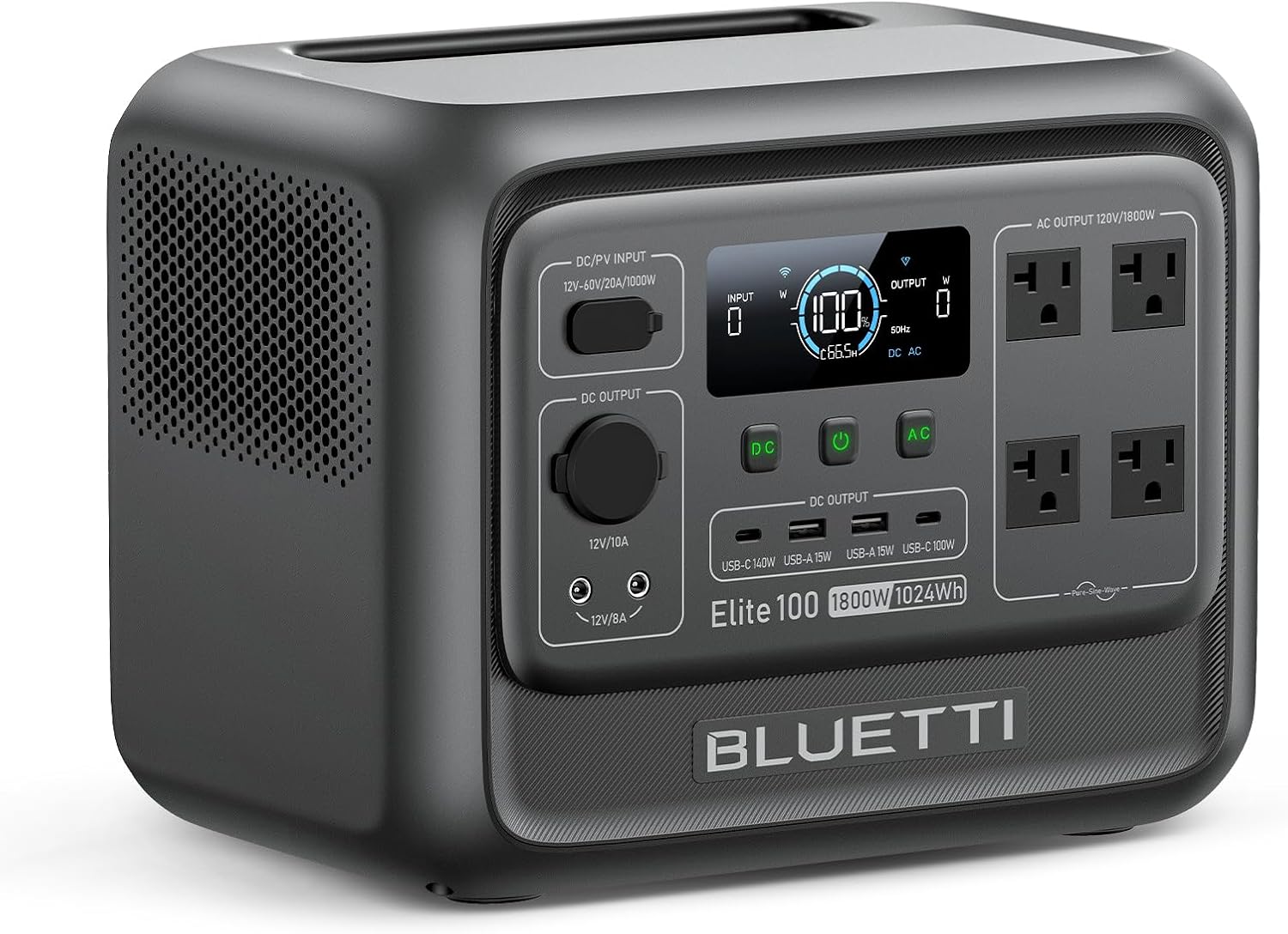
The Elite 100 V2 earns genuine praise across independent testing for its portability-to-power ratio, measured efficiency, and thermal performance — this isn’t just a smaller shell around the same internals as its predecessor, but a real engineering step forward. The charging speed claims require a bit of nuance to understand correctly (TurboBoost mode matters), and the limited expansion path and lack of 240V output are worth knowing if your needs might grow. For most buyers prioritizing a genuinely portable, well-tested 1kWh-class unit, it’s a strong recommendation.
Check the Bluetti Elite 100 V2 on Amazon →
For the full Bluetti lineup, see our best Bluetti solar generator guide. For a direct comparison against the AC180, see our Bluetti AC180 review. For cross-brand comparison at this capacity, see our best 1000W solar generators for the money guide and our Jackery vs Anker vs EcoFlow vs Bluetti comparison.