This post contains affiliate links. If you buy through our links we may earn a small commission — at no extra cost to you. This never influences our recommendations.
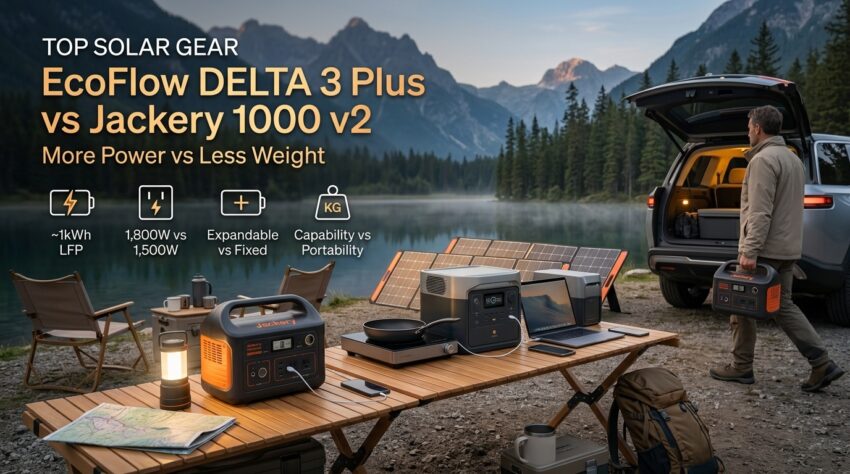
These two land in the same weight class, same price range, and the same best-of lists year after year.
Both pack roughly 1,000Wh of LiFePO4 capacity into a body light enough to toss in an SUV. The details split them in ways that matter on a real trip.
Full Spec Comparison
| Spec | EcoFlow DELTA 3 Plus | Jackery Explorer 1000 v2 |
|---|---|---|
| Capacity | 1,024Wh | 1,070Wh |
| Battery chemistry | LiFePO4 | LiFePO4 |
| Cycle life | 4,000 cycles to 80% capacity | 4,000 cycles to 70% capacity |
| AC output | 1,800W continuous | 1,500W continuous |
| Surge output | 2,200W (X-Boost) | 3,000W |
| AC charge time | ~56-70 minutes | ~1-1.7 hours |
| Solar input (max) | 1,000W (dual MPPT ports) | 800W per Jackery’s own listing |
| Weight | ~14 lbs | 23.8 lbs |
| UPS switchover | Under 10ms | Not specified as a headline feature |
| Expandable | Yes, to ~5,120Wh | No |
A note on the solar figure: at least one independent comparison cites the Jackery’s solar input as low as 400W. Jackery’s own product listing states 800W. We’re using the manufacturer’s own figure, but the discrepancy is worth knowing if solar charging speed is a deciding factor for you.
The Two Units Side by Side
EcoFlow DELTA 3 Plus
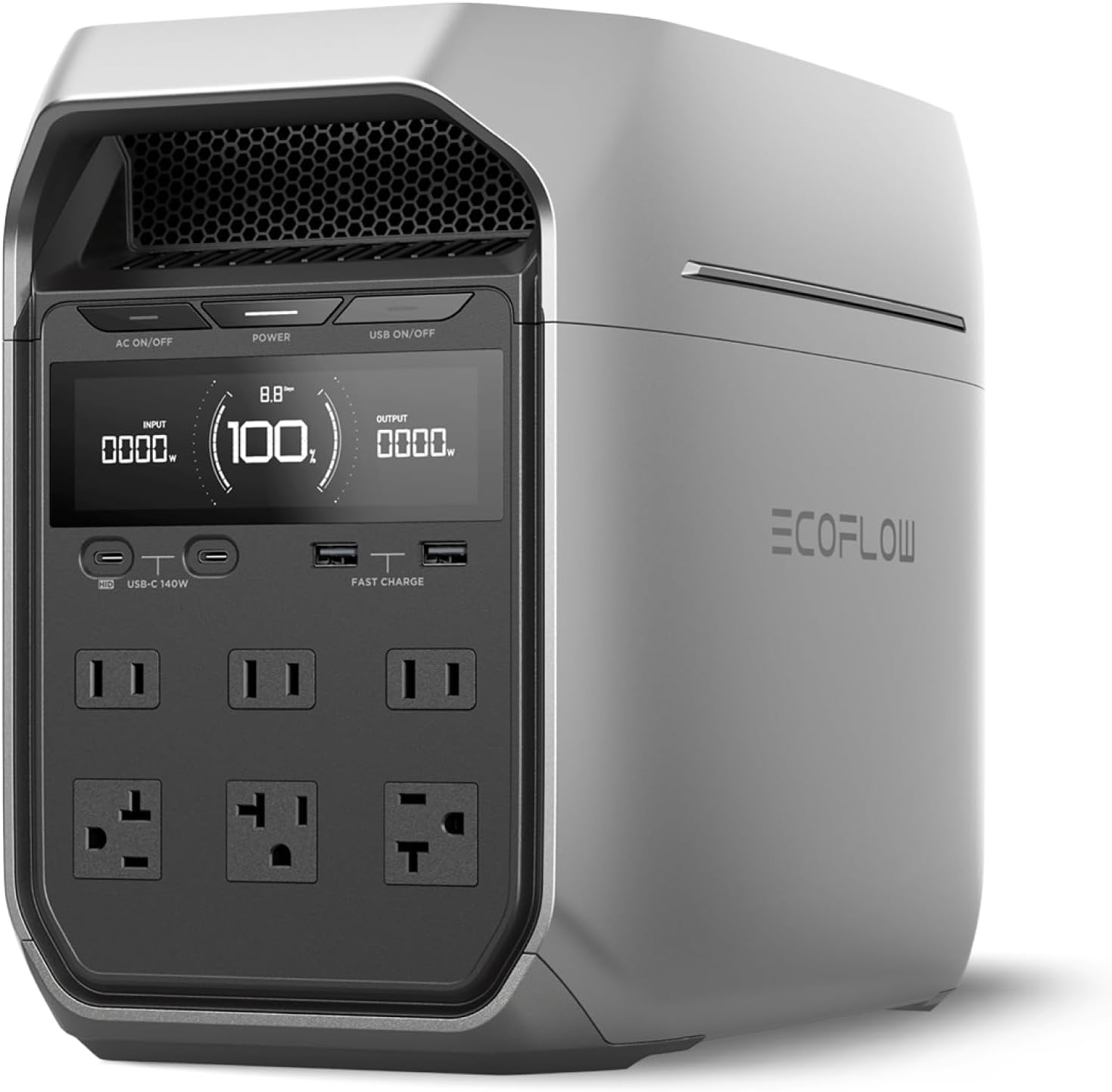
This wins on output and expansion. 1,800W continuous handles appliances the Jackery can’t — some microwaves, larger electric kettles above 1,500W.
It also charges faster from both AC and solar, and it’s the only one of the two that can grow past its base capacity later. For the full breakdown, see our EcoFlow DELTA 3 Plus review.
Jackery Explorer 1000 v2
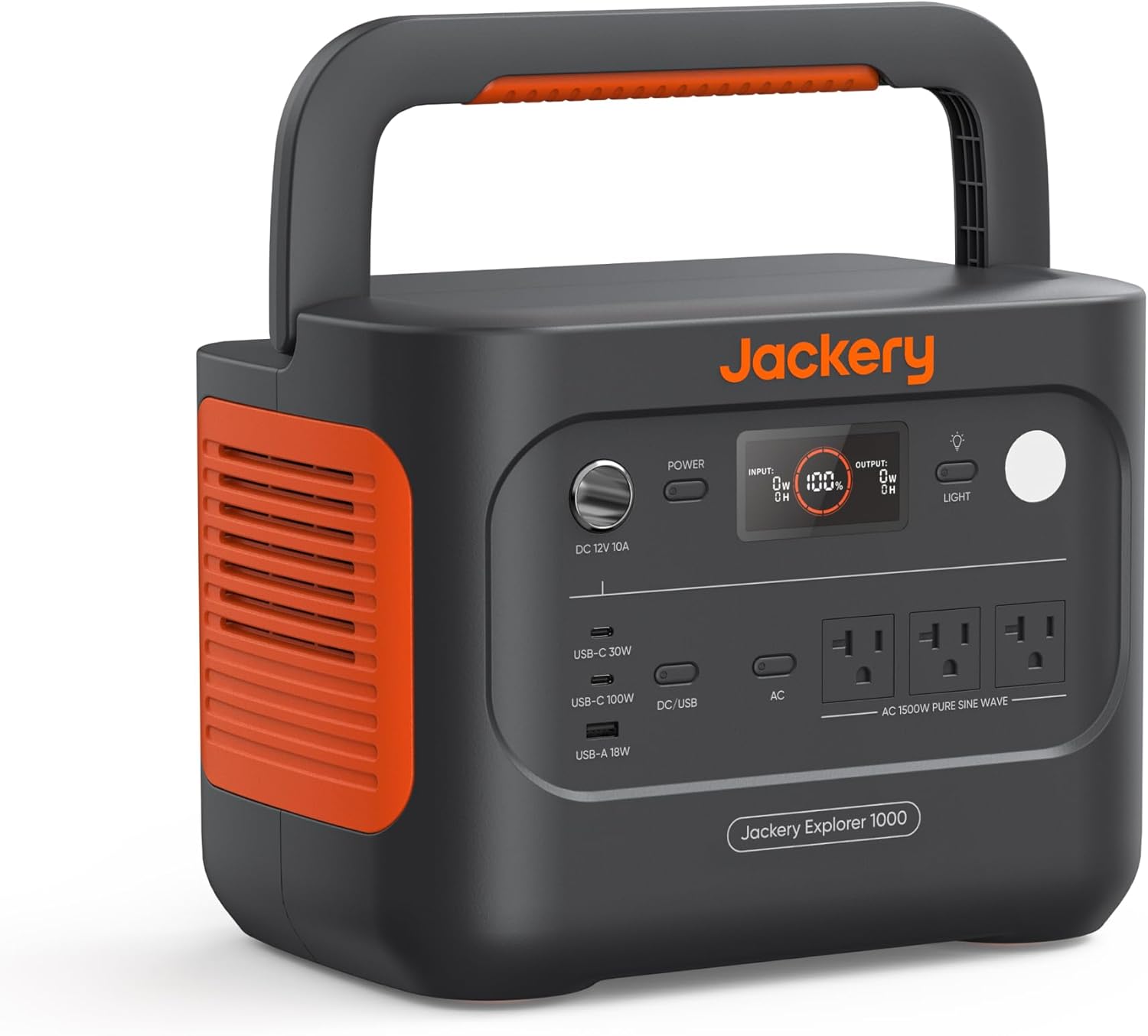
This wins on weight and simplicity. At 23.8 lbs, it’s meaningfully lighter than the roughly 27-lb DELTA 3 Plus — a real difference if you’re carrying it any distance.
Independent reviewers also note it feels simpler to operate straight out of the box, with less app-based configuration than EcoFlow’s ecosystem. For the full breakdown, see our Jackery Explorer 1000 v2 review.
The Cycle Life Gap Worth Knowing
Both units rate 4,000 charge cycles. The fine print differs.
The DELTA 3 Plus retains 80% of original capacity at that mark. The Jackery retains 70%. Over a decade of regular use, that 10-percentage-point gap adds up to measurably more usable capacity late in the unit’s life.
Which One Should You Buy?
| Your Situation | Better Fit |
|---|---|
| Want to run appliances above 1,500W | EcoFlow DELTA 3 Plus |
| Prioritize lightest possible weight | Jackery Explorer 1000 v2 |
| Want expansion room for the future | EcoFlow DELTA 3 Plus |
| Want the simplest out-of-box experience | Jackery Explorer 1000 v2 |
| Planning heavy, near-daily use for a decade | EcoFlow DELTA 3 Plus (better capacity retention) |
| Pairing with a large solar array | EcoFlow DELTA 3 Plus (higher solar input) |
Frequently Asked Questions
Which is better overall, the DELTA 3 Plus or Jackery 1000 v2?
For most buyers, the DELTA 3 Plus edges ahead — higher output, faster charging, and expansion capability the Jackery lacks. The Jackery remains the better pick specifically for lightest weight and simplest operation.
Which one is lighter?
The Jackery Explorer 1000 v2, at 23.8 lbs versus roughly 27 lbs for the DELTA 3 Plus — a real difference for anyone carrying it any distance.
Can either run a microwave?
The DELTA 3 Plus’s 1,800W continuous output handles some microwaves and larger kettles above 1,500W that the Jackery’s 1,500W rating cannot.
Which battery lasts longer?
Both rate 4,000 cycles, but the DELTA 3 Plus retains 80% capacity at that point versus the Jackery’s 70% — a meaningful difference for anyone planning heavy, long-term use.
Can I expand either unit’s capacity later?
Only the DELTA 3 Plus, which scales to roughly 5,120Wh with EcoFlow’s extra battery packs. The Jackery Explorer 1000 v2 has no expansion option — its capacity is fixed for life.
The Bottom Line
The EcoFlow DELTA 3 Plus wins on the numbers that matter most for most buyers — output, charging speed, cycle retention, and room to grow.
The Jackery Explorer 1000 v2 earns its place specifically for buyers who prioritize lightest weight and the simplest possible operation over raw capability.
For the full EcoFlow lineup, see our best EcoFlow solar generator guide. For a broader look at this capacity tier, see our best 1000W solar generators for the money guide.