This post contains affiliate links. If you buy through our links we may earn a small commission — at no extra cost to you. This never influences our recommendations.
These are the two most popular 1kWh-class power stations on the market, and for good reason — both use LiFePO4 batteries rated for 4,000 cycles, both charge fast by industry standards, and both target the same buyer. The differences that actually matter come down to output, charging speed, and weight, and each unit wins clearly on different fronts. This guide compares them directly.
Full Spec Comparison
| Spec | Jackery Explorer 1000 v2 | Anker SOLIX C1000 Gen 2 |
|---|---|---|
| Capacity | 1,070Wh | 1,024Wh |
| Battery chemistry | LiFePO4 | LiFePO4 |
| Cycle life | 4,000 cycles to 70% | 4,000 cycles |
| AC output | 1,500W continuous | 2,000W continuous |
| Surge output | 3,000W | 3,000W |
| AC charge time | ~1 hour (Emergency Mode) / 1.7 hrs standard | 49 minutes (Guinness World Record verified) |
| Solar input (max) | 800W | 600W |
| Weight | 23.8 lbs | ~28.7 lbs |
| Warranty | 5 years | 5 years |
The Two Units Side by Side
Jackery Explorer 1000 v2
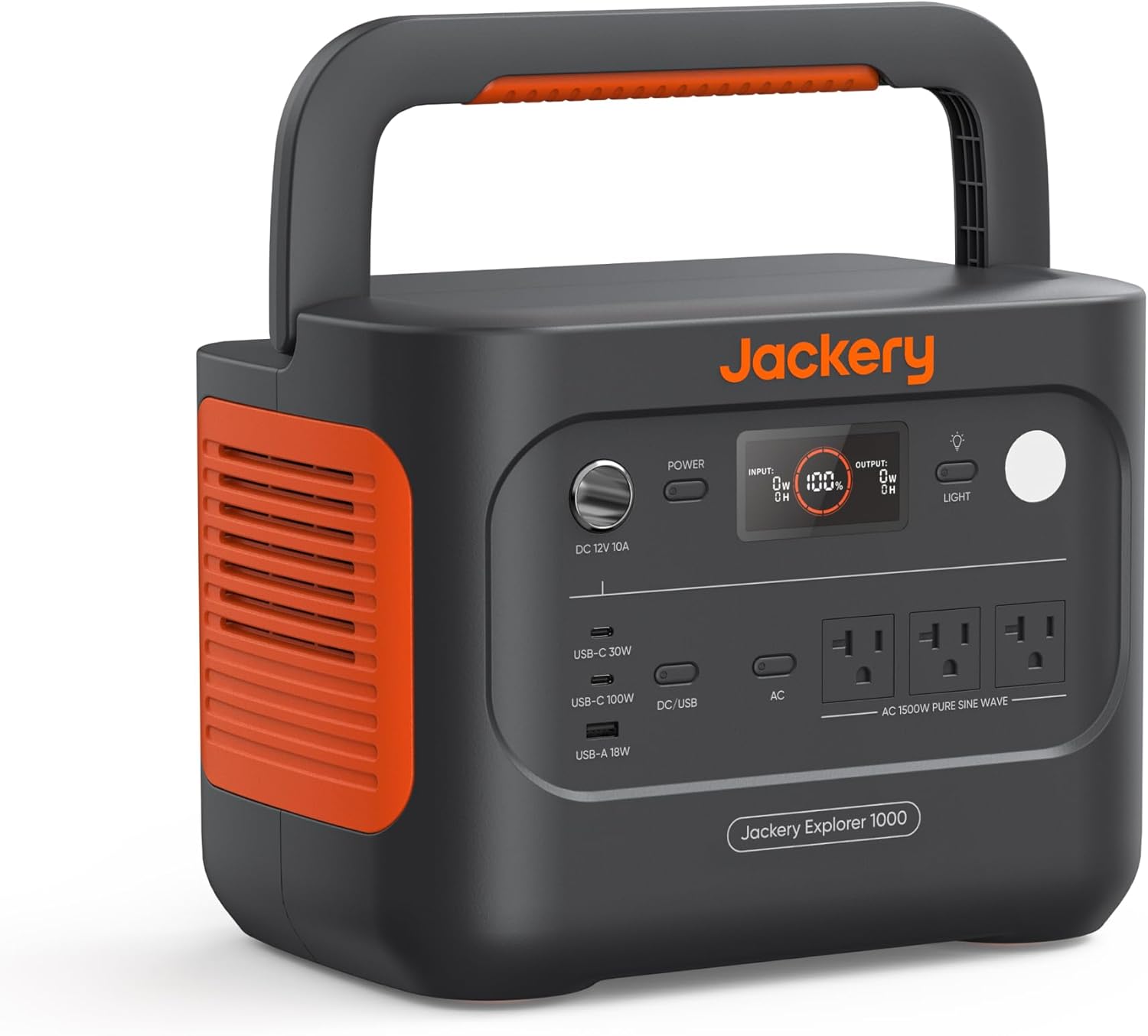
The Jackery wins clearly on two fronts: it’s the lighter of the two at 23.8 lbs, genuinely noticeable if you’re carrying it any real distance rather than just loading it into a vehicle, and it accepts up to 800W of solar input — the highest ceiling of the two, meaningful if you’re pairing it with a serious panel array for off-grid recharging. Independent testing consistently notes Jackery units run cooler under sustained load with less frequent fan cycling than comparable Anker units, a real-world thermal advantage that doesn’t show up on a spec sheet. Jackery’s 12-year head start in the category (founded 2012) and broad retail presence — Costco, Home Depot, Best Buy, in addition to Amazon — also make in-person purchases and returns simpler than some online-first competitors. For the full breakdown, see our Jackery Explorer 1000 v2 review.
Anker SOLIX C1000 Gen 2
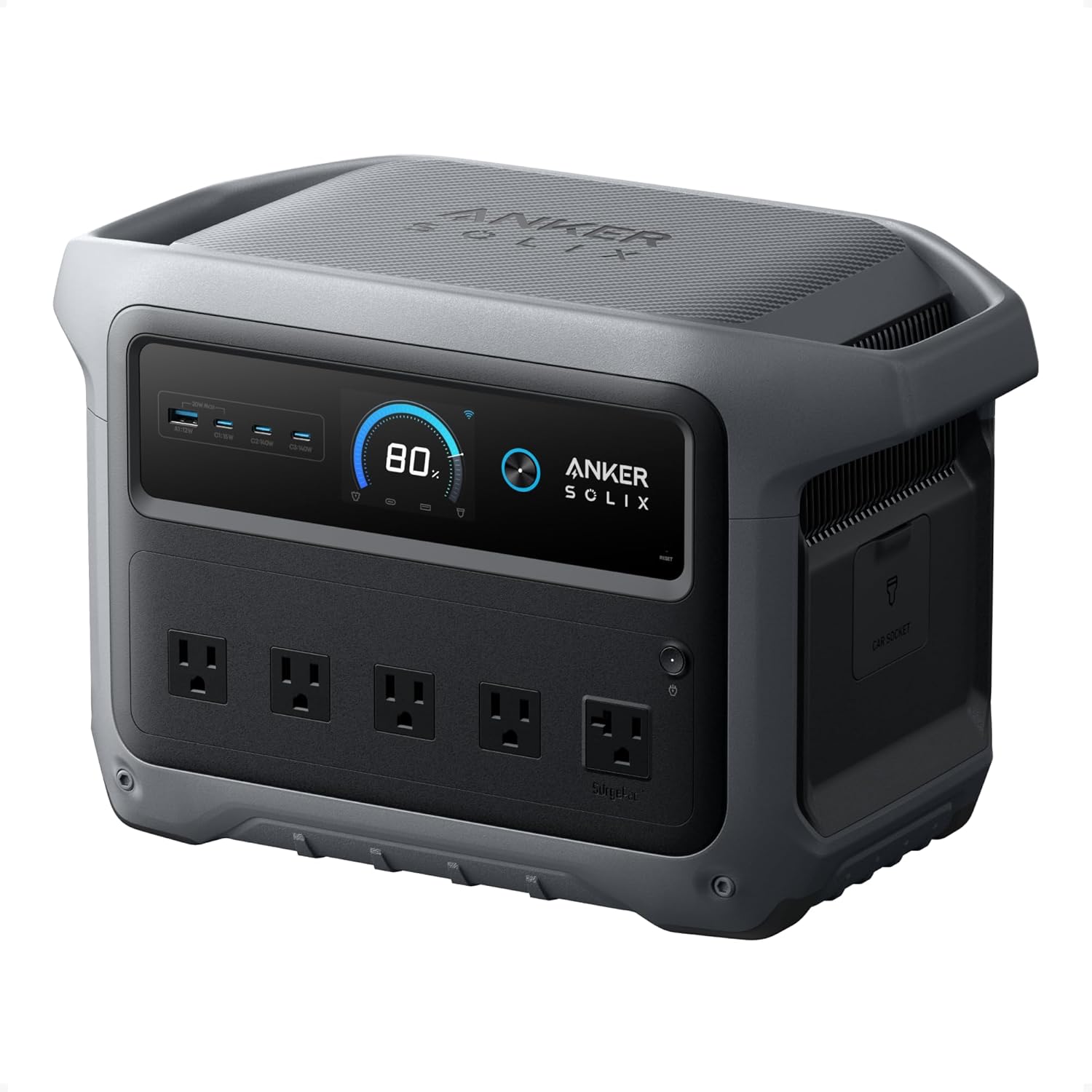
The Anker wins clearly on output and charging speed — 2,000W continuous is a genuine third more than the Jackery’s 1,500W, and the 49-minute full AC charge (independently verified by Guinness World Records for its class) is meaningfully faster than the Jackery’s standard 1.7-hour charge. This output gap matters in practice: a standard 2,000-3,000W kettle trips the Jackery’s 1,500W limit outright, while the Anker’s 2,000W sits right at the edge — some 2,000W kettles run, anything higher still trips. For anyone wanting to run demanding kitchen appliances or power tools off a 1kWh unit, the Anker’s extra headroom is a real, practical advantage. For the full Anker lineup breakdown, see our Anker solar generator guide.
Which One Should You Buy?
| Your Situation | Better Fit |
|---|---|
| Backpacking, frequent carrying, weight is the priority | Jackery Explorer 1000 v2 |
| Want the fastest possible recharge before a trip | Anker SOLIX C1000 Gen 2 |
| Running demanding kitchen appliances or power tools | Anker SOLIX C1000 Gen 2 |
| Pairing with a large solar panel array for off-grid use | Jackery Explorer 1000 v2 (higher solar input ceiling) |
| Want the quietest possible operation under load | Jackery Explorer 1000 v2 |
| Prefer buying/returning through a physical retail store | Jackery Explorer 1000 v2 |
Frequently Asked Questions
Which is better, Jackery Explorer 1000 v2 or Anker SOLIX C1000 Gen 2?
Neither wins outright — they trade off on different priorities. The Anker delivers higher output (2,000W vs 1,500W) and faster charging (49 minutes vs 1.7 hours), making it the stronger pick for demanding appliances and quick pre-trip top-ups. The Jackery is lighter (23.8 lbs vs ~28.7 lbs), accepts more solar input (800W vs 600W), and runs cooler under sustained load — the better pick for portability and off-grid solar charging.
Can either unit run a kettle?
The Jackery’s 1,500W continuous output trips on most standard 2,000-3,000W kettles — only a low-rated 1,000-1,200W travel kettle works reliably. The Anker’s 2,000W output sits right at the edge, running some 2,000W kettles while anything higher still trips its overload protection. For anyone specifically wanting to run a full-power kettle, the Anker has more headroom, though neither is a guaranteed fit for every kettle on the market.
Which charges faster from solar panels?
The Jackery has the higher maximum solar input ceiling at 800W versus the Anker’s 600W, meaning it can theoretically recharge faster with a sufficiently large panel array. For AC wall charging specifically, the Anker is faster at 49 minutes versus the Jackery’s 1.7-hour standard charge time.
Which is quieter?
Independent testing consistently notes Jackery units run cooler under sustained load with less frequent fan cycling than comparable Anker units — a real-world advantage for anyone using the unit near sleeping areas or in a quiet campsite setting.
Are both units genuinely LiFePO4 with similar long-term durability?
Yes — both use LiFePO4 chemistry rated for 4,000 charge cycles, translating to roughly a decade or more of regular use before meaningful capacity degradation. Neither has a clear durability advantage over the other on paper; the practical difference is more about output and charging speed than long-term battery life.
The Bottom Line
Both units genuinely deliver — you won’t go wrong with either. Choose the Jackery Explorer 1000 v2 if weight, quiet operation, and solar charging capacity matter most to your use case. Choose the Anker SOLIX C1000 Gen 2 if you want the fastest possible recharge and the highest continuous output for demanding appliances. If you’re genuinely torn, lean toward whichever spec — weight or output — you’re more likely to actually notice in your specific use case, since both are proven, reliable units in this capacity class.
For the complete Jackery lineup, see our best Jackery solar generator guide. For a broader comparison across brands, see our best 1000W solar generators for the money guide.