This post contains affiliate links. If you buy through our links we may earn a small commission — at no extra cost to you. This never influences our recommendations.
Solar Pool Heaters vs. Solar Panels — A Quick Distinction
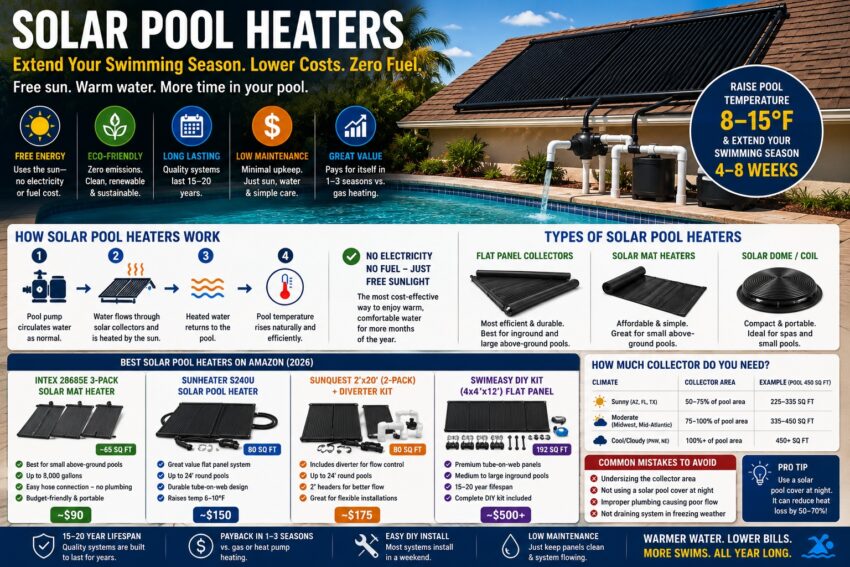
Before diving in: solar pool heaters are thermal solar collectors, not photovoltaic solar panels. They don’t generate electricity. They work by circulating pool water through black tubes or channels on a sun-facing collector, where sunlight directly heats the water before it returns to the pool.
This is a fundamentally different technology from the solar panels covered elsewhere on this site — but it uses the same free energy source to achieve genuine, meaningful results. A properly sized solar pool heating system can raise water temperature by 8–15°F and extend your swimming season by 4–8 weeks, with zero electricity cost and zero fuel cost beyond the initial installation. It’s one of the most cost-effective solar investments available for any homeowner with a pool.
How Solar Pool Heaters Work
The operating principle is simple and elegant. Your existing pool pump circulates water through the filtration system as normal. Instead of returning directly to the pool, water is diverted through the solar collector panels — flowing through dozens of small tubes where it picks up heat from the sun-warmed black collector surface. Heated water returns to the pool, gradually raising the overall temperature.
No electricity. No gas. No refrigerant. The energy source is entirely free sunlight, and the only operating cost is the marginal increase in pump energy to push water through the additional plumbing — negligible in practice.
The key variable is collector area. More square footage = more heat transferred per day. The standard sizing rule is that collector area should equal 50–100% of the pool’s surface area. A 15×30ft pool (450 sq ft) needs 225–450 sq ft of collector for optimal heating — meaning a series of panels, not a single unit.
Types of Solar Pool Heaters
Unglazed flat panel collectors are the most common and highest-performing type for pools — black polypropylene panels with the tube-on-web design. Unglazed because pool water temperatures are much lower than domestic hot water, making glass covers an unnecessary cost. UV-stabilised and designed to last 15–20 years. This is what the serious brands (SwimEasy, SunHeater, SunQuest) make.
Solar mat heaters are simplified flat mats that lie on the ground or deck. Water flows through the mat, picks up heat, and returns to the pool. Lower cost, lower performance per square foot than tube-on-web panels. Best for small above-ground pools as a supplementary source. The Intex mat is the Amazon bestseller in this category.
Solar dome / coil heaters sit on the pool deck with water circulating through a coiled tube inside a rounded dome. Compact but limited in collector area — best for small above-ground pools and spas under 5,000 gallons.
The honest hierarchy: For meaningful heating of a full-sized inground or large above-ground pool, flat panel systems are the only category worth serious consideration. Mats and domes are supplementary or small-pool tools.
How Much Will a Solar Pool Heater Raise My Temperature?
Flat panel systems (properly sized): 8–15°F above unheated pool temperature. A pool that naturally sits at 72°F in spring can be raised to 80–87°F — the comfortable swimming range. A pool at 78°F in summer can reach 86–90°F.
Solar mats (single units): 2–6°F on sunny days — noticeable but modest. Multiple units compound the effect.
The variables that matter most:
- Collector-to-pool surface area ratio — the single biggest determinant. Undersized systems underperform regardless of panel quality.
- Local sun hours — a system in Phoenix produces significantly more heat than the same system in Seattle.
- Pool cover use — a solar pool cover (thermal blanket) at night prevents heat gain from dissipating. It can reduce required collector area by 30–40% by retaining gained heat.
- Panel orientation and tilt — south-facing at a shallow tilt (10–20°) maximises collection during pool season.
What to Look for in a Solar Pool Heater
Polypropylene with UV stabilisers. Quality pool solar panels use UV-stabilised polypropylene specifically formulated to resist sunlight degradation. Panels without UV stabilisers can become brittle within 3–5 years. Quality brands rate their panels for 15–20 years of outdoor use.
Tube-on-web vs. mat design. The tube-on-web design runs individual tubes through a continuous polypropylene web — maximising surface contact and minimising flow restriction. For inground pools and larger above-ground pools, tube-on-web is the right specification.
Header diameter. Larger headers (2″ ID) allow higher flow rates with less back-pressure on your pump — important for maintaining good filtration flow. SwimEasy’s panels use 2″ headers with the manifold molded directly around the absorber tubes, eliminating the flow restrictions found in cheaper designs.
Freeze resistance. In frost-prone climates, panels must drain completely when the pump shuts down to prevent ice damage. A vacuum relief valve (included in quality kits) allows gravity drainage. Always verify freeze-drain compatibility.
Compatibility with your existing pump. Adding a solar panel system increases resistance in the plumbing circuit, which reduces pump flow rate somewhat. Larger-diameter headers and properly sized arrays minimise this effect. If your pump is already running near its limits, account for the additional head pressure.
The Best Solar Pool Heaters on Amazon Right Now — Verified Picks
| Product | Type | Collector Area | Pool Size | Price |
|---|---|---|---|---|
| Intex 28685E (3-pack) | Solar mat | ~65 sq ft | Up to 8,000 gal | ~$90 |
| SunHeater S240U | Flat panel | 80 sq ft | Up to 24′ round | ~$150 |
| SunQuest 2×2’×20′ + Diverter | Flat panel | 80 sq ft | Up to 24′ round | ~$175 |
| SwimEasy DIY Kit (4×4’×12′) | Flat panel | 192 sq ft | Medium inground | ~$500+ |
Intex 28685E Solar Pool Heater Mat — Best for Small Above-Ground Pools
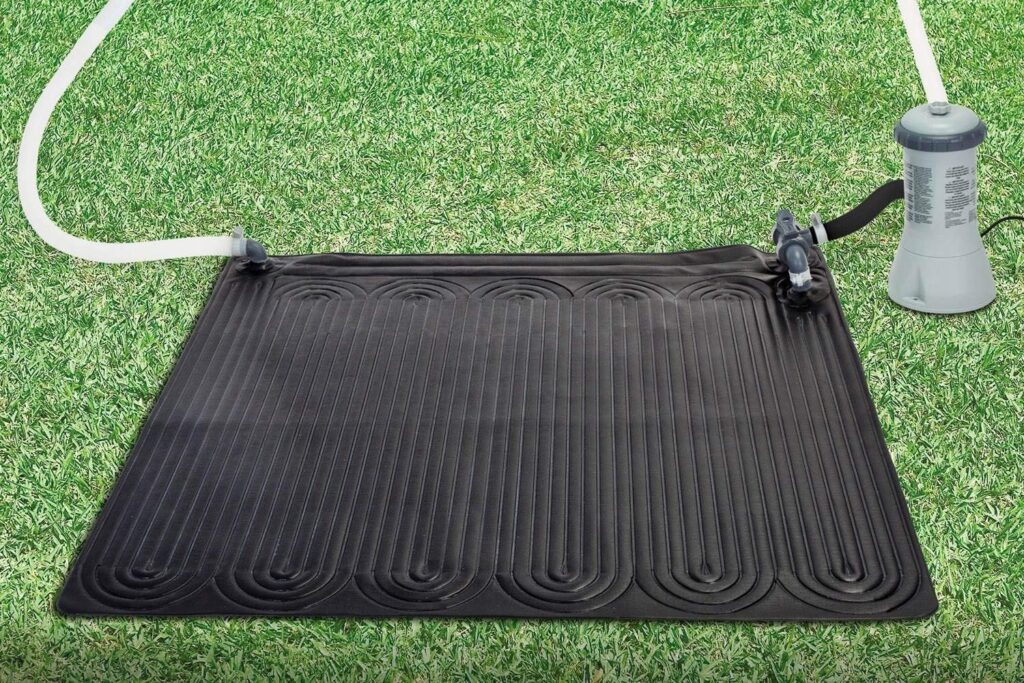
The Intex 28685E solar mat is the bestselling solar pool heater on Amazon — and for small Intex and above-ground pools up to 8,000 gallons, it’s a straightforward, no-permanent-plumbing solution. Each 47″×47″ mat provides approximately 15 square feet of collector area using simple hose connections. The 3-pack (three mats in series) provides ~45 square feet, adequate for pools up to 8,000 gallons as a supplementary heat source. Includes hose attachment points, adaptors, and bypass valve.
At ~$90 for a 3-pack it’s the lowest barrier-to-entry solar pool heater available. The honest limitation: mat-style collectors have lower heat transfer efficiency than tube-on-web panel designs, and collector area is genuinely limited for larger pools. For pools above 12,000 gallons, the SunHeater panel system is more cost-effective per square foot of collector area.
Pros: Lowest price, no permanent plumbing modifications, simple hose connection, Intex-compatible, easy installation
Cons: Limited collector area, lower efficiency than tube-on-web panels, primarily for small above-ground pools
Best for: Small Intex and above-ground pools up to 8,000 gallons, first-time solar heating, minimal-commitment trial
SunHeater S240U — Best Value Panel System
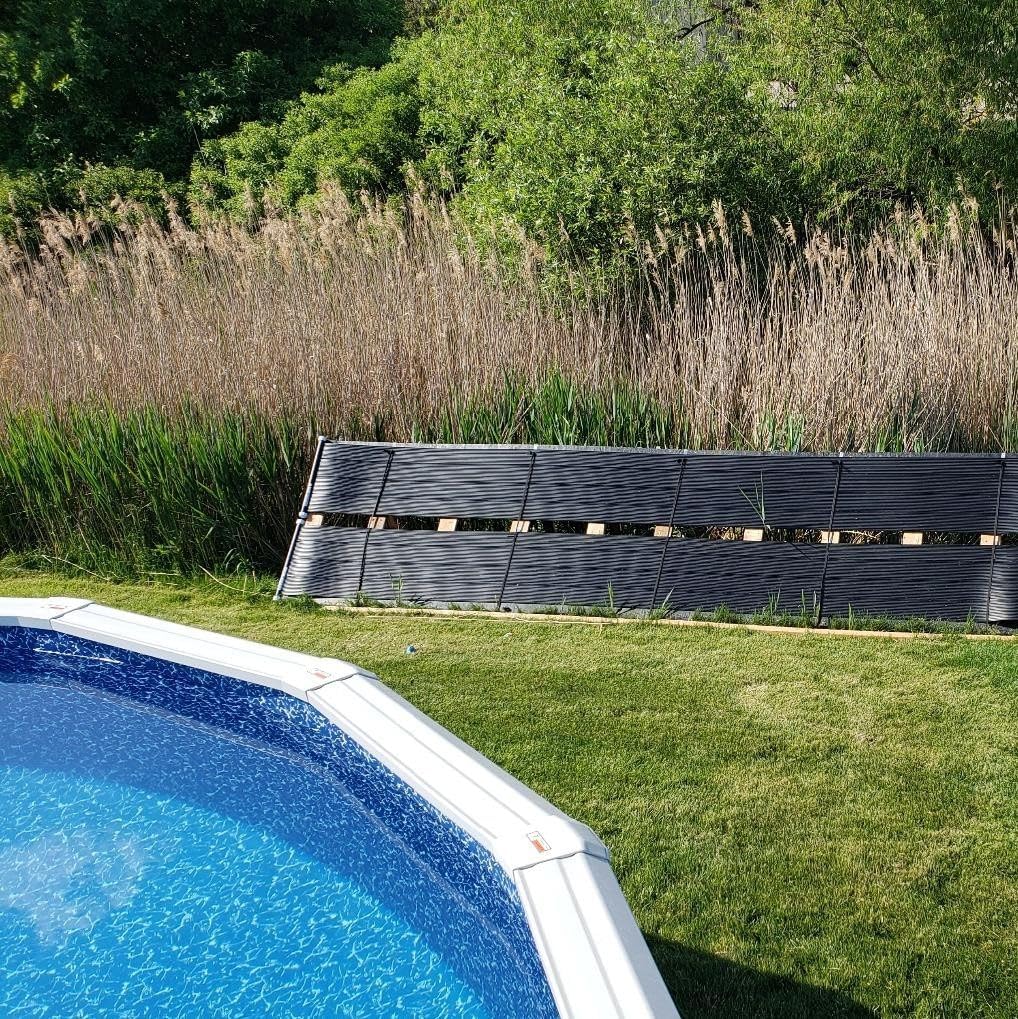
Two 2’×20′ panels (80 square feet total) with everything needed except roof mounting hardware. Each panel uses the proven tube-on-web design that handles high flow rates, and the system works equally well for above-ground and inground pools — on the ground, a PVC rack, or roof-mounted. The tube-on-web design allows panels to expand and contract with changing temperatures for long-term durability, with 6 stainless steel hose clamps and rubber connector hoses included.
Real-world user data confirms the performance: one owner in Philadelphia maintained 80–82°F in a 20,000-gallon pool through mid-June using four S240U systems (320 sq ft total) with air temperatures ranging from 60–80°F. The system is rated to raise pool temperature 6–10°F and extend pool season by weeks.
One trade-off worth knowing: adding the solar panel loop to your existing filtration plumbing does reduce pump flow rate to some degree. A bypass valve lets you redirect flow around the solar panels when heating isn’t needed, preserving full filtration flow on demand.
Pros: 80 sq ft tube-on-web panels, works for inground and above-ground, 6–10°F temperature raise, stainless steel hardware, proven real-world performance, affordable
Cons: Reduces pump flow rate when active, roof mounting hardware sold separately, 80 sq ft may be insufficient for larger pools without adding panels
Best for: Above-ground pools 10,000–20,000 gallons, inground pools as a starting system, buyers wanting proven mid-tier performance
SunQuest 2×2’×20′ with Diverter Kit — Best for Flexible Installation
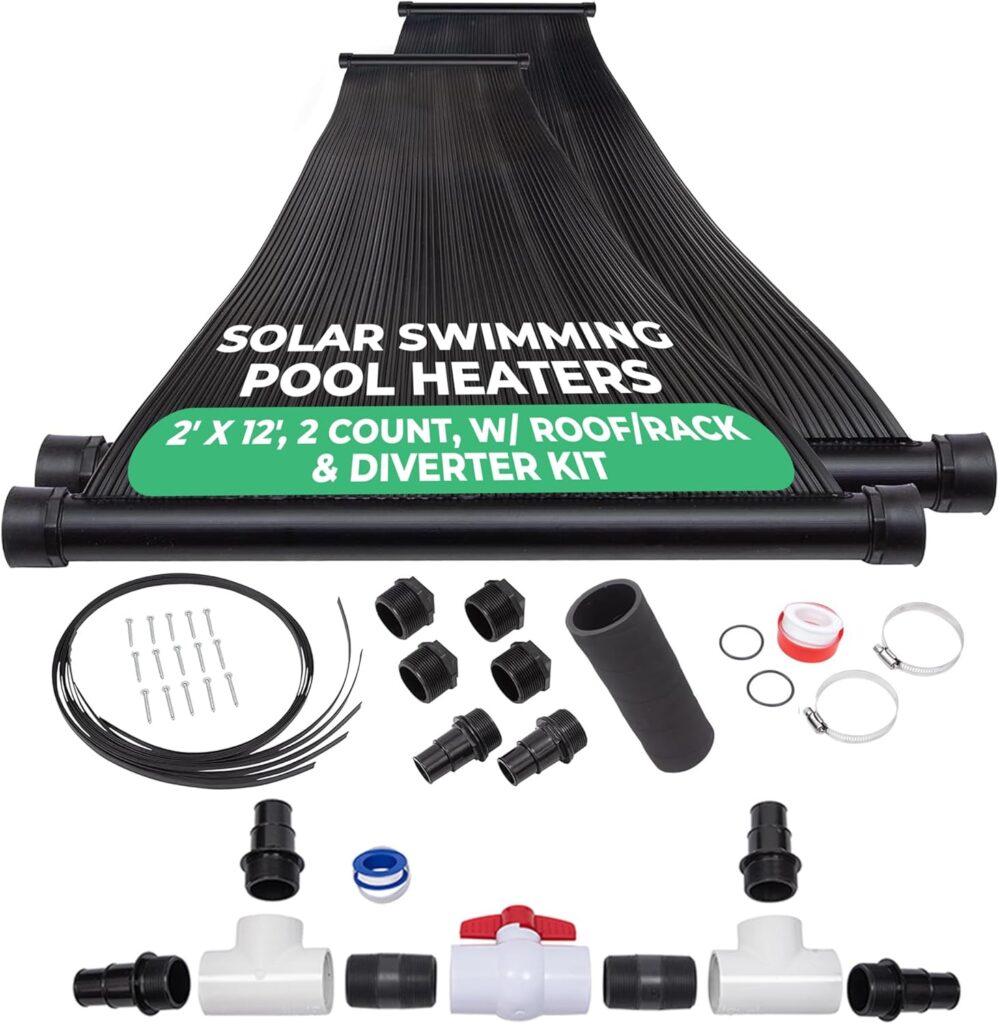
SunQuest delivers the same 80 square feet of tube-on-web panel as the SunHeater, with a meaningful addition: the included diverter kit that lets you control how much water flow goes through the solar panels versus straight to the pool. Rather than being fully on or off, the diverter allows you to partially redirect flow — letting you dial in heating rate and maintain better filtration flow simultaneously. This directly addresses the flow-reduction concern of adding solar heating to your existing plumbing.
The SunQuest panels use 2″ OD headers that handle higher flow rates with less back-pressure than 1.5″ header systems. Panels can sit on the ground, a PVC rack, or mount to a roof, and the system works for both above-ground and inground pools.
Pros: 80 sq ft tube-on-web panels, diverter kit included for precise flow control, 2″ OD headers for better flow, works on ground/rack/roof, inground and above-ground compatible
Cons: Requires basic plumbing modification, 80 sq ft alone insufficient for larger pools
Best for: Pools 10,000–25,000 gallons, buyers who want built-in flow control, flexible installation locations
SwimEasy DIY Solar Pool Heater Kit — Best for Serious Heating Performance
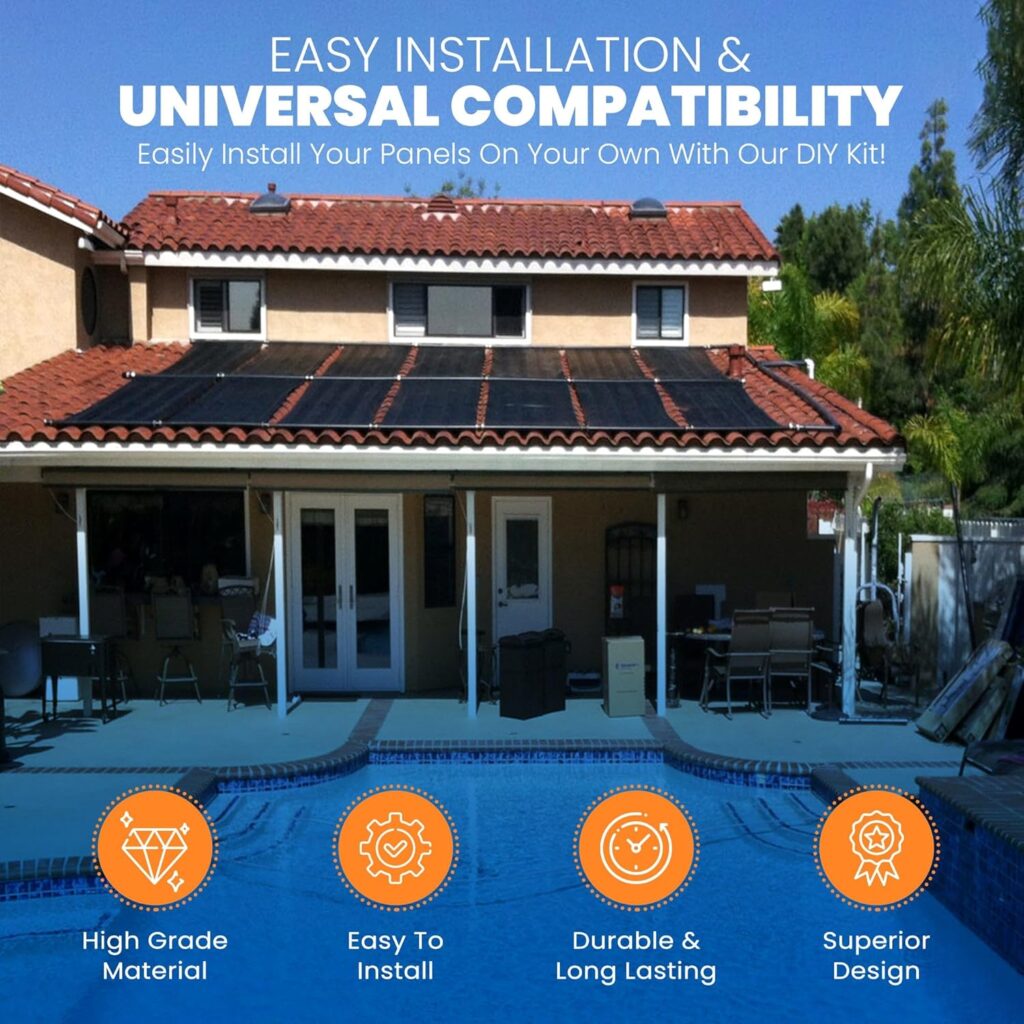
The SwimEasy DIY kit is the premium domestic option on Amazon — US-manufactured, 15–20 year rated lifespan, and available in multiple configurations from 2 panels to 7+ panels depending on pool size. The integrated manifold design — where the header is molded directly around the absorber tubes rather than attached separately — eliminates the flow restriction that occurs at the junction in cheaper designs. More flow through each tube means more heat transferred per panel.
The full DIY kit includes all hardware needed to mount the panels, connect them together with tie-down straps, and connect to your supply and return lines. The 4×4’×12′ configuration delivers 192 sq ft of collector area — appropriate for most medium inground pools (15,000–25,000 gallons in a sunny climate). Larger pools and cloudier climates step up to 6- or 7-panel configurations.
Pros: US-manufactured, 15–20 year lifespan, integrated manifold eliminates flow barriers, available in large multi-panel configurations, stainless steel mounting hardware, complete DIY kit
Cons: Higher price, more complex installation for multi-panel systems, requires roof or rack mounting
Best for: Inground pools over 15,000 gallons, homeowners wanting the longest-lasting and highest-performing solar pool heater on Amazon
How to Size a Solar Pool Heater Correctly
Getting the size right before buying is more important than which brand you choose. Undersized systems produce disappointing results regardless of product quality.
Step 1 — Calculate pool surface area
Length × Width = surface area in sq ft.
12’×24′ pool: 288 sq ft | 15’×30′ pool: 450 sq ft | 18’×36′ pool: 648 sq ft | 24′ round: ~452 sq ft
Step 2 — Determine required collector area
- Sunny climate (Southwest, Florida): 50–75% of pool surface area
- Moderate climate (Midwest, Mid-Atlantic): 75–100%
- Cooler/cloudier climate (Pacific Northwest, Northeast): 100%+
Example: 15×30ft pool in Texas: 450 × 0.65 = ~290 sq ft of collector needed. This means four 80 sq ft SunHeater/SunQuest systems, or two 4’×12′ SwimEasy panels.
Step 3 — Account for a pool cover
If you use a solar pool cover (thermal blanket) at night, reduce required collector area by 25–35%. The cover retains the day’s heat gain dramatically better than an uncovered pool.
Solar Pool Heater Installation — What’s Actually Involved
Solar pool heaters are genuinely DIY-friendly — significantly simpler than photovoltaic solar system installation.
For flat panel systems (roof or rack mount):
- Position panels on south-facing roof or ground rack
- Run supply and return hoses/pipe from pool plumbing to panels
- Install bypass/diverter valve to control flow
- Connect panels in a row with included connector hoses and clamps
- Bleed air from the system on startup
No electrical work. No permits required in most jurisdictions for above-ground pool systems (verify locally for roof-mounted). A competent DIYer installs a 2–4 panel system in a weekend.
For mat-style heaters (Intex): Even simpler — hose-based connection to the pool pump outlet and return using included adaptor fittings. No permanent plumbing modifications required.
The one real complexity: Ensuring panels drain completely when the pump shuts off to prevent freeze damage. The system must be installed at an angle allowing gravity drainage, and a vacuum relief valve (included in quality kits) must be installed to allow air in as water drains out.
Solar Pool Heaters vs. Gas and Heat Pump Alternatives
| Factor | Solar | Gas | Heat Pump |
|---|---|---|---|
| Operating cost | $0 (free sun) | High ($50–$200/month) | Low-moderate ($30–$80/month) |
| Upfront cost | Low–moderate ($150–$800) | High ($1,500–$4,000 installed) | High ($2,000–$5,000 installed) |
| Heating speed | Gradual (daily gain) | ✅ Fast (on demand) | Moderate |
| Works at night/cloudy days | ❌ No | ✅ Yes | ✅ Yes |
| Lifespan | 15–20 years | 8–12 years | 8–10 years |
| Environmental impact | ✅ Zero emissions | High | Low (uses electricity) |
Solar wins decisively on lifetime operating cost — a $500 SwimEasy system has zero operating cost for 15–20 years versus $100–$200/month for gas heating in peak season. The break-even against gas is typically 1–3 seasons. Solar loses on flexibility — it only heats during sun hours. Many pool owners use solar as the primary heat source and keep a gas or heat pump as backup for cold stretches.
Getting More From Your Solar Pool Heater
Use a solar pool cover at night. This is the single highest-impact supplementary step. A thermal solar cover retains 50–70% of daily heat gain that would otherwise be lost overnight through evaporation and convection.
Run the pump during peak sun hours. Solar panels heat most effectively between 10am and 3pm. If your pump runs on a timer, ensure maximum flow through the solar circuit during these hours.
Optimise panel angle. South-facing with a 10–20° tilt is optimal for pool heating season. Flat mounting on a south-facing roof is acceptable; adding tilt hardware improves performance.
Add panels as needed. All the panel systems in our picks are modular. Start with the calculated minimum and add panels one season at a time if performance is insufficient.
Clean panels annually. A garden hose rinse at the start of pool season maintains heat transfer performance. For solar maintenance principles that apply across all solar technologies, see our guide to how long solar panels last.
Frequently Asked Questions
How many degrees will a solar pool heater raise the temperature?
A properly sized flat panel system (collector area = 50–75% of pool surface area) typically raises pool temperature 8–15°F in moderate to sunny conditions. The SunHeater S240U is rated for 6–10°F from its 80 sq ft of panels. More panels = more heat. Without a solar pool cover at night, daily gains are partially offset by overnight losses.
Do solar pool heaters work in winter?
In mild-winter climates (Florida, Southern California, Texas, Arizona), yes — unglazed solar pool heaters can extend the season year-round. In cold-winter climates, panels must be drained and winterised when freezing temperatures arrive. For year-round heating in cold climates, a gas heater or heat pump is the appropriate primary system, with solar as a summer cost-reducer.
Can a solar pool heater be used with an existing gas heater?
Yes — this is an ideal combination. Run the solar heater as the primary source during sunny days (zero cost), and use the gas heater only when solar heating is insufficient. Most solar pool heater systems use a bypass valve that allows you to choose how much flow goes through the solar panels, so the two systems coexist in the same plumbing.
Do I need to modify my existing pool plumbing?
For flat panel systems, yes — a basic plumbing modification is required to divert water through the solar collectors. This involves adding a diverter/bypass valve and running hose or PVC pipe to the panel location. For mat-style heaters (Intex), connection is hose-based with included adaptors — no permanent plumbing changes required.
Is a permit required for a solar pool heater?
In most US jurisdictions, no permit is required for a solar pool heater connected to an existing pool plumbing system, particularly for above-ground pools. For roof-mounted systems, some jurisdictions require a structural assessment. Always check locally before installing roof-mounted panels.
How long do solar pool heater panels last?
Quality polypropylene panels (SunHeater, SunQuest, SwimEasy) are rated for 15–20 years with proper installation and winterisation. Budget mat heaters typically last 5–8 years. The primary failure modes are UV degradation (addressed by UV-stabilised materials) and freeze damage (prevented by proper gravity drainage). SwimEasy’s US-manufactured panels with specialised UV stabilisers carry the longest rated lifespan in our picks.
Final Verdict
| Your Situation | Best Pick |
|---|---|
| Small above-ground pool, budget | Intex 28685E 3-Pack (~$90) |
| Above-ground or small inground, value | SunHeater S240U (~$150) |
| Above-ground or inground, flow control | SunQuest with Diverter Kit (~$175) |
| Medium-large inground, best performance | SwimEasy DIY Kit — 4×4’×12′ (~$500+) |
| Already have gas heater, add solar | SunHeater S240U as supplementary system |
A solar pool heater is one of the clearest return-on-investment purchases available for pool owners. The operating cost is zero. The payback against a gas heater is typically 1–3 seasons. The lifespan of a quality system is 15–20 years. And the swimming season extension — an extra 4–8 weeks of comfortable water temperatures — is the kind of tangible improvement that pays off every single summer.
Start with your pool surface area, calculate the collector area you need, and choose the system that covers it. The rest is plumbing.
For more solar-powered pool equipment, see our guide to solar pool pumps — the solar alternative for running your pool’s circulation system. For surface debris management, see our solar powered pool skimmer guide. And for the solar panels that power the rest of your outdoor solar setup, our off-grid solar system guide covers complete system design.