Disclaimer: This article is for informational purposes only. Always consult a licensed electrician or solar installer before designing or installing an off grid solar system.
So You Want to Cut the Grid Completely
Maybe your property is too remote for utility hookup. Maybe you’re tired of rising electricity bills. Maybe you just want to be genuinely self-sufficient. Whatever the reason, an off grid solar system is the answer millions of Americans are turning to — and the technology has never been more reliable or affordable.
But here’s the thing: off grid solar is not the same as slapping a few panels on your roof and calling it a day. It’s a complete, self-contained power system. Get it right and you’ll have electricity whenever you need it. Get it wrong and you’ll be in the dark by Thursday.
This guide breaks down exactly how an off grid solar system works, what components make it up, how to size one for your needs, and what it realistically costs to get started.
What Is an Off Grid Solar System?
An off grid solar system is a standalone electricity setup that operates entirely independently from the utility grid. No power lines. No monthly bill. No blackouts caused by your neighbor’s tree falling on a transformer.
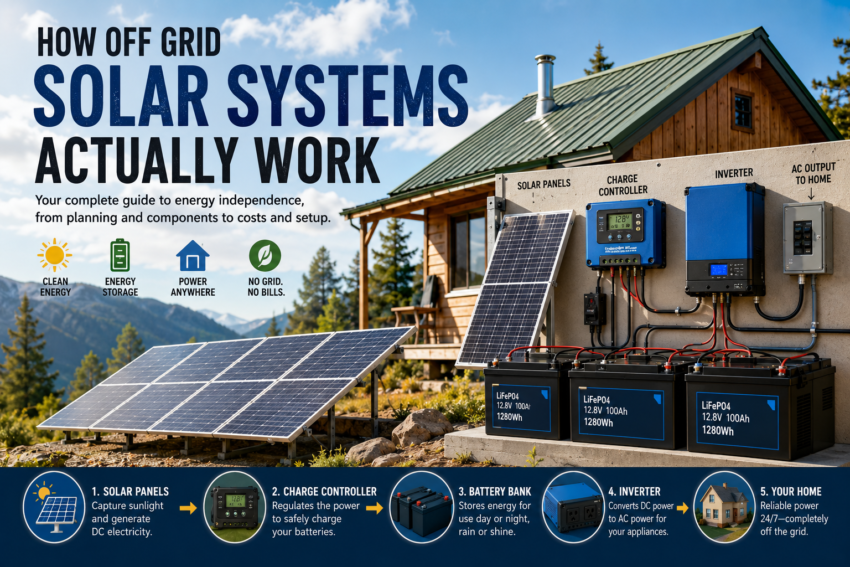
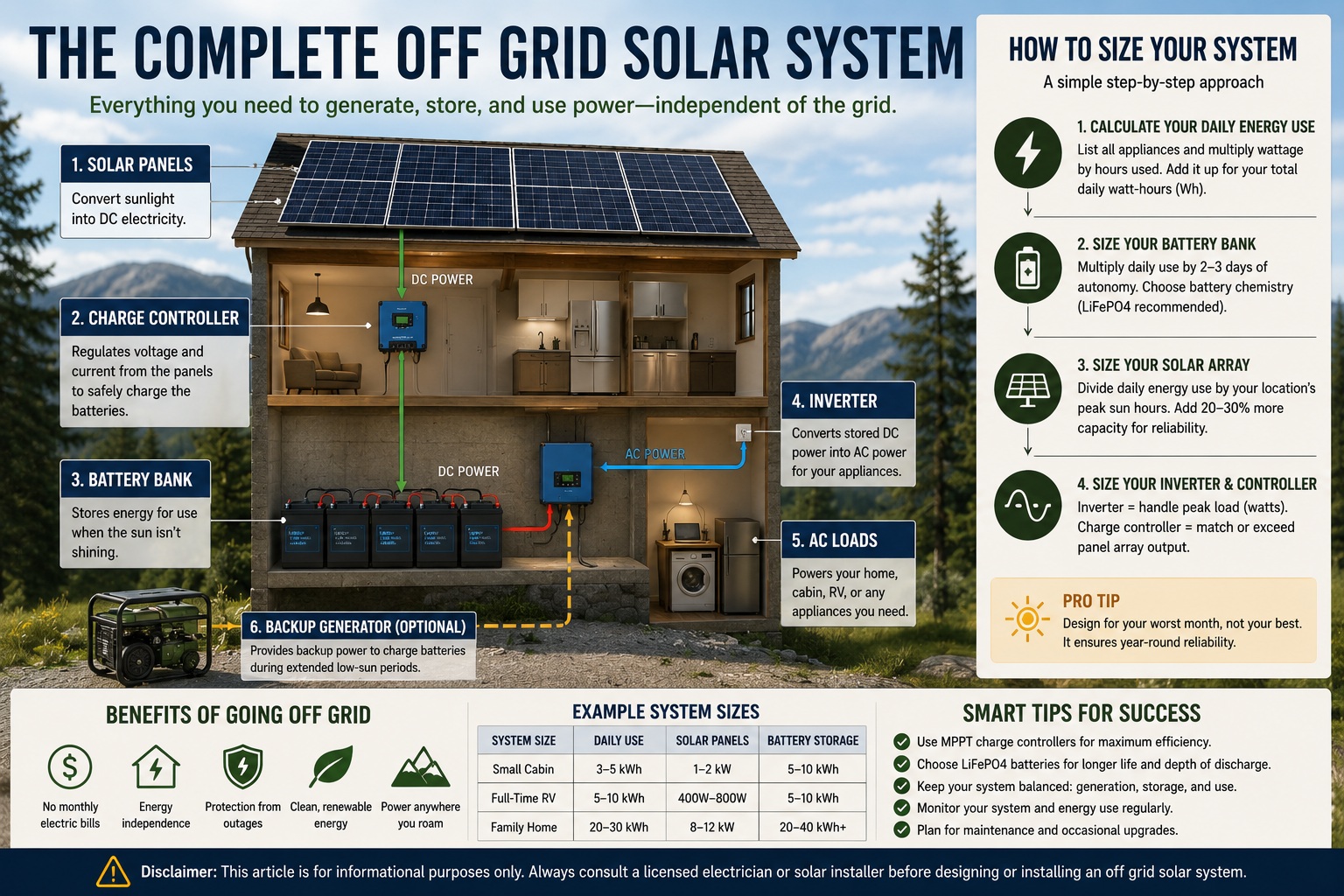
Your solar panels generate electricity from sunlight. That energy gets stored in a battery bank. An inverter converts stored DC power into usable AC power for your appliances. A charge controller manages the flow between panels and batteries so nothing overcharges or blows up.
That’s the core of it. Four main components working together to give you reliable, renewable electricity around the clock — even when the sun isn’t shining.
This is fundamentally different from a grid-tied solar system, which exports excess power back to the utility and draws from the grid when panels aren’t producing. Off grid means you’re fully on your own, which sounds daunting but is very achievable with the right design.
How Does an Off Grid Solar System Work?
Understanding the flow of electricity through the system makes everything else click. Here’s how it works step by step.
Step 1 — Panels Capture Sunlight
Solar panels (also called PV modules) convert sunlight into direct current (DC) electricity. More sunlight equals more output. On a clear summer day, a panel rated at 400W can get close to that number. On a cloudy winter day, expect significantly less — sometimes 10–20% of rated capacity.
Panel placement matters enormously here. South-facing panels tilted at the right angle for your latitude will always outperform panels thrown up in a shady spot. If you want to get the math right on that, this guide on solar panel azimuth and declination walks through exactly how to optimize your angle.
Step 2 — Charge Controller Manages the Flow
Raw power coming off your panels isn’t ready to go straight into your batteries. The solar charge controller sits between the panels and the battery bank and regulates voltage and current to protect your batteries from overcharging.
There are two types: PWM (Pulse Width Modulation) and MPPT (Maximum Power Point Tracking). MPPT controllers are more efficient — typically 15–30% better than PWM — and worth the extra cost for any serious off grid setup. You can read a full breakdown in this solar charge controller guide.
Step 3 — Batteries Store the Energy
This is the most critical piece of the puzzle. Your battery bank stores all the energy generated during daylight hours so you can use it at night, during cloudy weather, or whenever demand spikes.
Battery capacity is measured in kilowatt-hours (kWh). A small cabin might run fine on 5–10 kWh of storage. A full family home could need 20–40 kWh or more. The type of battery matters too — lithium iron phosphate (LiFePO4) batteries have largely replaced lead-acid in modern systems because they’re lighter, last longer (3,000–6,000 cycles vs. 500–1,000 for lead-acid), and can be discharged more deeply.
Step 4 — Inverter Converts DC to AC
Your appliances run on AC power. Your batteries store DC power. The inverter** bridges that gap. It takes the DC electricity from your battery bank and converts it into the 120V or 240V AC power your home uses.
For off grid use, you want a pure sine wave inverter. Modified sine wave inverters are cheaper but can damage sensitive electronics and cause motors to run hot. Don’t cut corners here.
Many modern off grid setups use a combined inverter-charger unit, which also handles charging the batteries from a backup generator if needed. That’s handy for extended cloudy periods.
The Complete Flow at a Glance
| Stage | Component | What It Does |
|---|---|---|
| Generation | Solar Panels | Convert sunlight to DC electricity |
| Regulation | Charge Controller | Protects batteries from overcharging |
| Storage | Battery Bank | Stores energy for later use |
| Conversion | Inverter | Converts DC to usable AC power |
| Backup (optional) | Generator | Charges batteries during low solar periods |
Off Grid vs. Grid-Tied vs. Hybrid — What’s the Difference?
| System Type | Grid Connection | Battery Storage | Best For |
|---|---|---|---|
| Off Grid | None | Required | Remote properties, full independence |
| Grid-Tied | Yes | Optional | Urban/suburban homes, lower cost |
| Hybrid | Yes (backup) | Required | Energy independence with grid safety net |
If you have grid access but want backup power during outages, a hybrid system — or even a high-capacity solar generator — may be more practical. Our guide to the best solar generators for home backup covers some excellent portable options that work well as a starting point or supplement.
How to Size an Off Grid Solar System
This is where most people go wrong. They buy panels first and figure out storage later. Do it the other way around — start with your load, work backwards.
1. Calculate Your Daily Energy Use
List every appliance you plan to run and how many hours per day you’ll use it. Multiply wattage by hours to get watt-hours (Wh). Add it all up for your daily total.
A typical American home uses around 30 kWh per day. A well-optimized off grid cabin might use 3–5 kWh per day. The more you conserve, the smaller (and cheaper) your system needs to be.
2. Size Your Battery Bank
You want enough storage to cover 2–3 days of use without any solar input — this is your days of autonomy. It accounts for cloudy stretches and seasonal dips in solar production.
If your daily use is 5 kWh and you want 3 days of autonomy, you need 15 kWh of usable battery capacity. With LiFePO4 batteries (which can typically discharge to 80–90%), plan for around 16–19 kWh of rated capacity.
3. Size Your Solar Array
You need your panels to fully recharge your batteries on an average sunny day. Divide your daily energy use by your location’s average peak sun hours. A home in Arizona gets around 5.5–6 peak sun hours daily. Maine gets closer to 4.
If you need 5 kWh per day and get 5 peak sun hours, you need 1,000W (1 kW) of panels minimum — more is better to account for inefficiencies and cloudy days. Most installers recommend oversizing by 20–30%.
4. Size Your Inverter and Charge Controller
Your inverter needs to handle your peak load — the combined wattage of everything that might run at the same time. Your charge controller rating must match or exceed your panel array’s output current.
What Does an Off Grid Solar System Cost?
Here’s an honest range. Costs vary massively based on system size, battery chemistry, and whether you’re doing it yourself or hiring an installer.
| System Size | Typical Use Case | Estimated DIY Cost | Installed Cost |
|---|---|---|---|
| 1–2 kW | Cabin, shed, tiny home | $2,000–$5,000 | $5,000–$10,000 |
| 3–5 kW | Small home, RV full-time | $6,000–$12,000 | $12,000–$20,000 |
| 8–12 kW | Full family home | $15,000–$25,000 | $25,000–$45,000 |
The federal solar Investment Tax Credit (ITC) currently offers a 30% tax credit on qualified solar installations, which can significantly reduce your net cost. Check with a tax professional to confirm eligibility for off grid systems.
If you’re starting smaller — say, powering a shed or workshop — you don’t need a full home system on day one. A compact off grid setup for a shed can cost as little as $500–$1,500 DIY. We’ve covered exactly how to do that in this solar power for shed guide.
Off Grid Solar for RVs and Mobile Living
Off grid solar isn’t just for remote homesteads. It’s become the standard setup for full-time RVers and van lifers who want to camp anywhere without hookups.
RV systems are scaled-down versions of home systems — typically 200W–800W of panels and 50–200Ah of lithium battery storage. The principles are identical; the components are just smaller and lighter. RV solar panel kits make it easy to get the right combination of components without piecing everything together yourself.
Flexible panels have also opened up RV installs considerably. If your roof has curves or limited flat space, flexible solar panels can conform to the shape of your vehicle without drilling through a rigid mount.
Common Off Grid Solar Mistakes to Avoid
- Undersizing the battery bank. This is the number one mistake. People invest in great panels but cheap out on storage, then wonder why they’re out of power by 10pm.
- Ignoring winter sun hours. Your system needs to work in December, not just July. Size for your worst month, not your best.
- Using modified sine wave inverters. Fine for simple resistive loads like incandescent lights and heating elements. Bad for motors, medical equipment, and most modern electronics.
- No backup plan. Extended cloudy periods happen. A small generator or backup charger is cheap insurance.
- Poor wire sizing. Undersized wires create resistance, heat, and efficiency losses. Use the correct gauge for your current loads.
- Skipping fuses and breakers. DC systems can cause fires just as easily as AC systems. Proper overcurrent protection is not optional.
Products Worth Knowing About
If you’re building or expanding an off grid solar system, these are real, well-reviewed components that consistently come up in the DIY solar community.
Renogy 400W 12V Monocrystalline Solar Panel
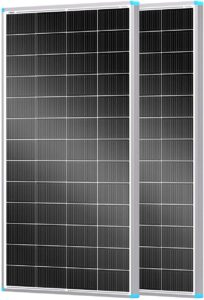
Renogy is one of the most trusted names in DIY off grid solar. Their 400W mono panel is a solid workhorse — high efficiency, durable frame, and widely compatible with standard mounting hardware. Good starting point for a small system build.
Ampere Time (LiTime) 100Ah 12V LiFePO4 Battery
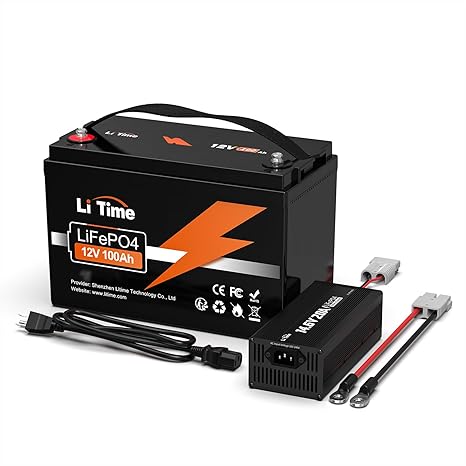
LiFePO4 batteries have become the go-to for off grid storage and this one delivers solid capacity, a built-in BMS, and a 4,000-cycle lifespan at an accessible price point. Easy to wire in series or parallel to build a larger bank.
Renogy 40A MPPT Solar Charge Controller
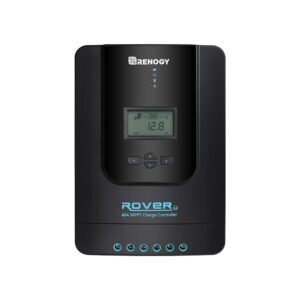
Renogy’s MPPT controller is a popular pick for systems up to about 520W (12V) or 1040W (24V). Clean LCD display, reliable performance, and plays well with lithium battery profiles.
Putting It All Together
An off grid solar system is one of the most empowering projects a homeowner, RVer, or remote property owner can take on. The technology is mature, the components are more affordable than ever, and the payoff — genuine energy independence — is real.
The key is doing the math first. Know your daily energy use. Size your batteries for days of autonomy. Build your panel array around your worst-case sun hours. Pick an MPPT controller, a pure sine wave inverter, and quality LiFePO4 batteries. Then build it carefully, fuse everything properly, and enjoy a power bill of zero.
Start small if you need to. A shed system or a single battery-and-panel setup teaches you the fundamentals before you go all-in on a full home install. The principles are exactly the same — just scaled up.
Frequently Asked Questions
What is an off grid solar system?
An off grid solar system is a standalone power setup that generates, stores, and delivers electricity entirely without connection to the utility grid. It uses solar panels, a charge controller, a battery bank, and an inverter to power a home, cabin, RV, or other property independently.
How does an off grid solar system work?
Solar panels generate DC electricity from sunlight. A charge controller regulates that power and sends it to a battery bank for storage. When you need electricity, an inverter converts the stored DC power into AC power for your appliances and devices.
How many solar panels do I need for an off grid home?
It depends on your daily energy consumption and your local peak sun hours. A typical energy-efficient off grid home using 5 kWh per day in a region with 5 peak sun hours would need a minimum of 1,000W–1,500W of solar panels, accounting for system inefficiencies.
What batteries are best for off grid solar?
Lithium iron phosphate (LiFePO4) batteries are the current best choice for most off grid applications. They last 3,000–6,000 cycles, can be discharged to 80–90% depth, are lighter than lead-acid, and require virtually no maintenance.
Can an off grid solar system power a whole house?
Yes, but it requires a properly sized system. Full homes typically need 8–15 kW of panels and 20–40 kWh of battery storage. Energy efficiency measures — LED lighting, efficient appliances, heat pumps — dramatically reduce system size requirements and cost.
How long do off grid solar systems last?
Solar panels typically last 25–30 years with minimal degradation. MPPT charge controllers and quality inverters often last 10–15 years. LiFePO4 batteries typically last 10–15 years depending on cycle use. With proper maintenance, a well-built system can deliver power reliably for decades.
Do I need a generator with an off grid solar system?
It’s not strictly required, but a small backup generator is highly recommended. Extended cloudy periods — particularly in winter — can deplete batteries faster than panels can recharge them. A generator provides an easy safety net without requiring a massively oversized solar array.
Always consult a licensed solar installer or electrician for system design, permitting, and installation. Off grid electrical systems involve high-voltage DC power which presents serious safety risks if improperly installed.