This post contains affiliate links. If you buy through our links we may earn a small commission — at no extra cost to you. This never influences our recommendations.
What Monocrystalline Actually Means
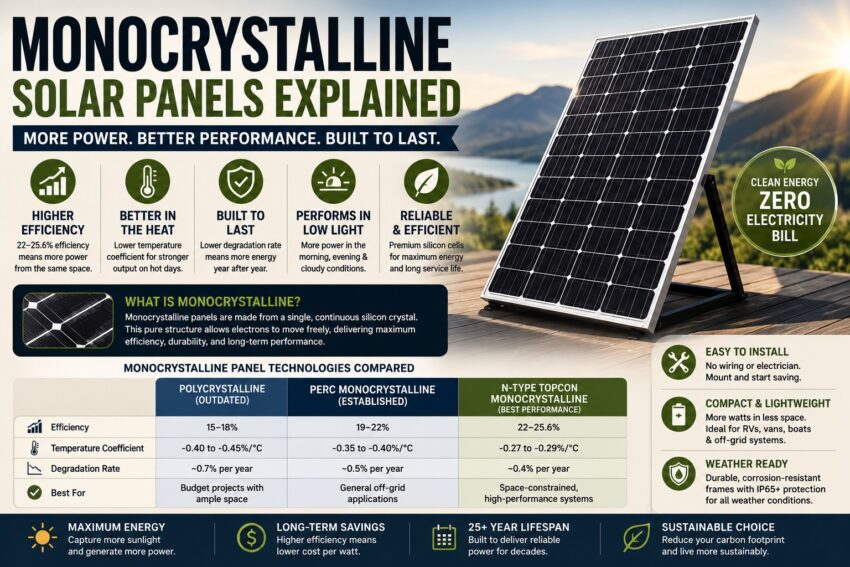
Every solar panel sold today is made from silicon — but not all silicon is the same. The word “monocrystalline” refers to how the silicon is structured at the atomic level, and that structure is what makes monocrystalline panels the best-performing solar panels available to consumers.
In a monocrystalline cell, the entire silicon wafer is cut from a single, continuous silicon crystal — grown slowly and carefully to achieve a perfectly uniform atomic lattice. That uniformity is what gives monocrystalline its efficiency advantage: electrons generated by sunlight move through the crystal with minimal resistance or disruption, maximising the conversion of light into electricity.
In a polycrystalline cell, the silicon is melted and poured into a mould, forming multiple crystals with grain boundaries between them. Those boundaries interrupt electron flow, reducing efficiency. Polycrystalline panels are recognisable by their speckled blue appearance — monocrystalline panels are uniformly dark, almost black.
The practical result: monocrystalline panels produce more electricity from the same surface area, perform better in low light, and lose less output in heat. This performance advantage has driven monocrystalline to essentially replace polycrystalline in the consumer market.
Monocrystalline vs. Polycrystalline — Is This Still a Relevant Comparison?
Less than it used to be. Polycrystalline panels have largely disappeared from the consumer market — the price difference has shrunk to almost nothing while the efficiency gap has widened. The more meaningful distinction today is within monocrystalline technology: PERC vs. N-Type TOPCon.
| Feature | Polycrystalline | PERC Monocrystalline | N-Type TOPCon |
|---|---|---|---|
| Typical efficiency | 15–18% | 19–22% | 22–25.6% |
| Temperature coefficient | -0.40 to -0.45%/°C | -0.35 to -0.40%/°C | -0.27 to -0.29%/°C |
| Degradation rate | ~0.7%/yr | ~0.5%/yr | ~0.4%/yr |
| Cost | Lowest | Moderate | Higher |
| Appearance | Speckled blue | Dark blue/black | Near black |
The choice in 2026 isn’t mono vs. poly. It’s PERC vs. N-Type — and the right answer depends on your budget and how much mounting space you have.
PERC Monocrystalline — The Established Workhorse
PERC stands for Passivated Emitter and Rear Contact. A standard monocrystalline cell has an aluminium back surface that reflects some unabsorbed light back through the silicon. PERC adds a passivation layer to the rear of the cell that does this more efficiently — reflecting longer-wavelength light while also reducing electron recombination. The result: 19–22% efficiency vs. 17–19% for standard monocrystalline.
PERC is proven, widely manufactured, well-priced, and available in every wattage from 50W to 400W+ from every major brand. The Renogy 100W RNG-100D-SS — the #1 bestselling solar panel on Amazon — is PERC monocrystalline. At ~$60 for a 100W panel with a 25-year power output warranty, it remains the default recommendation for most off-grid buyers.
N-Type TOPCon Monocrystalline — The Current Performance Leader
N-Type TOPCon represents the next generation of monocrystalline technology. The N-Type silicon uses phosphorus rather than boron doping, creating fewer impurities and less susceptibility to light-induced degradation. The TOPCon (Tunnel Oxide Passivated Contact) adds a passivating tunnel oxide layer that pushes efficiency to 25–25.6% in the best consumer panels.
Three meaningful advantages over PERC:
1. More power from the same size. A 100W N-Type panel at 25% efficiency is physically smaller than a 100W PERC panel at 21% efficiency. For space-constrained RV, van, and boat installations, that size difference is directly useful — the same mounting area produces more watts.
2. Better heat performance. N-Type panels have a temperature coefficient of -0.27 to -0.29%/°C vs. -0.35 to -0.40%/°C for PERC. On a hot summer day at 65°C panel temperature, an N-Type panel loses roughly 11–12% output while a PERC panel loses 14–16%. In hot climates, this difference compounds daily over 25 years.
3. Lower long-term degradation. At ~0.4%/yr vs. ~0.5%/yr for PERC, an N-Type panel retains approximately 90% of its original output at year 25 vs. ~87.5% for PERC — meaningful additional lifetime energy from the same panel.
The trade-off: N-Type panels cost 20–30% more than PERC panels of the same wattage. For space-constrained installations like RVs, vans, and boats, the premium is almost always worth it. For ground-mounted systems where more panels can be added instead, the calculus is less clear.
How to Read Monocrystalline Solar Panel Specs
Wattage (W) — rated power output under Standard Test Conditions (STC): 25°C panel temperature, 1,000W/m² irradiance. Real-world output is typically 10–25% below STC due to higher temperatures and varying sun angles.
Efficiency (%) — percentage of sunlight converted to electricity. Higher efficiency = more watts from the same physical area. Current PERC: 19–22%. Current N-Type TOPCon: 22–25.6%.
Voc (Open Circuit Voltage) — maximum voltage when no load is connected. The Voc of panels wired in series must not exceed your charge controller’s maximum input voltage.
Temperature coefficient (%/°C) — output loss per degree Celsius above 25°C. Lower (more negative) is better for hot climates. -0.29%/°C is meaningfully better than -0.40%/°C.
Power tolerance — the acceptable range around rated wattage. Quality panels specify positive-only tolerance (+0/+3%) — they produce at or above rated output. Panels with negative tolerance can legally deliver less than labelled.
IP rating — IP65 is the minimum for outdoor use. IP67 is available on premium panels for marine applications.
The Best Monocrystalline Solar Panels on Amazon Right Now
Every panel below is verified on Amazon with specs confirmed from official listings.
| Panel | Wattage | Cell Type | Efficiency | Temp Coeff | Warranty | Price |
|---|---|---|---|---|---|---|
| Renogy 100W (RNG-100D-SS) | 100W | PERC Mono | 21% | -0.29%/°C | 25yr power | ~$60 |
| Renogy 100W N-Type 16BB | 100W | N-Type TOPCon | 25% | -0.29%/°C | 25yr power | ~$80 |
| Renogy 200W N-Type 16BB | 200W | N-Type TOPCon | 25% | -0.29%/°C | 25yr power | ~$120 |
| ECO-WORTHY 100W PERC | 100W | PERC Mono | 23% | -0.35%/°C | 25yr power | ~$45 |
| DOKIO 100W Mono Rigid | 100W | Mono | 21% | — | 25yr power | ~$55 |
Renogy 100W PERC Monocrystalline (RNG-100D-SS) — Best Overall
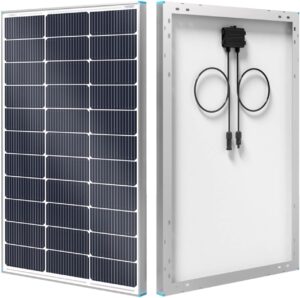
The Renogy 100W RNG-100D-SS is the #1 bestselling solar panel on Amazon — and has been for years. PERC monocrystalline cells deliver 21% efficiency with a temperature coefficient of -0.29%/°C — better heat performance than most budget competitors despite being a PERC design. At 11% smaller and 8% lighter than its predecessor with the same 100W output, it fits tight mounting configurations easily.
IP65 junction box, corrosion-resistant aluminium frame, and pre-drilled mounting holes make installation and future expansion straightforward. MC4 connectors work with any quality charge controller. Backed by Renogy’s 5-year materials warranty and 25-year power output warranty — supported by 13+ million customers and US-based support.
Pros: #1 Amazon bestseller, 21% PERC efficiency, -0.29%/°C temp coefficient, compact design, IP65, 25yr power warranty, best support ecosystem in off-grid solar
Cons: PERC rather than N-Type — 25% efficiency available from the N-Type version at a small premium
Best for: First solar system builds, RV and boat use, anyone wanting the most proven monocrystalline panel at the best price
Renogy 100W N-Type 16BB Monocrystalline — Best 100W High Efficiency
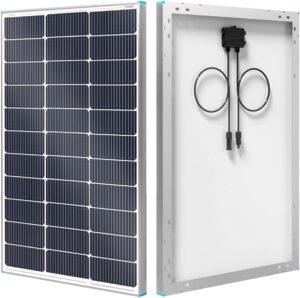
Everything the PERC version does, but with N-Type TOPCon cells that push efficiency to 25% and reduce degradation to ≤0.4%/yr. The 16BB busbar design minimises hotspot risk and improves partial shade performance. At ~$80 vs ~$60 for the PERC version, it’s a 33% price premium for a 19% efficiency improvement — worth it for space-constrained installations where every watt from a given footprint matters.
Same -0.29%/°C temperature coefficient, same IP65 protection, same 25-year power output warranty. Produces 20W more than a conventional PERC 100W panel of the same physical size.
Pros: 25% N-Type efficiency, 16BB anti-hotspot, ≤0.4%/yr degradation, 20W more than same-size PERC, full Renogy support
Cons: 33% more expensive than the PERC version — only pays off in space-constrained builds
Best for: RV roofs, van builds, and boat decks where maximising watts per square foot justifies the premium
Renogy 200W N-Type 16BB Monocrystalline — Best Value Per Watt
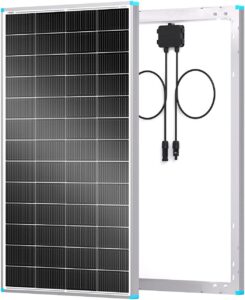
The Renogy 200W N-Type delivers 25% efficiency and -0.29%/°C temperature coefficient in a single panel at ~$120 — exceptional value per watt. For RV and boat installations, one 200W panel versus two 100W panels means fewer connections, simpler wiring, and a cleaner install with identical output. Compatible with both 12V and 24V battery systems. At ~$0.60/watt for 25% N-Type efficiency, it’s one of the best value propositions in the high-efficiency consumer solar market.
Pros: 25% N-Type at ~$0.60/watt, 12V/24V compatible, fewer connections than two 100W panels, ≤0.4%/yr degradation, 25yr power warranty
Cons: Single large panel less flexible for irregular mounting configurations
Best for: RV roofs and boat decks, 200–400W system builds wanting maximum performance per square foot
ECO-WORTHY 100W PERC Monocrystalline — Best Budget Panel
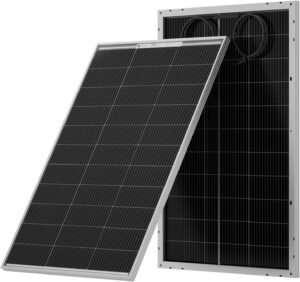
The ECO-WORTHY 100W is the most popular budget monocrystalline panel on Amazon, consistently delivering on its specs at ~$45 — roughly 25% below the Renogy equivalent. The 23% PERC efficiency is genuine, the IP65 junction box handles weather reliably, and the corrosion-resistant aluminium frame is rated to 2400Pa wind and 5400Pa snow loads. Pre-attached MC4 cables for quick installation.
The temperature coefficient of -0.35%/°C is slightly worse than Renogy’s -0.29%/°C — in hot climates this produces a small but real difference. For moderate climates and budget-conscious system builds, it’s negligible.
Pros: Best price at ~$45, 23% PERC efficiency, IP65, 25yr warranty, pre-attached cables, solid track record
Cons: -0.35%/°C temp coefficient slightly worse than Renogy
Best for: Budget system builds, adding panels to existing setups, cabins and sheds where cost per watt is the priority
DOKIO 100W Monocrystalline Rigid — Best Budget With Proven History
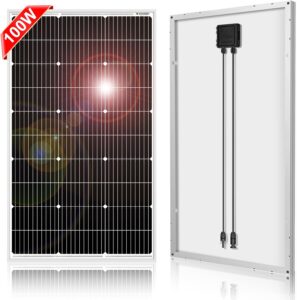
DOKIO has 17 years in the solar panel market — one of the longest track records of any consumer brand on Amazon. Their 100W rigid glass panel offers honest monocrystalline specs, glass-and-aluminium frame construction, MC4 connectors, and pre-drilled mounting holes at ~$55. The 17-year history means DOKIO’s warranty claims have genuine institutional backing — unlike brands that appeared on Amazon in the last 2–3 years.
Pros: 17 years brand history, honest specs, glass/aluminium frame, MC4 connectors, solid low-light performance
Cons: 21% efficiency at ~$55 vs ECO-WORTHY’s 23% at ~$45 — value proposition is tighter
Best for: Budget buyers who want a proven brand with real market longevity rather than a no-name alternative
Monocrystalline Solar Panels by Application
RV and van solar: Space is constrained — efficiency matters. Start with the Renogy 100W PERC for a budget-conscious first build, or the Renogy N-Type for maximum watts per square foot. For a complete system including charge controller and wiring, see our guide to the best RV solar panel kits.
Boat and marine: Same logic as RV — limited mounting space, premium on efficiency. IP65 minimum; consider IP67 for spray-exposed positions. Always use an MPPT charge controller — see our RV solar battery charger guide for marine-compatible options.
Cabin and shed: More mounting flexibility means cost per watt becomes the priority over efficiency. ECO-WORTHY 100W at ~$45 is excellent for cabin builds. See our solar power for shed guide for full sizing guidance.
Off-grid home: Multiple panels in a ground-mount array. ECO-WORTHY for tight budgets, Renogy PERC for reliability-first builds, Renogy N-Type for maximum lifetime output. Pair with a quality MPPT controller — see our solar charge controller guide.
Portable and camping: Rigid monocrystalline panels aren’t the right tool. See our guide to flexible solar panels for portable options.
What Charge Controller Do Monocrystalline Panels Need?
Always pair monocrystalline panels — especially N-Type — with an MPPT (Maximum Power Point Tracking) charge controller rather than PWM.
Monocrystalline panels, particularly N-Type TOPCon, have higher Voc (open circuit voltage) than older panel types. A PWM controller can’t take advantage of this voltage differential — it clips the extra voltage and wastes 20–30% of the energy the panel generates. An MPPT controller continuously tracks the optimal operating point and converts excess voltage into additional battery charging current, capturing the panel’s full output.
The rule: if your panel is monocrystalline at 200W or above, use MPPT. The efficiency gains recover the cost difference within a single season of use. See our solar charge controller guide for verified Amazon picks at every price point.
Frequently Asked Questions
What is a monocrystalline solar panel?
A monocrystalline solar panel uses cells cut from a single continuous silicon crystal — giving it a uniform structure that allows electrons to flow with minimal resistance. This makes monocrystalline panels more efficient than polycrystalline (multi-crystal) panels, which have grain boundaries that interrupt electron flow. All quality consumer solar panels sold today are monocrystalline.
What is the difference between PERC and N-Type monocrystalline?
Both are monocrystalline — the difference is in cell construction. PERC adds a passivation layer to the rear of the cell, improving light capture and reducing electron recombination, achieving 19–22% efficiency. N-Type TOPCon uses phosphorus-doped silicon plus a tunnel oxide passivating contact, achieving 22–25.6% efficiency, lower degradation (0.4% vs 0.5%/yr), and better heat performance. N-Type costs 20–30% more than PERC.
How long do monocrystalline solar panels last?
Quality monocrystalline panels carry 25-year power output warranties and typically maintain 87–90% of original output at year 25. The limiting factors are usually the junction box and connectors rather than the silicon cells — IP65+ rated panels with quality MC4 connectors consistently outlast cheaper alternatives with inferior weather sealing.
Can monocrystalline solar panels work in shade?
All solar panels lose output in shade. Modern monocrystalline panels with bypass diodes and 16BB designs handle partial shading better than older designs — when one cell is shaded, bypass diodes route current around it rather than letting it drag down the whole panel’s output. N-Type 16BB panels handle partial shading better than PERC.
What size monocrystalline solar panel do I need?
Calculate your daily watt-hours needed, divide by your average peak sun hours (typically 4–5 for most of the US), and add 20% buffer. For 1,000Wh daily need at 5 peak sun hours: 1,000 ÷ 5 × 1.2 = 240W of panels. See our off-grid solar system guide for full sizing detail.
Are monocrystalline panels worth the extra cost over polycrystalline?
Yes — but the comparison is largely academic since quality polycrystalline panels have effectively disappeared from the consumer market. The meaningful comparison today is PERC monocrystalline vs. N-Type monocrystalline, not mono vs. poly.
The Bottom Line
Monocrystalline solar panels are the default choice for every consumer off-grid solar application in 2026 — the question is which type and which brand. For most buyers, the Renogy 100W PERC (RNG-100D-SS) at ~$60 is the right starting point: proven, widely documented, and backed by the strongest customer support ecosystem in off-grid solar.
If mounting space is constrained — RV roof, van, boat — step up to the Renogy N-Type. The 25% efficiency in the same footprint pays for itself in additional power every single day for the next 25 years.
And if budget is the first constraint, the ECO-WORTHY 100W at ~$45 genuinely delivers what it claims and is one of the best value solar panels available anywhere on Amazon.
For more on choosing the right panels for your specific situation, see our guides on cheap solar panels for budget-focused buyers and high efficiency solar panels for performance-first buyers — they cover everything built on the foundation explained here.