This post contains affiliate links. If you buy through our links we may earn a small commission — at no extra cost to you. This never influences our recommendations.
What Is an MPPT Solar Charge Controller?
Every solar system that charges a battery needs a charge controller between the panels and the battery. Without one, solar panels would overcharge and destroy the battery within days. The charge controller regulates the voltage and current flowing from the panels into the battery, managing the charging process through bulk, absorption, and float stages — charging efficiently without causing damage.
There are two types: PWM (Pulse Width Modulation) and MPPT (Maximum Power Point Tracking). MPPT is the type worth buying for any serious solar installation.
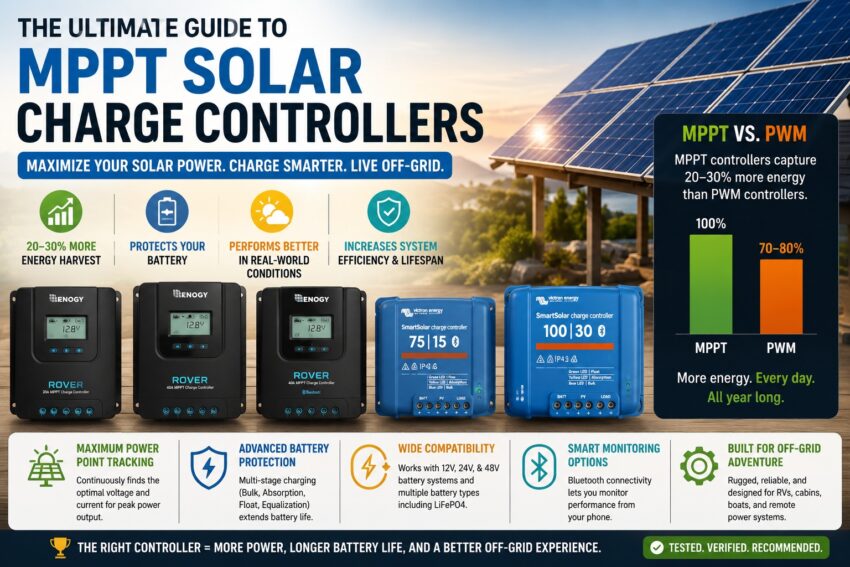
The core difference in one sentence: A PWM controller wastes 20–30% of your panel’s output by clipping excess voltage. An MPPT controller converts that excess voltage into additional charging current, capturing it rather than discarding it.
Solar panels have a maximum power point — the voltage/current combination that produces peak power output. This point shifts continuously based on temperature, cloud cover, and sun angle. An MPPT controller continuously tracks this moving target and adjusts its operating point in real time, extracting the maximum available power at any given moment.
The practical result: In real-world conditions — partial cloud, morning and evening sun, cold weather — an MPPT controller delivers 20–30% more energy into your battery than a PWM controller connected to the same panels. On a 400W system producing 1,700Wh per day with MPPT, a PWM controller would deliver only 1,200–1,360Wh. That’s 340–500Wh per day lost — the equivalent of running a 12V camping fridge for 7–11 extra hours, every single day.
MPPT vs. PWM — When Each Makes Sense
| Factor | MPPT | PWM |
|---|---|---|
| Energy recovery | 20–30% more than PWM | Baseline |
| Cost | Higher (~$60–$200+) | Lower (~$15–$50) |
| Panel compatibility | Any panel voltage | Panel Vmp must ≈ battery voltage |
| Performance in cold | Excellent — captures voltage boost | Poor — clips cold-weather voltage rise |
| Partial shade performance | Good — finds best operating point | Poor |
| Justification | Systems 200W+ | Systems under 100W with matched panels |
The honest sizing rule: For any system 200W or above, use MPPT — the energy recovery pays for the cost difference within the first season. Below 100W in a warm climate with panels closely matched to battery voltage, PWM is acceptable. Between 100W and 200W, MPPT is still the better long-term choice.
The Two Numbers That Define an MPPT Controller
Maximum PV input voltage (Vmax)
The highest voltage the controller can safely accept from panels. Panels wired in series add their voltages together. On a cold morning, panel open-circuit voltage (Voc) rises above its rated value — sometimes significantly.
The rule: add up the Voc of all panels in your series string, then multiply by 1.25. The result must be below the controller’s maximum input voltage.
Example: three 100W panels each with Voc of 22.5V in series:
22.5V × 3 × 1.25 = 84.4V → requires a controller rated for at least 85V (100V recommended)
Maximum charge current (Amps)
Determines how much current the controller can push into your battery. The formula:
Controller amps needed = (Total panel wattage × 1.25) ÷ Battery voltage
- 400W on a 12V system: (400 × 1.25) ÷ 12 = 41.7A → 40A controller minimum
- 400W on a 24V system: (400 × 1.25) ÷ 24 = 20.8A → 20A or 30A controller
How to Size an MPPT Controller for Your System
| Panel Array | Battery Voltage | Min Controller | Recommended |
|---|---|---|---|
| Up to 200W | 12V | 20A MPPT | 20A MPPT 75V+ |
| Up to 400W | 12V | 40A MPPT | 40A MPPT 100V+ |
| Up to 400W | 24V | 20A MPPT | 30A MPPT 100V+ |
| Up to 800W | 24V | 40A MPPT | 40A MPPT 150V+ |
| Up to 1,200W | 48V | 30A MPPT | 40A MPPT 150V+ |
Always leave headroom for expansion. A 40A controller sized for your current 400W system will also handle 500W without replacement — sensible planning that avoids a costly upgrade later.
For a complete sizing walkthrough for different system types, see our off-grid solar system guide and our RV solar panel kit guide.
The Best MPPT Solar Charge Controllers on Amazon Right Now
Every controller below is verified on Amazon with specs confirmed from official listings.
| Controller | Amps | Max PV Voltage | Bluetooth | Price | Best For |
|---|---|---|---|---|---|
| Renogy Rover 20A MPPT | 20A | 100V | Add-on | ~$60 | 100–200W systems |
| Renogy Rover 40A MPPT | 40A | 100V | Add-on | ~$90 | 200–400W systems |
| Renogy Rover 40A + Bluetooth | 40A | 100V | ✅ Built-in | ~$110 | 200–400W with monitoring |
| Victron SmartSolar 75/15 | 15A | 75V | ✅ Built-in | ~$80 | 100–200W, best monitoring |
| Victron SmartSolar 100/30 | 30A | 100V | ✅ Built-in | ~$160 | 200–400W, premium choice |
Renogy Rover 20A MPPT — Best for 100–200W Systems
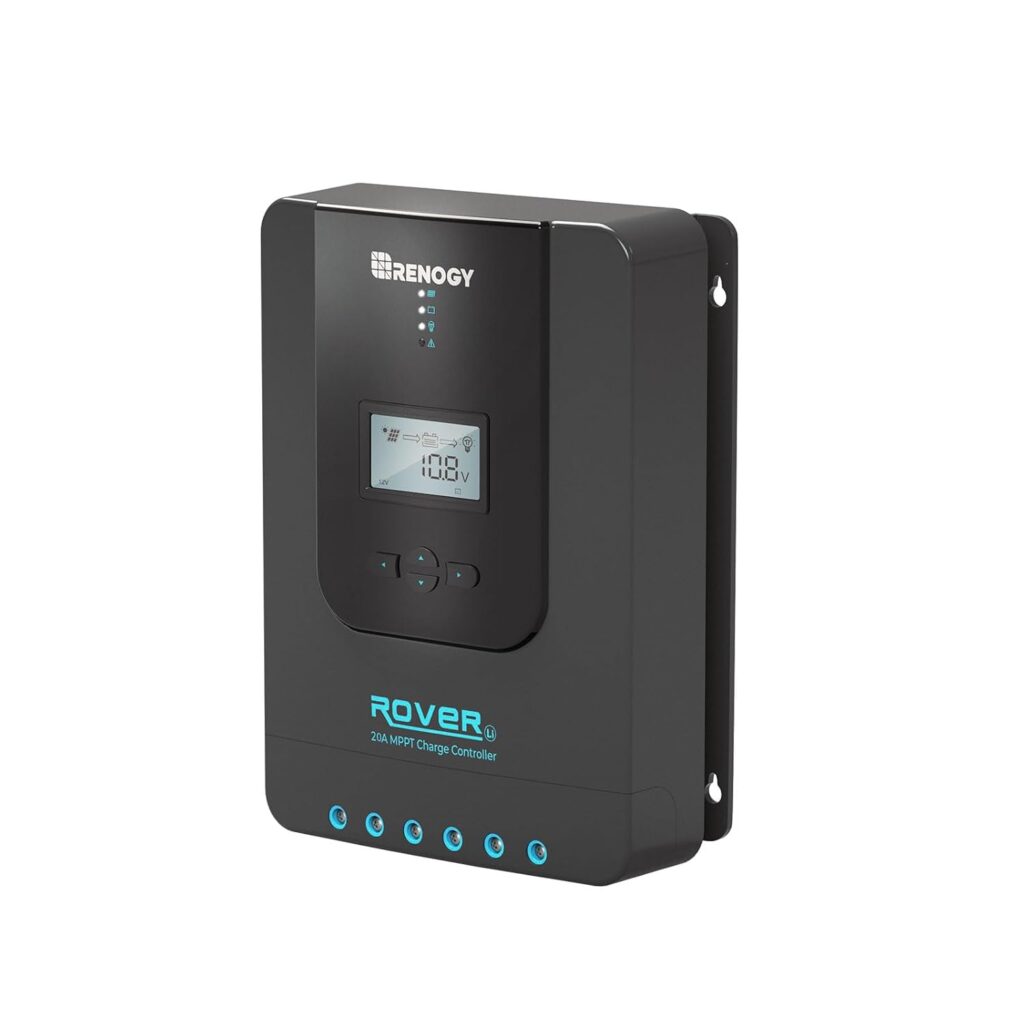
The Renogy Rover 20A auto-detects 12V or 24V systems and is fully compatible with gel, sealed, flooded, and lithium batteries. Advanced dual-peak MPPT algorithms deliver 98% conversion efficiency, maximising harvest even in cloudy conditions and with partially shaded panels. The 4-stage charging (bulk, absorption, float, equalization) maintains battery health over thousands of cycles. The lithium recovery feature can revive deeply discharged LiFePO4 batteries — a useful safety net for off-grid systems that occasionally run flat.
Bluetooth monitoring requires the BT-1 or BT-2 module sold separately (~$15–$30). If you want built-in Bluetooth at this amperage, the Victron SmartSolar 75/15 is the alternative at a similar price point.
Pros: Right size for 100–200W systems, 99% tracking efficiency, 4-stage charging, lithium recovery, auto 12V/24V detection, LCD display, Renogy ecosystem compatible
Cons: No built-in Bluetooth — requires separate module, 100V PV max limits some series wiring configurations
Best for: 100–200W off-grid systems, RV starter setups, shed and cabin systems on a budget
Renogy Rover 40A MPPT — Best Mid-Range Controller
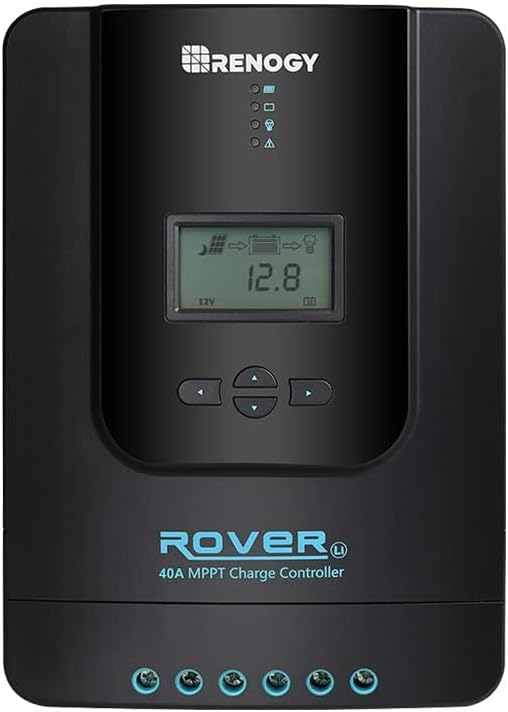
The Rover 40A masters partial shading and cloudy conditions with 99.9% multi-peak tracking efficiency — with advanced algorithms delivering 98% conversion efficiency even with damaged or partially shaded panels. Engineered for demanding RV solar systems, off-grid cabins, and marine setups, with full compatibility with gel, sealed, flooded, and lithium batteries.
The dual-peak tracking algorithm is a real-world advantage for RV installations where shading from trees or structures is common — it scans the full power curve to find the true maximum power point rather than getting stuck at a local maximum caused by shading. TVS surge protection blocks 6kV lightning strikes with reverse polarity and overload safeguards. The 365-day data logging and Modbus protocol support remote monitoring and smart home integration. This controller is included in Renogy’s Premium 400W kit — the most proven complete kit on Amazon.
Pros: 99.9% dual-peak MPPT, handles 400–520W on 12V, 4-stage charging with lithium recovery, 6kV lightning protection, 365-day logging, Modbus support
Cons: No built-in Bluetooth — BT-1 or BT-2 module sold separately, 100V PV voltage limit
Best for: 200–500W systems, RV solar, off-grid cabins, marine installations — the default choice for most off-grid buyers at this power level
Renogy Rover 40A MPPT with Bluetooth — Best Value Monitored Controller
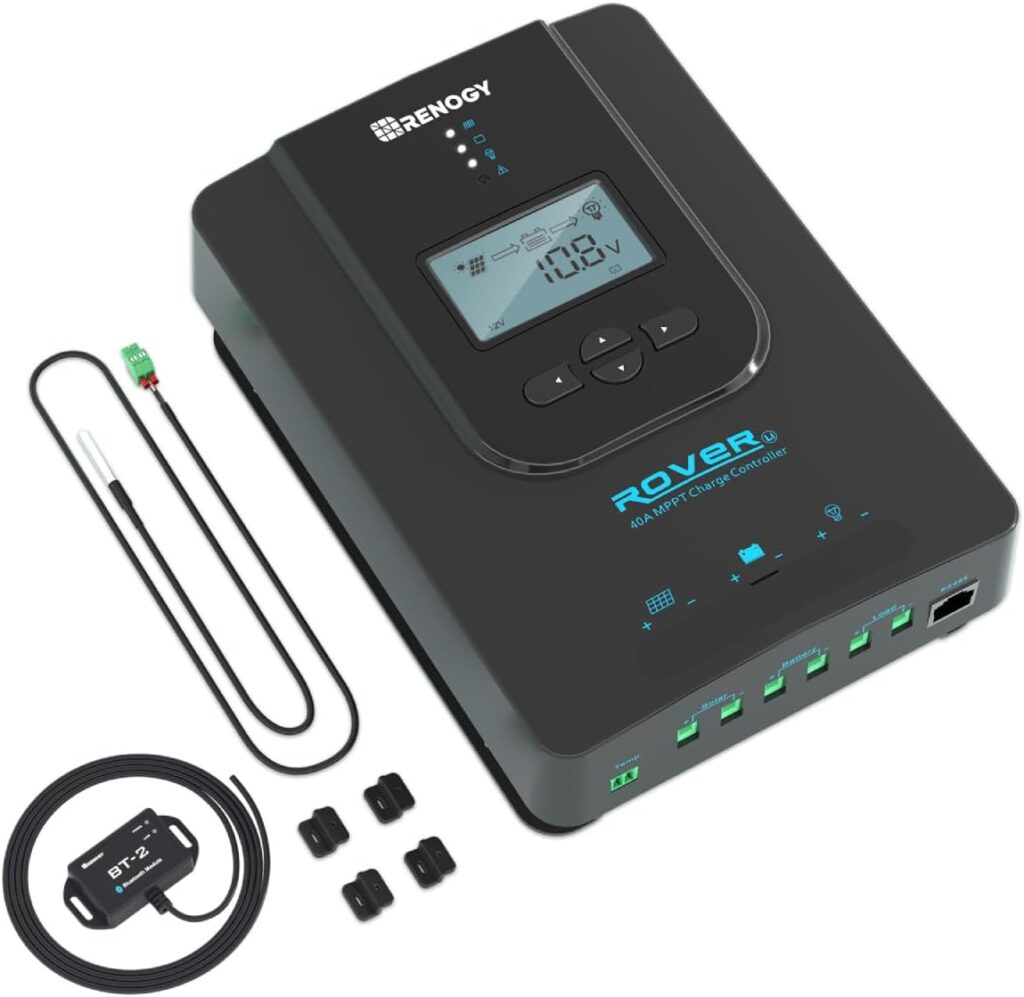
All the capabilities of the standard Rover 40A with built-in Bluetooth connectivity for real-time monitoring and parameter adjustments via the Renogy DC Home App. At ~$110 — just $20 more than buying the standard 40A and a BT-1 module separately — this is the practical choice for anyone who wants Rover performance with integrated monitoring from day one.
The Renogy DC Home App shows real-time input wattage, battery state of charge, load output, and 30-day historical charging data from up to 82 feet. Checking your solar from inside the RV or cabin without going to the controller is something you use every single day — the built-in module is worth the small premium over the add-on.
Pros: Same Rover 40A performance, built-in Bluetooth saves separate module purchase, real-time and historical monitoring, 99.9% dual-peak MPPT
Cons: Renogy app functional but less polished than Victron’s VictronConnect, 100V PV voltage limit
Best for: Anyone building a Renogy 400W system who wants monitoring built in from day one
Victron SmartSolar MPPT 75/15 — Best Premium Small System Controller
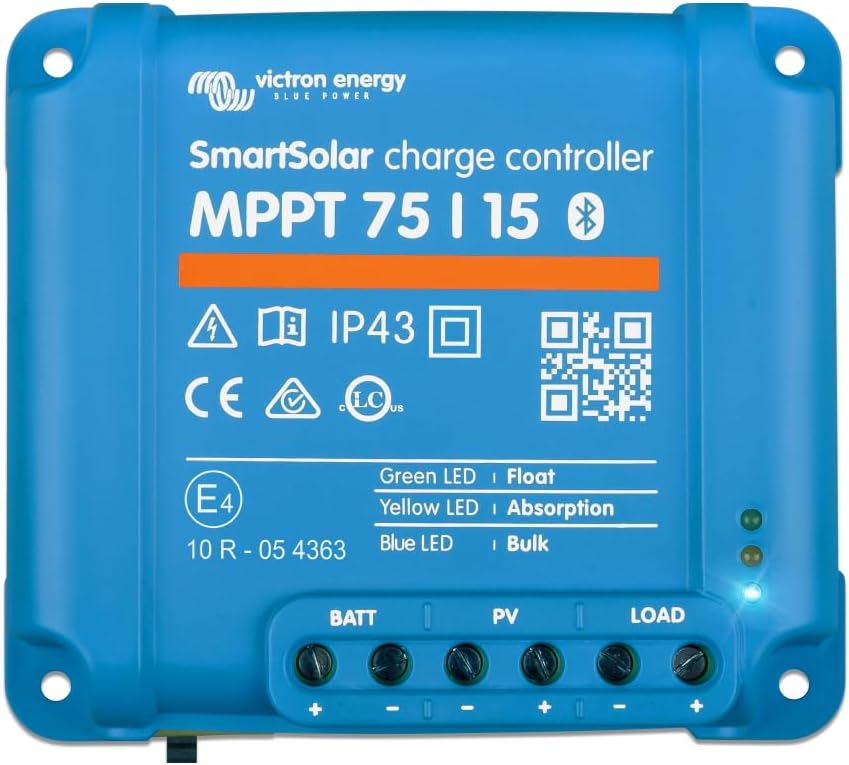
Victron’s MPPT tracking algorithm is widely regarded as the fastest and most accurate in the consumer market — the brand professional installers reach for when performance is the priority. The SmartSolar 75/15 uses ultra-fast MPPT technology to pull the highest possible power even during partial shading and automatically works with 12V or 24V systems.
Bluetooth is built in with no separate module required. The VictronConnect app — trusted by millions worldwide — shows real-time solar output, daily yield, battery status, and 30-day historical data, and allows configuration changes directly from your smartphone. VictronConnect is genuinely superior to Renogy’s app: cleaner interface, more detailed data, more battery configuration options, and optional remote access via the VRM portal.
The 75V PV input limit means panels must be wired to keep Voc below 60V (operating). For two 100W panels in series (Voc ~45V), fine. Three panels in series approaches the limit. For larger series strings, step up to the 100/30.
Pros: Industry-leading MPPT algorithm, built-in Bluetooth, best monitoring app (VictronConnect), compact aluminium enclosure, 5-year warranty, professional-grade reliability
Cons: 75V PV limit restricts series wiring with higher-Voc panels, premium price for 15A capacity, no LCD display
Best for: 100–200W systems where monitoring quality and tracking accuracy matter most — van builds, boats, and anyone wanting the best monitoring ecosystem
Victron SmartSolar MPPT 100/30 — Best Premium Mid-Range Controller
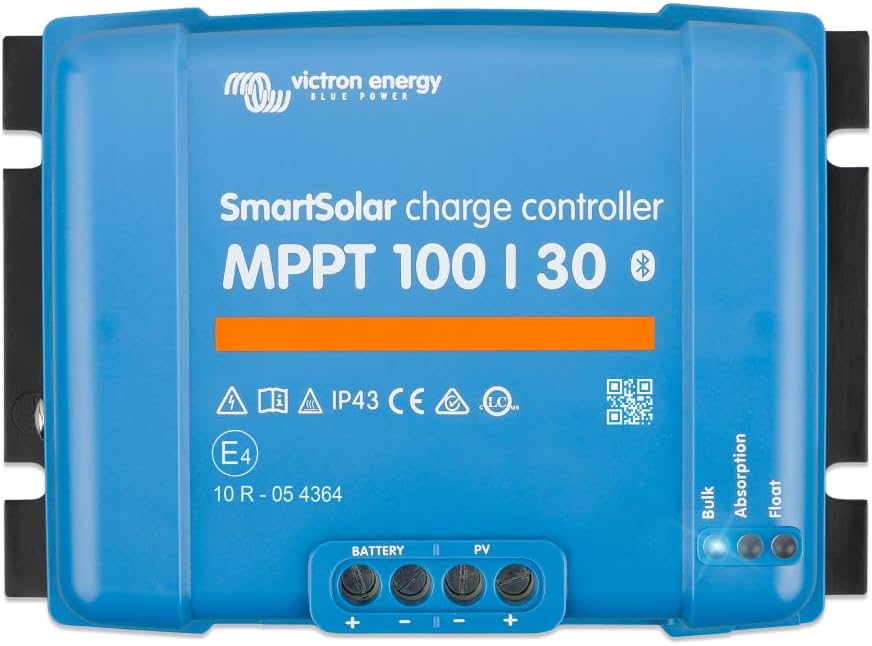
The SmartSolar 100/30 steps up to 30A charge current and 100V PV input — the right Victron controller for most 400W off-grid and RV systems. The SafetyShield+ protection suite includes temperature-compensated charging, over-temperature protection, and safeguards against PV short-circuits, reverse polarity, and reverse current.
At 30A on a 12V system it handles up to 360W of panels; on a 24V system up to 720W — covering most residential off-grid and RV applications. The 100V PV input accommodates wider series wiring options than the 75/15. Ultra-fast MPPT tracking maximises energy even from partially shaded panels, and the VictronConnect app allows monitoring and configuration from anywhere.
Pros: 30A handles most 400W systems, 100V PV input, Victron’s best-in-class MPPT algorithm, built-in Bluetooth, VictronConnect app, 5-year warranty, SafetyShield+ protection
Cons: Higher price than Renogy equivalent, 30A limits at 12V for full 400W (40A is more appropriate at 12V)
Best for: Van builds, boats, cabins, and serious off-grid installers who want the most reliable controller and best monitoring ecosystem
MPPT Features Worth Paying For
Built-in Bluetooth vs. add-on module: Both work — but built-in Bluetooth means one less thing to buy and one less connection to fail. If you’re going to monitor your system (and you should), built-in is worth the small premium.
Dual-peak or multi-peak MPPT tracking: Standard MPPT algorithms find one local maximum power point. Multi-peak algorithms scan the full power curve — critical when partial shading creates multiple local maxima. Renogy’s dual-peak and Victron’s ultra-fast tracking both address this, particularly relevant for RV and van installations under trees.
Temperature compensation: Battery charging voltage needs to be higher in cold and lower in heat. A controller with temperature compensation adjusts automatically. Victron SmartSolar includes temperature compensation; Renogy Rover includes a temperature sensor in the box.
LiFePO4 presets and lithium recovery: All five picks support LiFePO4, but support quality varies. Victron allows precise custom charging profiles for any lithium chemistry. Renogy includes specific LiFePO4 presets and lithium recovery for deeply discharged batteries.
Connecting Your MPPT Controller — The Right Wiring Order
This is the most important practical instruction for first-time installation. Get the sequence wrong and you’ll damage the controller.
Always connect in this order:
- Battery to controller first — always
- Solar panels to controller second — only after battery is connected
Disconnect in reverse order:
- Solar panels first
- Battery second
Connecting panels before battery can create a voltage spike that damages the controller’s internal circuitry. Every manufacturer specifies this sequence in their manual for good reason.
Wire sizing: A 40A system requires minimum 8 AWG for runs under 10 feet and 6 AWG for longer runs. Use UV-rated, tinned-copper wire for outdoor installations.
Fusing: Always install a fuse between the battery and charge controller — sized to the controller’s maximum charge current (40A controller = 40A ANL fuse). This protects the wiring against short circuits. See our solar battery charger guide for compatible fusing and wiring accessories.
MPPT Controllers and Battery Types
Sealed/AGM lead-acid: Fully supported by all picks. Use the sealed or AGM preset. No equalization needed.
Flooded lead-acid: Fully supported. Enable equalization to prevent sulfation — monthly or quarterly depending on use.
LiFePO4: Supported by all picks with a specific LiFePO4 preset or custom profile. The controller must charge to 14.2–14.6V (12V system) and equalization must be disabled. Victron’s custom profile capability gives the most precise LiFePO4 control.
For RV battery charging considerations, see our RV solar battery charger guide.
Frequently Asked Questions
What is the difference between MPPT and PWM solar charge controllers?
A PWM controller sends power to the battery in pulses, throttling panel output to match battery voltage — wasting any panel voltage above the battery voltage. An MPPT controller converts excess panel voltage into additional charging current, recovering 20–30% more energy from the same panels every day. For any system 200W or above, MPPT is the correct choice.
How do I know what size MPPT controller I need?
Calculate: (Total panel watts × 1.25) ÷ battery voltage = minimum controller amps. Round up to the next standard size (20A, 30A, 40A). Also verify that your series panel voltage (Voc × panels in series × 1.25) stays below the controller’s maximum PV input voltage.
Can I use a 40A MPPT controller with only 200W of panels?
Yes — a controller can be oversized without any problem. The controller simply won’t reach its maximum current output until you add more panels. It’s often sensible to buy a 40A controller for a 200W system if you plan to expand to 400W later — one less component to replace.
Do MPPT controllers work better in cold weather?
Yes — this is one of their most underappreciated advantages. Cold temperatures increase panel Voc significantly. A PWM controller clips this voltage increase, wasting the energy. An MPPT controller converts it into additional charging current. In winter or cold climates, the MPPT advantage over PWM often exceeds the typical 20–30% figure.
What is the best MPPT charge controller for a van or RV?
For most van and RV systems with 200–400W of solar, the Renogy Rover 40A with Bluetooth is the best value choice — proven reliability, dual-peak MPPT, built-in monitoring, and compatibility with the Renogy panel ecosystem. For builders who want the best monitoring experience and are willing to pay the premium, the Victron SmartSolar 100/30 is the professional choice.
Final Verdict
| Your Situation | Best Pick |
|---|---|
| 100–200W system, budget | Renogy Rover 20A MPPT |
| 200–400W system, best value | Renogy Rover 40A MPPT |
| 200–400W with built-in monitoring | Renogy Rover 40A with Bluetooth |
| 100–200W, best monitoring | Victron SmartSolar MPPT 75/15 |
| 200–400W, premium choice | Victron SmartSolar MPPT 100/30 |
| Van build or boat | Victron SmartSolar (best monitoring) |
The MPPT charge controller is one of the most important components in a solar system — arguably more important than which brand of panel you choose. A quality MPPT controller recovers 20–30% more energy from your panels every single day for the life of the system. That energy recovery compounds across thousands of sunny days.
For most buyers, the Renogy Rover 40A with Bluetooth is the right answer — proven, capable, well-supported, and priced to match the Renogy ecosystem. For those who want the best monitoring and tracking algorithm available, Victron SmartSolar is worth the premium.
For complete solar system builds around these controllers — panels, batteries, and wiring — see our off-grid solar system guide. For the panels themselves, see our guides to cheap solar panels, high efficiency solar panels, and monocrystalline solar panels. For RV-specific systems, our RV solar panel kit guide covers complete kits with controllers pre-matched to panels.