
This post contains affiliate links. If you buy through our links we may earn a small commission — at no extra cost to you. This never influences our recommendations.
Bluetti has built its reputation on a straightforward value proposition: more watt-hours and higher output per dollar than Jackery or EcoFlow at comparable price points, backed by LiFePO4 batteries rated for 3,000–6,000+ cycles. With models ranging from budget-friendly entry units to expandable home-backup systems, the lineup spans a wide range — this guide maps it clearly and tells you which model actually fits your situation.
Why Bluetti’s Value Proposition Holds Up
Bluetti uses LiFePO4 (LFP) battery chemistry across its entire current lineup — rated for 3,000 to 6,000+ cycles to 80% capacity, compared to the 500–2,500 cycle range typical of NMC lithium-ion batteries some competitors still use in select models. At daily use, that’s the difference between roughly 3–5 years and closer to a decade of usable battery life. Independent six-month testing across multiple current Bluetti models measured capacity degradation between 0.6% and 1.4% after 38–58 cycles — tracking consistently with the brand’s stated multi-thousand-cycle projections.
The Current Bluetti Lineup at a Glance
| Model | Capacity | Output | AC Charge (0–80%) | Solar Input | Best For |
|---|---|---|---|---|---|
| AC70 | 768Wh | 1,000W / 2,000W surge | 45 min | 500W max | Weekend van trips, best energy density |
| AC180 | 1,152Wh | 1,800W / 2,700W surge | 45 min | 500W max | Best overall value, serious camping |
| AC200L | 2,048Wh | 2,400W | 45 min | 900W max | Home backup, RV with 30A hookup, expandable |
Best Bluetti Models — Verified Picks
Best for Weekend Van Trips: BLUETTI AC70
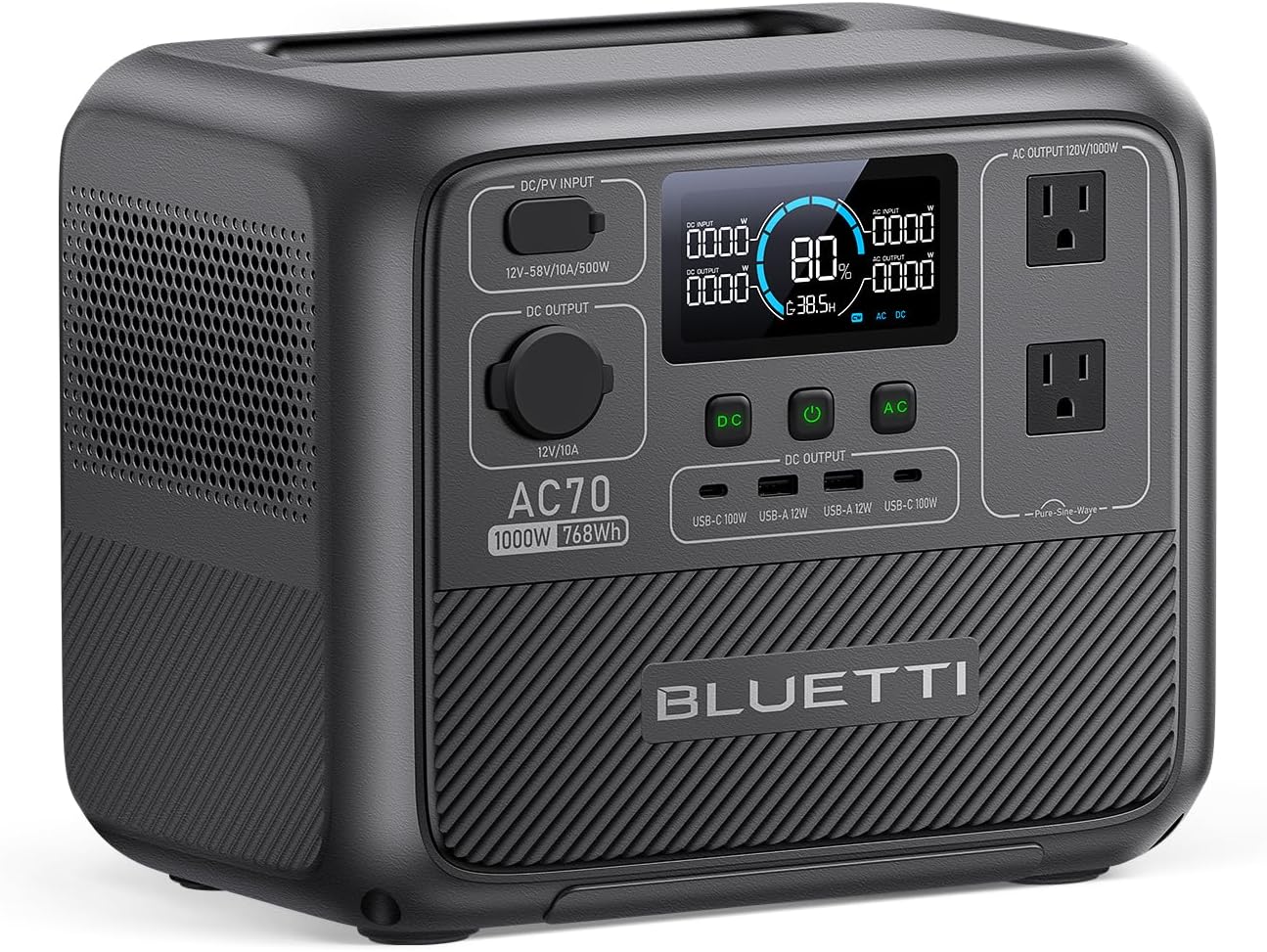
At 768Wh in a 22.5 lb package, the AC70 delivers the best energy density in its price range — roughly 34Wh per pound, genuinely noticeable when carrying it between a vehicle and a campsite. In real-world three-day testing, its 1,000W inverter (2,000W in Power Lifting mode) handled a 12V fridge, laptop, and camera charging simultaneously without issue. Turbo charging reaches 80% in 45 minutes via AC — fast enough for a coffee shop stop between destinations to leave you with a near-full battery.
The B80 expansion battery option scales total capacity to 1,574Wh when needed, then detaches for lighter day trips — genuinely useful modularity that most fixed-capacity competitors at this size don’t offer. Solar input maxes at 500W, delivering a full recharge in roughly 2 hours with well-matched panels. Independent testing flagged one build-quality note: the plastic housing flexes slightly under pressure — not a dealbreaker for occasional use, but worth knowing if you’re rough on gear.
Pros: Best energy density in its class (34 Wh/lb), 45-min turbo charge, modular B80 expansion option, handles fridge+laptop+camera simultaneously in real testing
Cons: Plastic housing flexes under pressure in independent testing; 500W solar input trails the larger models
Best for: Weekend van life trips, solo campers who value portability, buyers who want fridge-and-device coverage without carrying a bigger unit
Best Overall Value: BLUETTI AC180
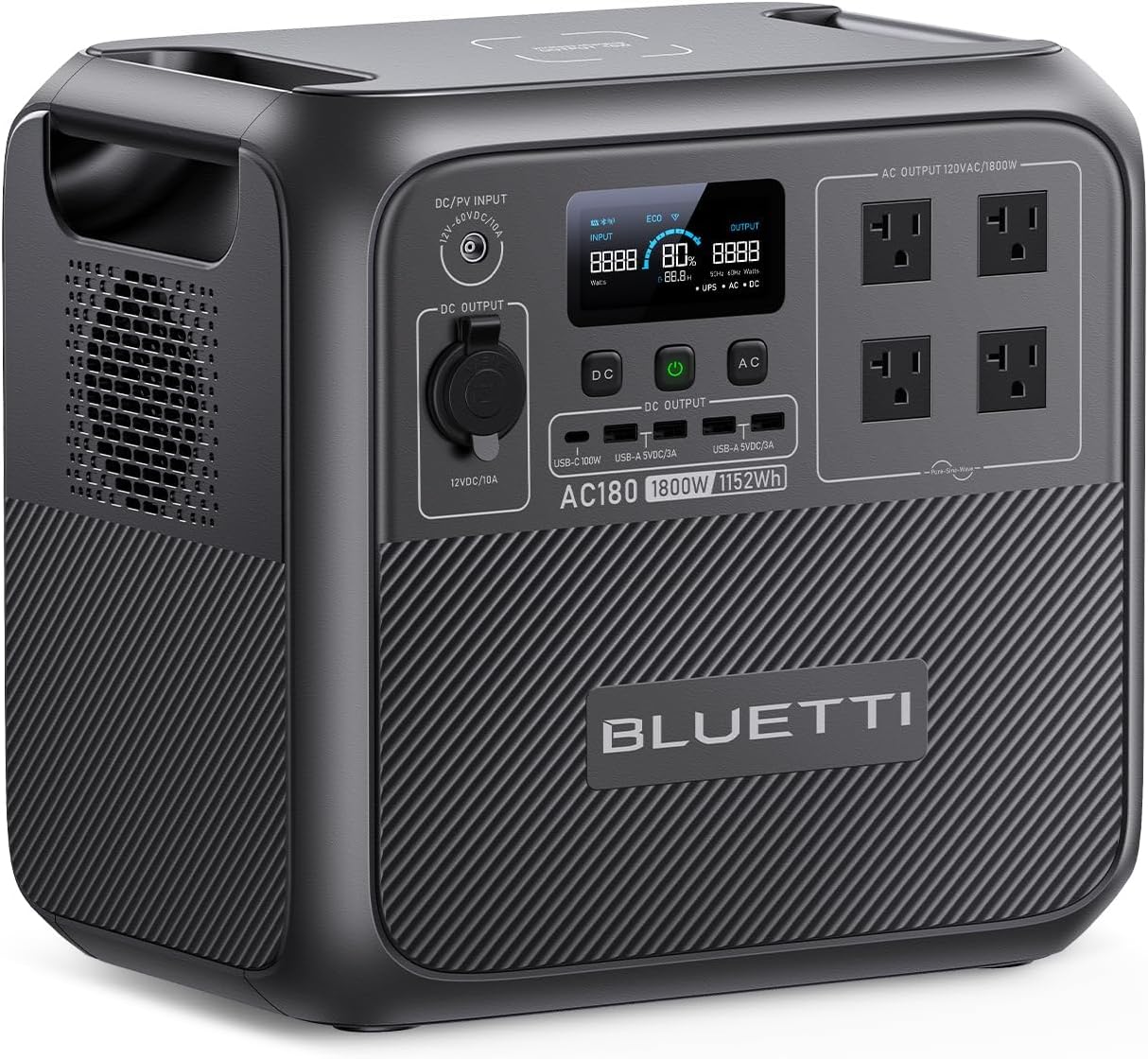
The AC180 is repeatedly ranked as Bluetti’s strongest value pick — 1,152Wh of capacity, 1,800W continuous output (2,700W via Power Lifting mode), and the same 45-minute turbo charge to 80% as the rest of the current lineup, all at a price point that consistently undercuts comparable competitors by hundreds of dollars. Independent testing measured real-world efficiency at approximately 82% — roughly 945Wh of genuinely usable energy from the 1,152Wh rating, a useful number to plan around rather than the spec-sheet figure alone.
Expansion via the B80 battery pack (806Wh) brings total capacity to 1,958Wh for a moderate additional cost — a reasonable upgrade path if your needs grow. The 500W solar input accommodates typical van roof arrays (300–500W) without needing an oversized panel setup. For a full deep-dive review including honest efficiency testing and real-world drawbacks, see our Bluetti AC180 review.
Pros: Strongest value-per-dollar in Bluetti’s lineup, 45-min turbo charge, expandable via B80 battery, well-matched to typical van solar arrays
Cons: Real-world efficiency (~82%) trails the rated capacity — plan around ~945Wh usable rather than the full 1,152Wh spec
Best for: Budget-conscious buyers wanting proven reliability, van lifers with regular access to shore power for quick charging
Best for Home Backup and RV Use: BLUETTI AC200L
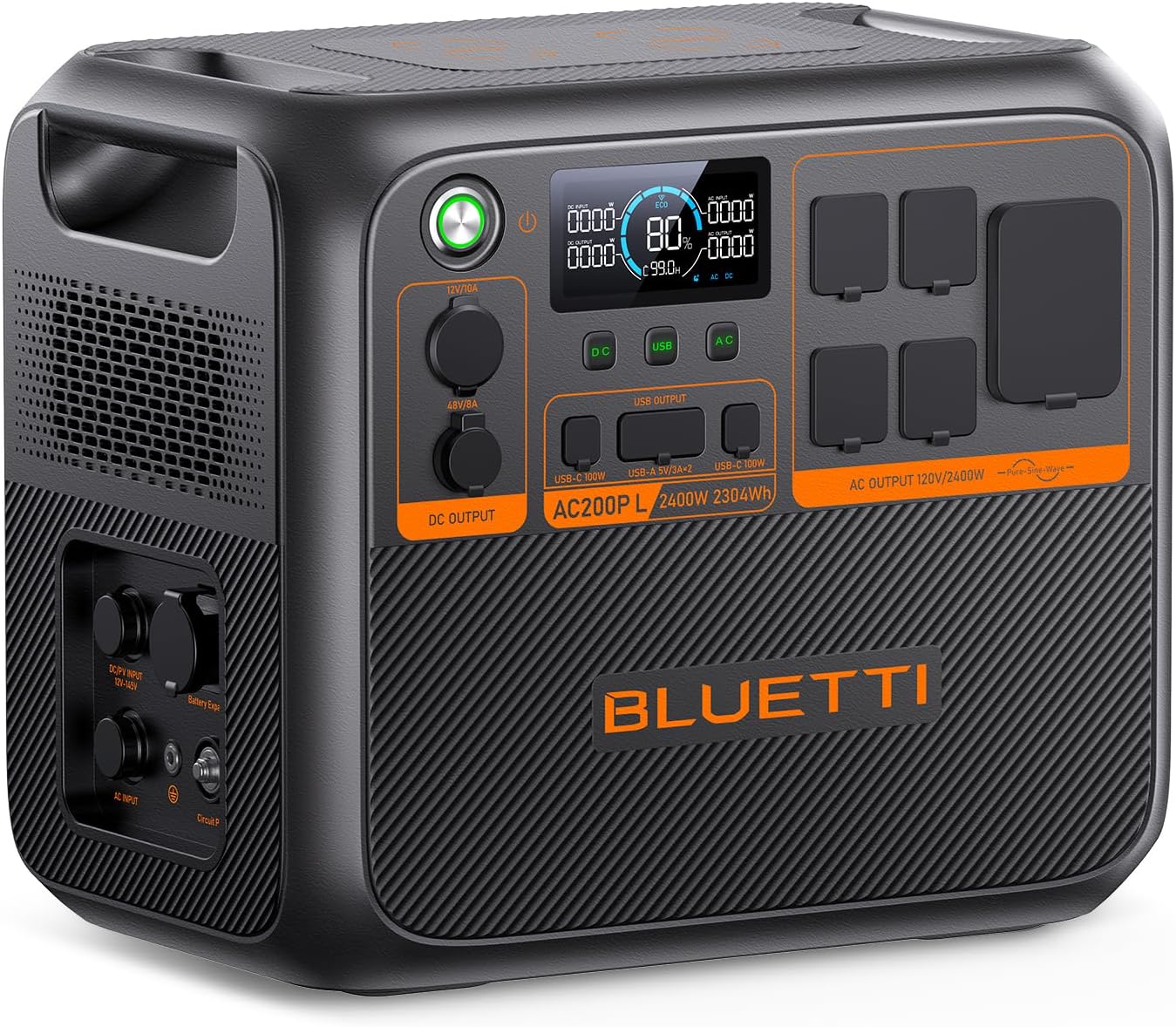
The AC200L sits at the top of this comparison for good reason — 2,048Wh capacity, 2,400W continuous AC output, and the same class-leading 45-minute charge to 80% found throughout the current lineup, but at a capacity level that genuinely supports home backup and RV integration rather than just weekend trips. Six simultaneous charge methods — AC, solar, car, generator, and more — mean you’re never dependent on a single power source to recharge, a genuine practical advantage during extended outages with unpredictable weather.
The native NEMA TT-30R (30A) port is the standout feature for RV owners specifically — it connects directly to a rig’s shore power inlet without an adapter, changing how the whole unit integrates into a van or trailer’s electrical system. Expandable up to 7kWh via external battery modules, the AC200L offers the most future-proof capacity path under $1,000 in Bluetti’s current catalog, and the 900W max solar input supports a genuinely fast off-grid recharge with 2–3 panels. For a full breakdown of RV-specific sizing across brands, see our solar generator for RV guide.
Pros: Native TT-30R (30A) RV port, expandable to 7kWh, six simultaneous charge methods, 45-min charge at this capacity is class-leading, 900W solar input
Cons: Heaviest and priciest model in this comparison; overkill for simple weekend camping needs
Best for: Full-time RVers, home backup through extended outages, buyers who want the most expandable and future-proof option under $1,000
Sizing Solar Panels to Your Bluetti Model
| Model | Solar Input Ceiling | Recommended Panel Setup |
|---|---|---|
| AC70 | 500W | One or two 200–350W panels |
| AC180 | 500W | Two 350W panels in parallel for sub-90-min charging |
| AC200L | 900W | Three 350W panels (1,050W combined) for near-max throughput |
For general-purpose panels compatible across brands (not just Bluetti’s own lineup), see our 200 watt solar panel guide and 300 watt solar panel guide.
Beyond This Comparison: Bluetti’s Premium Tier
For buyers whose needs exceed even the AC200L’s 2,048Wh base capacity, Bluetti’s Elite 200 V2 and flagship Apex 300 target full-time off-grid living with dual-voltage output and more aggressive expansion ecosystems — the Apex 300 specifically supports scaling well beyond 7kWh through its modular battery system, at a correspondingly higher entry price. These sit outside the scope of this comparison but are worth researching if you’re planning serious whole-home or full-time off-grid infrastructure beyond what a single AC200L covers.
Bluetti vs Jackery vs Anker vs EcoFlow
Value per watt-hour: Bluetti consistently delivers more capacity and output per dollar than Jackery, EcoFlow, or Anker at comparable price points — the core reason for its growing market share.
Cycle life: Bluetti’s 3,000–6,000+ cycle LiFePO4 batteries are competitive with or exceed the cycle ratings across all three other brands’ current LFP-based models.
Charging speed: Bluetti’s 45-minute charge to 80% is consistent across nearly its entire current lineup — matching Anker’s fastest models and beating EcoFlow’s standard DELTA charge times.
Ecosystem maturity: Jackery and EcoFlow both have longer market track records and larger accessory ecosystems; Bluetti’s expansion system (B80 battery packs) is solid but newer to some models than the equivalent options from these competitors.
For the other three brands’ full lineups, see our best Jackery solar generator guide, Anker solar generator guide, and best EcoFlow solar generator guide.
Frequently Asked Questions
What is the best Bluetti solar generator overall?
For most buyers, the AC180 offers the strongest value — meaningful capacity, fast charging, and a price that consistently beats comparable competitors. For home backup or RV integration specifically, the AC200L’s expandability and native TT-30R port make it the better long-term investment despite the higher price.
Is Bluetti a reliable brand compared to Jackery or EcoFlow?
Yes — Bluetti has an active user community, responsive official support channels, and independent six-month degradation testing across multiple models tracked consistently with stated cycle-life projections. Warranty terms range from 2 to 5 years depending on the model, with some flagships extending to 5 years with product registration.
How does Bluetti’s real-world efficiency compare to advertised capacity?
Independent testing on the AC180 specifically measured roughly 82% real-world efficiency — about 945Wh of usable energy from a 1,152Wh rating. This gap between rated and delivered capacity is normal for inverter-based power stations across the industry, not unique to Bluetti, but it’s a more honest number to plan runtime expectations around.
Can I expand a Bluetti power station’s capacity later?
Yes, on most current models. The AC70 and AC180 both support B80 expansion battery packs, and the AC200L expands up to 7kWh via external battery modules. This lets you start with a base unit and scale capacity later rather than replacing the whole system if your needs grow.
Which Bluetti model has a native RV shore power port?
The AC200L includes a native NEMA TT-30R (30A) port, connecting directly to an RV’s shore power inlet without an adapter. The AC70 and AC180 do not include this port and would need a standard adapter for RV shore power connection.
Final Verdict
| Your Situation | Best Pick |
|---|---|
| Weekend van trips, best portability-to-capacity ratio | BLUETTI AC70 (B0CLG6FYLQ) |
| Best overall value | BLUETTI AC180 (B0C1SMJTDT) |
| Home backup, RV with 30A hookup, expandable | BLUETTI AC200L (B0D17CW6KK) |
For most buyers, the AC180 is the easiest recommendation — Bluetti’s clearest value proposition, backed by fast charging and a solid expansion path if your needs grow. Van lifers who prioritize portability above raw capacity should look at the AC70, and anyone planning genuine home backup or full-time RV use should go straight to the AC200L for its native RV port and expandability to 7kWh.
For a broader comparison across all major brands, see our best Jackery solar generator guide, Anker solar generator guide, and portable power station guide for the complete picture across every option.