The Problem Most 300Wh Power Stations Have
Most compact power stations in this class feel like they were designed for exactly one use case — camping once a year, or keeping a phone alive during a short outage. They hit a wall fast. One appliance, one evening, and you’re rationing what’s left.
The BLUETTI Apex 300 was built to fix that. It’s not just another small-capacity box. BLUETTI gave it expandable battery support, serious solar input, and an output list that covers real household needs — not just USB charging and one AC outlet.
This review breaks down everything: specs, real-world performance, what it handles well, what it doesn’t, and exactly who should buy it.
BLUETTI Apex 300 Overview
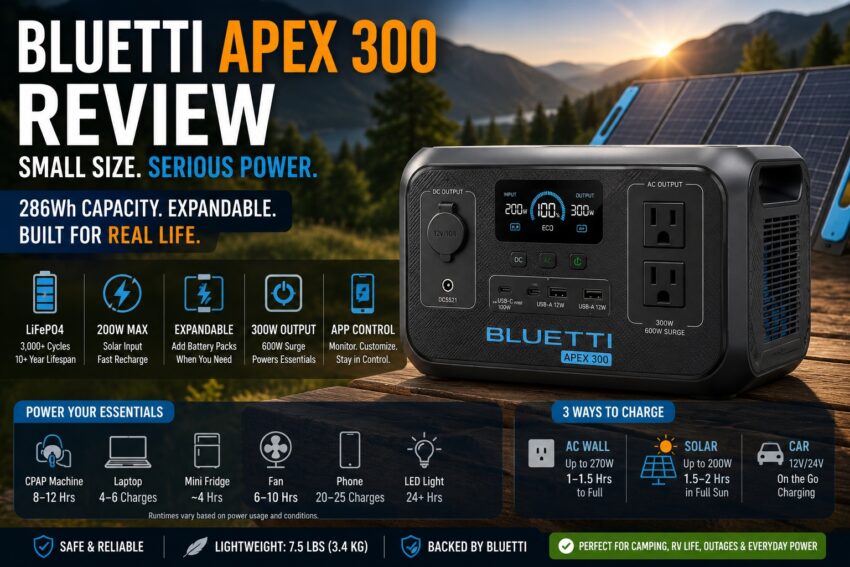
The Apex 300 is BLUETTI’s latest compact solar generator, sitting at 286.72Wh of base capacity with a LiFePO4 (lithium iron phosphate) battery at its core. That chemistry matters — it’s safer, runs cooler, and lasts significantly longer than standard lithium-ion cells used in budget units.
What makes it stand out in the sub-300Wh category is its battery expansion capability. You’re not locked into the base capacity. BLUETTI designed the Apex 300 to grow with your needs, which is rare at this price and size.
It also pulls up to 200W via solar, charges via AC wall outlet, car port, or dual-source simultaneously. For a unit this size, that’s a well-rounded charging lineup.
BLUETTI Apex 300 Specs at a Glance
| Spec | Detail |
|---|---|
| Capacity | 286.72Wh (expandable) |
| Battery Type | LiFePO4 (lithium iron phosphate) |
| AC Output | 300W (600W surge) |
| AC Outlets | 2 × AC outlets |
| USB-A Output | 2 × USB-A (12W each) |
| USB-C Output | 2 × USB-C (100W each) |
| DC Output | 1 × DC5521 (12V/10A) |
| Car Port | 1 × DC Car Port (12V/10A) |
| Max Solar Input | 200W |
| AC Charging | Up to 270W |
| Expansion Battery Compatible | Yes (BLUETTI B60 / compatible packs) |
| Weight | Approx. 7.5 lbs (3.4 kg) |
| Display | LED/LCD information display |
| App Control | Yes (Bluetooth / BLUETTI app) |
| Battery Lifespan | 3,000+ charge cycles to 80% capacity |
Key Features of the BLUETTI Apex 300
LiFePO4 Battery Chemistry
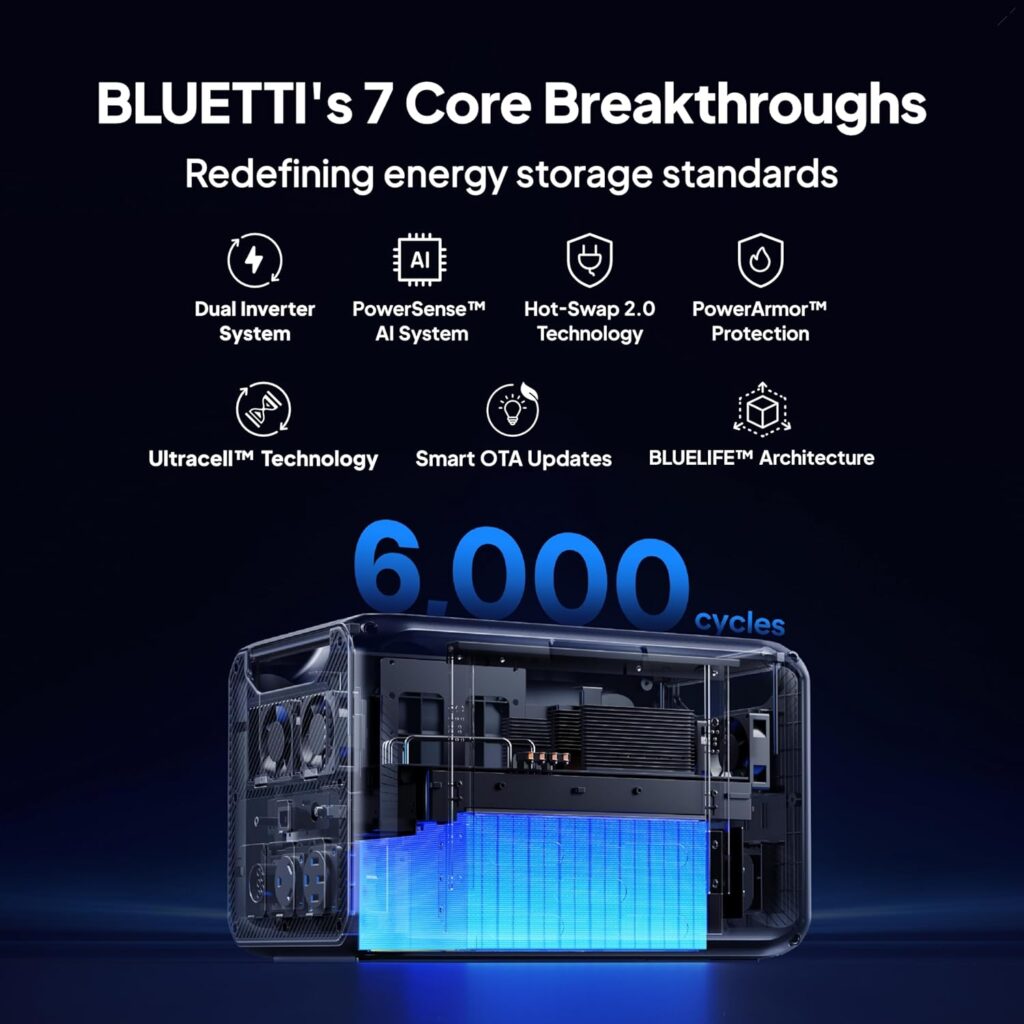
This is the first thing worth calling out. LiFePO4 chemistry gives the Apex 300 a rated 3,000+ cycle lifespan — that’s roughly 8–10 years of daily use before the battery degrades to 80% capacity. Cheaper units use lithium-ion or NMC chemistry with cycle counts closer to 500–800.
It also runs cooler and has a lower risk of thermal runaway. For something you’re using indoors during an outage or sleeping near on a camping trip, that safety margin matters.
Expandable Capacity
The headline feature. The Apex 300 supports battery expansion packs, letting you stack additional capacity without buying a whole new unit. If you start with 286Wh and find that’s not enough for a weekend off-grid, you can add a pack and double or triple your usable energy.
This kind of modularity is usually reserved for BLUETTI’s larger units like the AC200MAX. Bringing it down to the compact class is a smart move — and a real differentiator.
If you want to see how this compares to BLUETTI’s larger modular approach, the Bluetti AC200MAX review is worth a read.
200W Solar Input
For a 286Wh battery, 200W of solar input is fast. In peak sun conditions, you’re looking at roughly 1.5 to 2 hours to a full charge from solar alone — which is genuinely impressive at this size and price point.
The MPPT charge controller built into the unit maximizes what your panels deliver. If you’re pairing it with quality monocrystalline panels, you’ll see the best results. Our guide to monocrystalline solar panels breaks down which panel types give you the most efficient harvest.
Want to understand how the MPPT side of things works under the hood? The explainer on MPPT solar charge controllers covers the tech in plain English.
Output Ports — All Bases Covered
The Apex 300 has two 100W USB-C ports, which means you can fast-charge two laptops simultaneously while still running something on AC. That’s unusual at this capacity tier. Most competitors give you one USB-C at 60W and call it a day.
Two AC outlets at 300W continuous (600W surge) handle small appliances — a mini fridge, a CPAP machine, a small TV, or a fan without any drama. The 600W surge rating means motors that need a startup spike won’t trip the unit.
App Control
The BLUETTI app (iOS and Android) connects via Bluetooth and gives you a real-time view of input/output wattage, battery percentage, estimated runtime, and charging mode settings. You can also enable ECO mode remotely, which automatically shuts the unit down when it detects very low draws — useful for overnight charging scenarios.
Real-World Performance
What It Can Run
At 300W continuous AC output, the Apex 300 covers a solid list of real-world loads. Here’s a practical breakdown:
- CPAP machine (no humidifier): 8–12 hours on a full charge
- Laptop: 4–6 full charges
- Smartphone: 20–25 charges
- LED TV (40″): 4–5 hours
- Mini fridge (60W): ~4 hours continuous, longer with cycling
- Box fan: 6–10 hours depending on speed setting
- LED lighting: Well over 24 hours
- Drone battery charger: Multiple charge cycles
It won’t run a microwave, hair dryer, or electric kettle — those pull 800W–1500W, well above the 300W limit. But for anything that draws under 300W, it handles the job cleanly.
Charging Speed
AC wall charging at up to 270W means you’re back to full in about 1–1.5 hours from a standard outlet. That’s fast. Plenty of comparable units in this class take 3–5 hours on AC.
Solar charging at up to 200W is equally impressive. You won’t hit 200W unless you’re using panels rated at that input in ideal conditions, but even at 120–150W from a single 200W panel in good sun, you’re looking at 2–2.5 hours to full. For a weekend camping setup, that’s workable on a cloudy day too.
For a complete camping power setup, our guide to solar power for camping pairs well with the Apex 300’s capabilities.
Noise and Heat
The internal fan is quiet — noticeably quieter than many competing units. Under moderate load, you’ll barely notice it. It kicks up slightly under heavy AC draw, but never gets disruptive. Heat output is minimal, which lines up with what you’d expect from LiFePO4 chemistry.
Weight and Portability
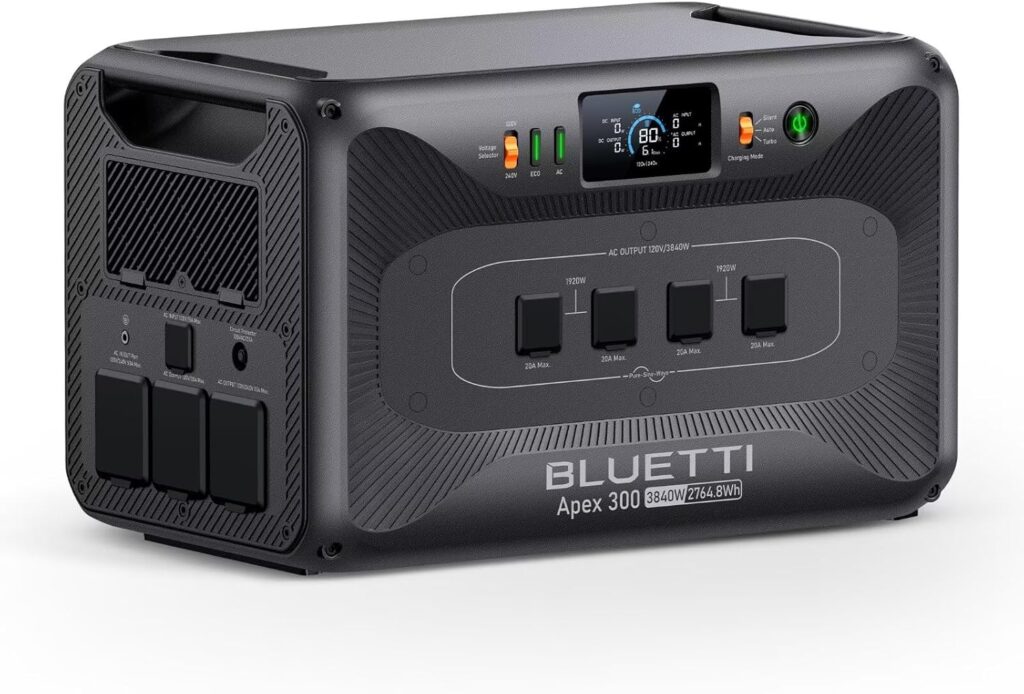
At roughly 7.5 lbs, this is one-hand portable. You can toss it in a car trunk, haul it to a campsite, or carry it up stairs during a home outage without it being a chore. The handle design is solid — no flex, no awkward grip.
BLUETTI Apex 300: Pros and Cons
| Pros | Cons |
|---|---|
| LiFePO4 battery — long lifespan, safe chemistry | 300W AC limit rules out high-draw appliances |
| Expandable battery — rare at this size | Expansion packs are an added cost |
| 200W solar input — fast recharge | No wireless charging pad |
| Fast AC wall charging (270W) | Base 286Wh capacity fills quickly under heavy loads |
| Dual 100W USB-C ports | App occasionally slow to sync via Bluetooth |
| Lightweight and truly portable | Single DC5521 output (limited for DC setups) |
| App control with real-time monitoring | |
| Quiet fan operation |
Who the BLUETTI Apex 300 Is Built For
Campers and Overlanders
If you spend weekends off-grid and want to keep devices charged, run a fan, and power a light or two without worrying about a dead battery by morning — the Apex 300 fits. The solar charging speed means a few hours of sun restores what you used overnight.
Pair it with a 200W panel, and you have a system that can sustain itself across a multi-day trip. Check out our guide to solar power for camping for help building a full setup around this unit.
Home Backup Users
For shorter outages — a few hours to half a day — the Apex 300 keeps the essentials running: a router, phone, laptop, and medical devices like CPAP machines. The expansion battery option means you can scale up if your outages run longer.
If you’re serious about home backup and want to understand the broader system picture, our roundup of the best solar generators for home backup gives a useful comparison framework.
Remote Workers and Van Lifers
Two 100W USB-C ports and a 300W AC outlet handle a laptop, monitor, and phone simultaneously. That’s a proper remote work rig in a 7.5-lb box. Couple it with a rooftop panel and you’ve got a sustainable daily power loop.
Emergency Preparedness
Compact enough to store in a closet, fast enough to charge from a wall outlet in 90 minutes before a storm hits. The LiFePO4 chemistry means it holds charge well during storage and doesn’t degrade as quickly sitting unused — a real advantage for an emergency kit that doesn’t get used daily.
Who It’s NOT For
If you need to power a full-size refrigerator, a sump pump, or any large appliance over 300W — this isn’t your unit. You’d want to look at a 1000W+ station for those loads. The Apex 300 is a compact, everyday-portable power solution, not a whole-home backup system.
Verdict
The BLUETTI Apex 300 earns its place in a crowded market by doing things that most compact power stations don’t bother with. LiFePO4 chemistry, expandable battery support, 200W solar input, and dual 100W USB-C ports in a sub-8-lb unit is a serious combination.
The base 286Wh capacity won’t last forever under heavy use, but the expansion path means you’re not stuck. You can start small and scale up without buying a new unit. That’s the right way to design a power station.
For campers, remote workers, emergency preparedness, or anyone who wants reliable portable power without lugging around a 30-lb suitcase — this is a genuinely strong pick in 2026.
Frequently Asked Questions
What can the BLUETTI Apex 300 power?
It can run anything that draws under 300W continuously. That includes laptops, TVs, fans, CPAP machines, mini fridges, lights, and most small kitchen appliances like a coffee grinder or slow cooker. High-draw devices like microwaves and hair dryers exceed its 300W AC limit.
How long does the BLUETTI Apex 300 take to charge?
From a wall outlet at 270W, roughly 1 to 1.5 hours. From solar at the full 200W input, approximately 1.5 to 2 hours in good sun. Car charging is slower, typically 5–6 hours via the 12V port.
Can you expand the BLUETTI Apex 300’s battery capacity?
Yes. The Apex 300 supports compatible BLUETTI expansion battery packs, allowing you to add capacity beyond the base 286.72Wh. This is one of its most unique features in the compact power station category.
Is the BLUETTI Apex 300 safe to use indoors?
Yes. LiFePO4 batteries are among the safest battery chemistries available — they’re far less prone to thermal runaway than standard lithium-ion. The unit produces no fumes and is designed for indoor use during outages.
How many solar panels can the BLUETTI Apex 300 support?
It accepts up to 200W of solar input total. You can use a single 200W panel or combine two smaller panels as long as you stay within the voltage and wattage limits in the manual. Always check open-circuit voltage (Voc) stays within the unit’s rated solar input range.
Does the BLUETTI Apex 300 work with any solar panels?
It works with any compatible solar panels within its MPPT input specs. BLUETTI’s own panels are optimized for their units, but third-party panels work fine as long as the voltage range matches. Our guide to 400W solar panels and what to pair them with covers compatible options in detail.
How long does the battery last before it needs replacing?
BLUETTI rates the Apex 300’s LiFePO4 battery at 3,000+ charge cycles to 80% capacity. If you cycle it once per day, that’s over 8 years of daily use. Occasional-use scenarios extend that lifespan considerably. For context on how solar battery life compares to panel longevity, see our piece on how long solar panels last.
Is the BLUETTI Apex 300 worth it compared to other compact power stations?
For the combination of LiFePO4 chemistry, expandability, 200W solar input, and dual 100W USB-C outputs, the Apex 300 offers standout value in its class. The main trade-off is the 300W AC ceiling — if your needs exceed that, you’d need a larger unit. If they don’t, it’s hard to beat at this size and weight.
Disclosure: As an Amazon Associate, I earn from qualifying purchases.