
This post contains affiliate links. If you buy through our links we may earn a small commission — at no extra cost to you. This never influences our recommendations.
Choosing a solar generator for an RV is different from choosing one for camping or home backup. The capacity needs are higher, the daily loads are more demanding, and — for full-timers especially — the unit needs to handle repeated deep cycling without degrading quickly. You also need to think about how it connects to your RV’s power system, whether it has a TT-30R port for direct hookup, and how fast it recharges from solar so you’re not sitting in a cloudy campsite with a dead battery.
This guide covers how to size a solar generator for your specific RV use case, what specs actually matter for RV power, and the best picks at each capacity level.
How Much Power Does an RV Actually Need?
The answer varies more than most guides admit. A teardrop trailer used for weekend camping has completely different power needs than a Class A motorhome used full-time. Start with your actual daily loads before buying anything.
| Load | Typical Draw | Daily Use | Daily Wh |
|---|---|---|---|
| 12V compressor fridge | 40–50W | 24 hrs cycling | 480–600Wh |
| Residential fridge (if applicable) | 100–150W | 24 hrs cycling | 800–1,200Wh |
| LED lighting | 20–40W | 5 hrs | 100–200Wh |
| Laptop + phone charging | 80–100W | 4–6 hrs | 320–600Wh |
| CPAP (no humidifier) | 30–60W | 8 hrs | 240–480Wh |
| Starlink (portable mode) | 65–75W | 8 hrs | 520–600Wh |
| RV roof AC (5,000 BTU) | 450–600W | 4 hrs | 1,800–2,400Wh |
| Electric skillet / induction cooktop | 1,000–1,800W | 0.5–1 hr | 500–1,800Wh |
Add your expected daily loads, then apply a 1.25× safety factor for inverter losses and inefficiencies. That gives you your minimum daily energy requirement. Your solar generator’s capacity should cover at least one full day’s needs — ideally 1.5–2 days to handle cloudy stretches without running flat.
Quick sizing reference:
| RV Use Case | Daily Load | Minimum Capacity | Recommended |
|---|---|---|---|
| Teardrop / small trailer, weekend use | 500–800Wh | 1,000Wh | 1,000–1,500Wh |
| Mid-size RV, no AC, part-time | 800–1,200Wh | 1,500Wh | 2,000Wh |
| Full-time RV, no AC | 1,200–2,000Wh | 2,000Wh | 2,000–3,000Wh |
| Full-time RV with AC use | 3,000–5,000Wh | 3,500Wh+ | Expandable system 4,000Wh+ |
The TT-30R Port — Why It Matters for RV Use
Most RVs use a TT-30R (30 amp) shore power connection — the standard RV campground hookup plug. A solar generator with a built-in TT-30R port connects directly to your RV’s shore power inlet, exactly like plugging into a campground pedestal. Without it, you’re running extension cords and adapters to standard household AC outlets — workable but significantly less convenient and less efficient.
Only a handful of solar generators include a TT-30R port. Of the picks in this guide, the Bluetti AC200L is the standout for this feature. The EcoFlow DELTA 2 Max and Anker SOLIX C1000 Gen 2 use standard household outlets — you’ll need a TT-30 adapter if connecting to your RV’s shore power inlet, which does work but adds a step.
Solar Input — How Fast Can It Recharge From Panels?
For boondocking and off-grid camping, solar recharge speed is as important as capacity. A solar generator that takes 8–10 hours to recharge from panels is only useful if you have reliable full sun all day. Here’s how the top RV options compare:
| Model | Max Solar Input | Recharge Time (full sun) |
|---|---|---|
| EcoFlow DELTA 2 Max | 1,000W | ~2.5 hrs (400W panel) |
| Bluetti AC200L | 1,200W | ~1.7–2.2 hrs (1200W input) |
| Jackery Explorer 2000 Plus | 1,200W | ~2.5 hrs (6×200W panels) |
| Anker SOLIX C1000 Gen 2 | 600W | ~2 hrs (600W panels) |
Higher solar input ceiling means faster recharge from the same number of panels — and the flexibility to add more panels later if needed. For extended boondocking where you’re relying entirely on solar, a 1,000W+ solar input capability gives meaningful headroom.
Best Solar Generators for RV — Verified Picks
| Model | Capacity | Output | Solar Input | TT-30R | Best For |
|---|---|---|---|---|---|
| EcoFlow DELTA 2 Max | 2,048Wh | 2,400W | 1,000W | No (adapter needed) | Best overall — most RVers |
| Bluetti AC200L | 2,304Wh | 2,400W | 1,200W | Yes — 30A native | Best for full-time RV, direct hookup |
| Jackery Explorer 2000 Plus | 2,042Wh | 3,000W | 1,200W | No (adapter needed) | Best for high-wattage loads, expandability |
| Anker SOLIX C1000 Gen 2 | 1,024Wh | 2,000W | 600W | No (adapter needed) | Best for small RVs, teardrops, supplemental |
Best Overall: EcoFlow DELTA 2 Max
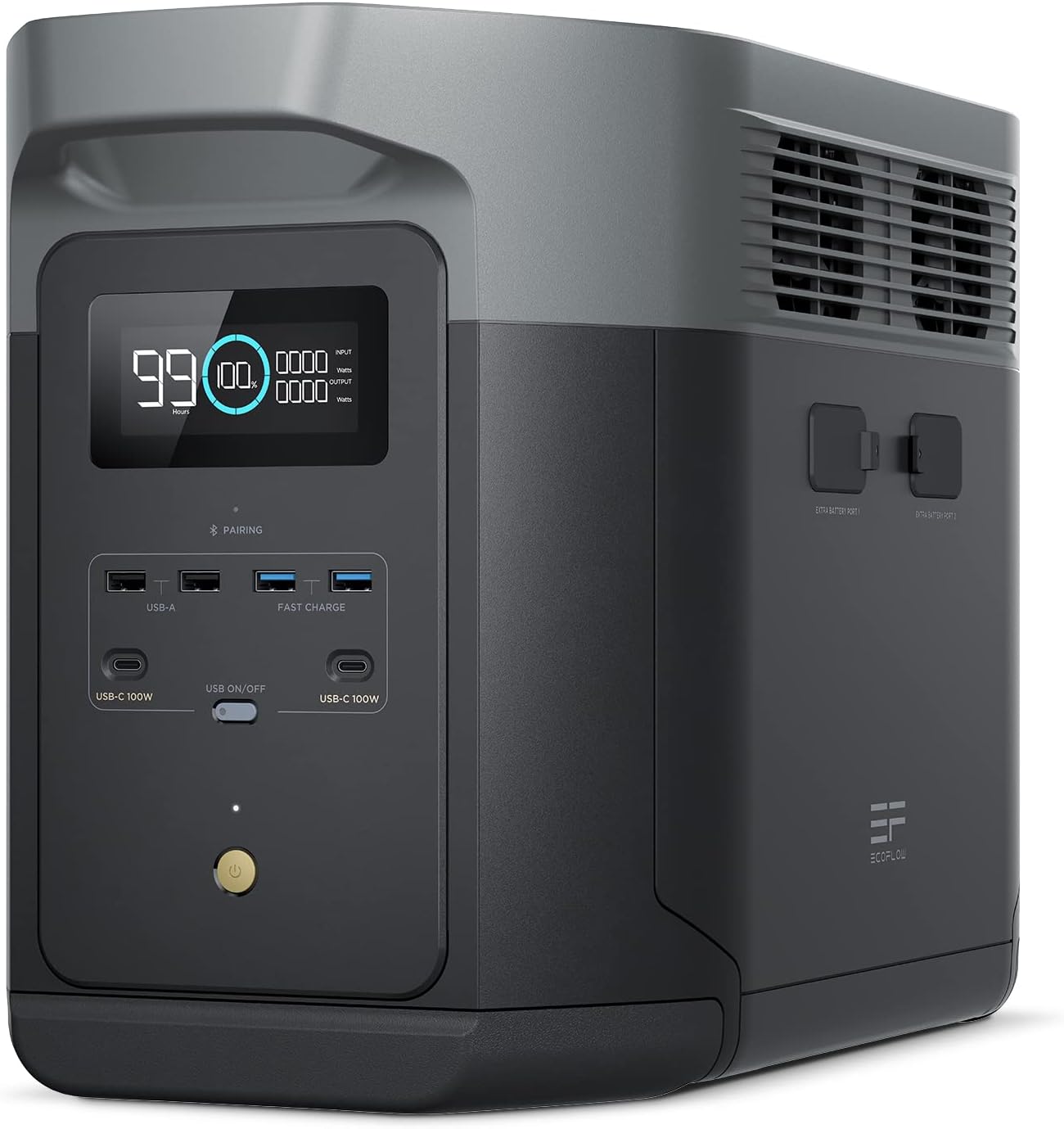
The DELTA 2 Max is the best solar generator for the majority of RV owners — a 2,048Wh LFP battery, 2,400W continuous output (3,400W via X-Boost mode), and 1,000W maximum solar input that fully recharges from a pair of 500W panels in under three hours of good sun. The 43-minute AC charge to 80% is the fastest in its class — critical when you’re at a campground with shore power for a few hours before heading back into the wild.
The DELTA 2 Max handles a 12V compressor fridge running 24/7 with easy headroom, a CPAP machine through the night, Starlink, lighting, and device charging — the standard full-time RV load stack without AC — on a single charge with buffer to spare. X-Boost mode can power appliances up to 3,400W that would otherwise exceed the inverter’s rated ceiling, including hair dryers, coffee makers, and small induction cooktops. The 15 output ports handle every real-world RV connection simultaneously.
Expandable to 6,144Wh with two additional battery packs — useful if you want to grow the system after initial purchase. 3,000-cycle LFP battery rated for 10+ years. App control via Wi-Fi and Bluetooth. Five-year warranty.
Pros: 43-min AC charge to 80%, 1,000W solar input, 2,400W output (3,400W X-Boost), expandable to 6kWh, 15 ports, 5-year warranty, 3,000 LFP cycles
Cons: No native TT-30R port — needs adapter for direct RV shore power hookup; 2kWh capacity may fall short for full-time RVers with AC use
Best for: Part-time to full-time RVers without AC, anyone who wants the fastest-charging 2kWh solar generator with strong solar input
Best for Full-Time RV with Direct Hookup: Bluetti AC200L
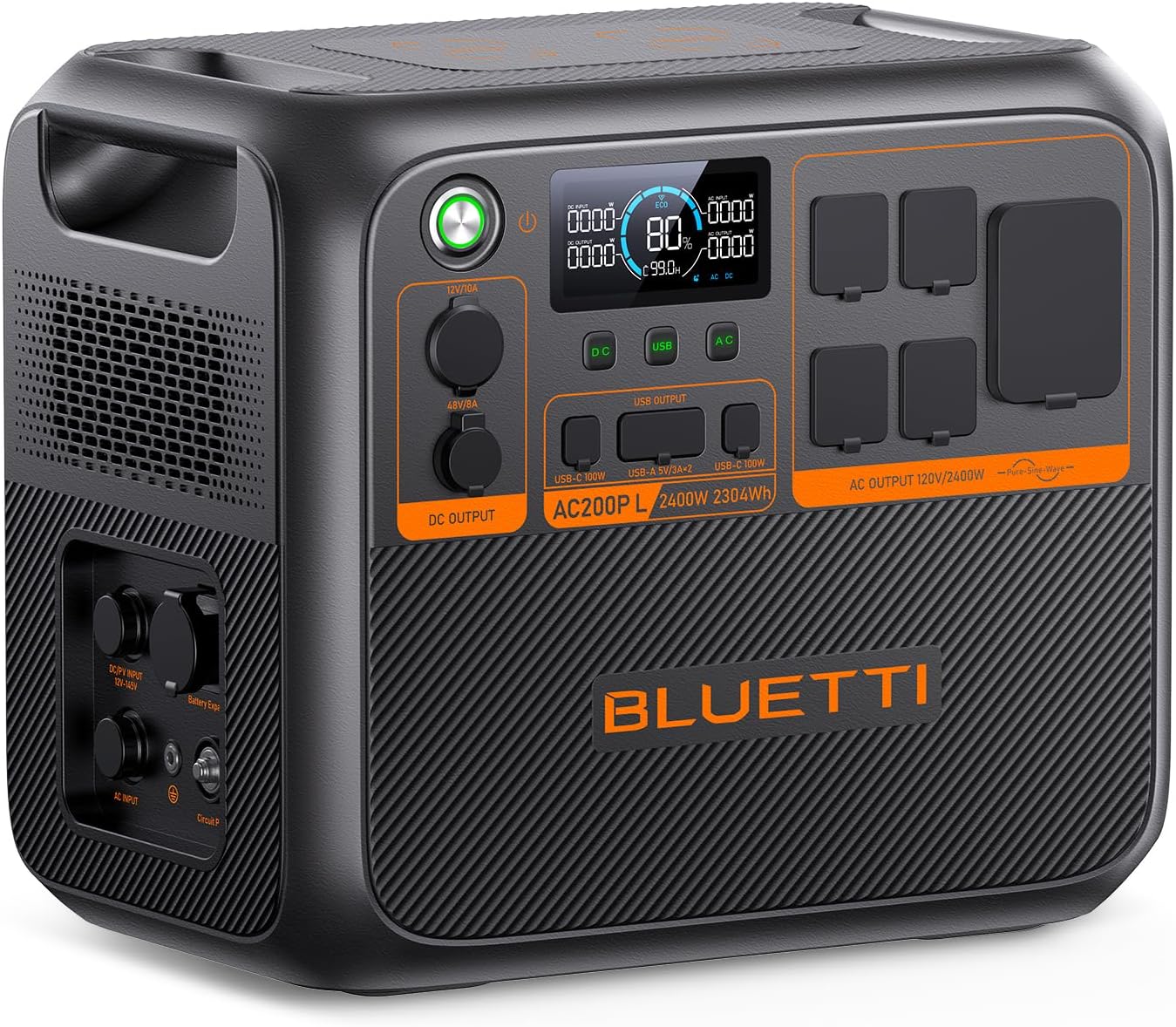
The Bluetti AC200L is the pick for full-time RVers who want to plug directly into their rig’s shore power inlet. The native TT-30R (30 amp) port eliminates adapters and runs your RV’s electrical system exactly as it expects — including the converter/charger that keeps your house batteries topped up through the same connection campgrounds use. For RVers who live in their rig for weeks at a time, this is a genuinely meaningful convenience and reliability advantage.
At 2,304Wh with 2,400W continuous output and Power Lifting mode that handles appliances up to 3,600W, it covers the same daily load stack as the DELTA 2 Max. Where it pulls ahead is expandability — up to 8,192Wh with compatible battery packs, the highest ceiling of any portable solar generator in this price range. For full-time boondockers who want to build a serious off-grid RV power system gradually, the AC200L’s expansion path is the most cost-effective in this category. 1,200W maximum solar input recharges fully in under 2 hours with enough panels.
The trade-off is weight — at 62 lbs vs the DELTA 2 Max’s lighter build, the AC200L is a two-person lift. For RVers where it lives in the basement storage bay and rarely moves, this is a non-issue. For anyone who wants to carry it into a campsite, it’s significant.
Pros: Native TT-30R (30A) RV port, expandable to 8,192Wh, 1,200W solar input, 2,400W output with 3,600W Power Lifting, 11 ports, 45-min AC charge to 80%
Cons: 62 lbs — heavy for a unit you want to move regularly; no wheels standard
Best for: Full-time RVers, anyone who wants native TT-30 shore power connection and the highest expandability ceiling available
Best for High-Wattage Loads and Expandability: Jackery Explorer 2000 Plus
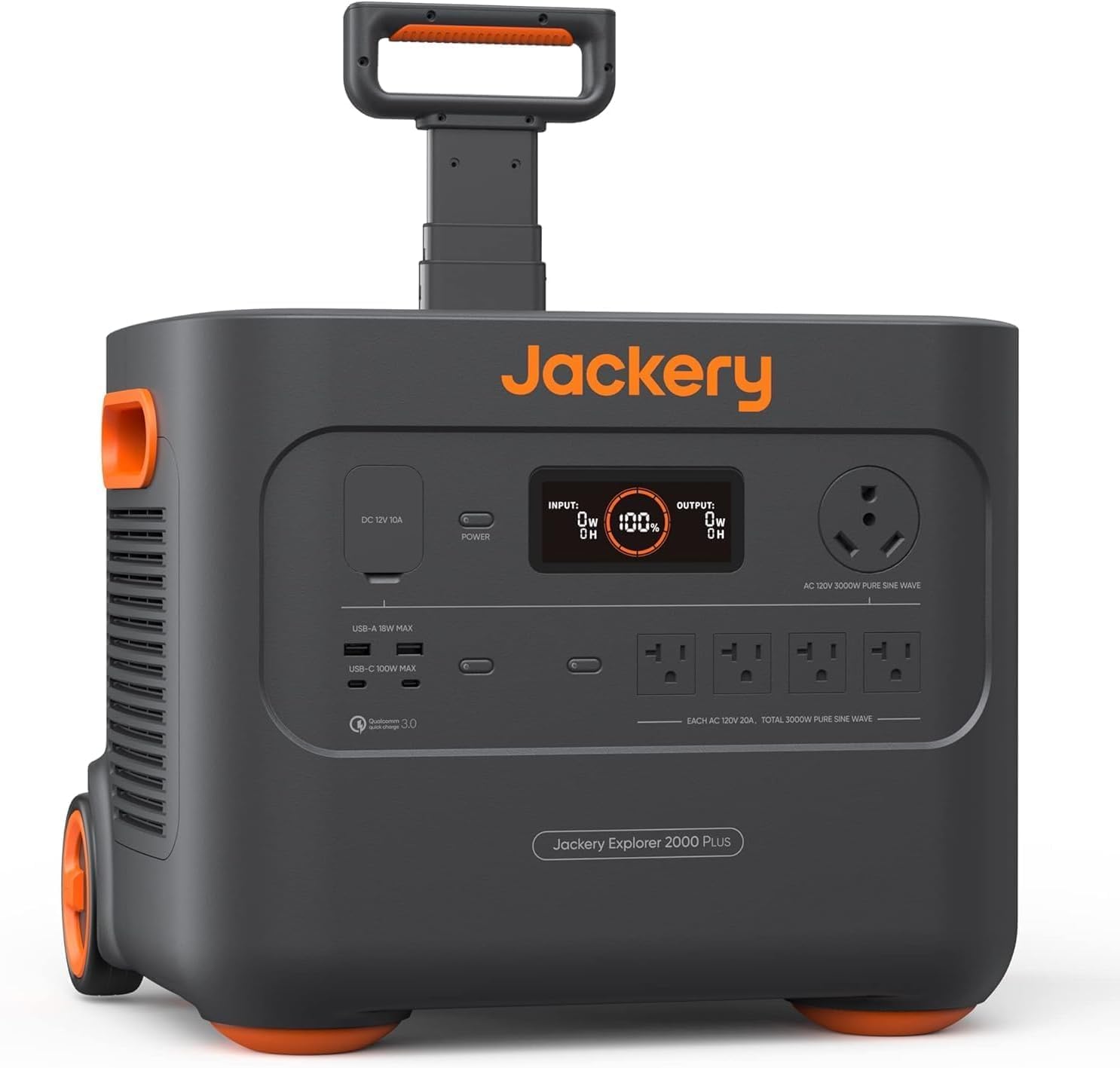
The Explorer 2000 Plus stands out for its 3,000W continuous output and 6,000W surge capability — the highest output in this comparison, and the unit to consider if you’re running appliances that push the limits of a standard 2,400W inverter. It’s also expandable to 24,000Wh with Jackery’s battery packs — by far the largest expansion ceiling of any portable solar generator available.
The 2,042Wh base capacity with 4,000 LFP cycles (rated to 70% capacity) and 1,200W solar input make it a strong boondocking unit. At 39.5 lbs with telescoping handle and wheels, it’s the most portable of the full-capacity units here — manageable for one person. No native TT-30R port, but the TT-30 to standard outlet adapter is inexpensive and widely available. For a full breakdown of this unit, see our Jackery Explorer 2000 Plus review.
Pros: 3,000W continuous output, 6,000W surge, expandable to 24kWh, 4,000 LFP cycles, lightest at 39.5 lbs, wheels and handle
Cons: No native TT-30R port; AC charge takes longer than EcoFlow and Bluetti competitors
Best for: Weekend to part-time RVers with high-wattage appliance needs, anyone who wants the highest output and greatest expansion ceiling
Best for Small RVs and Teardrops: Anker SOLIX C1000 Gen 2
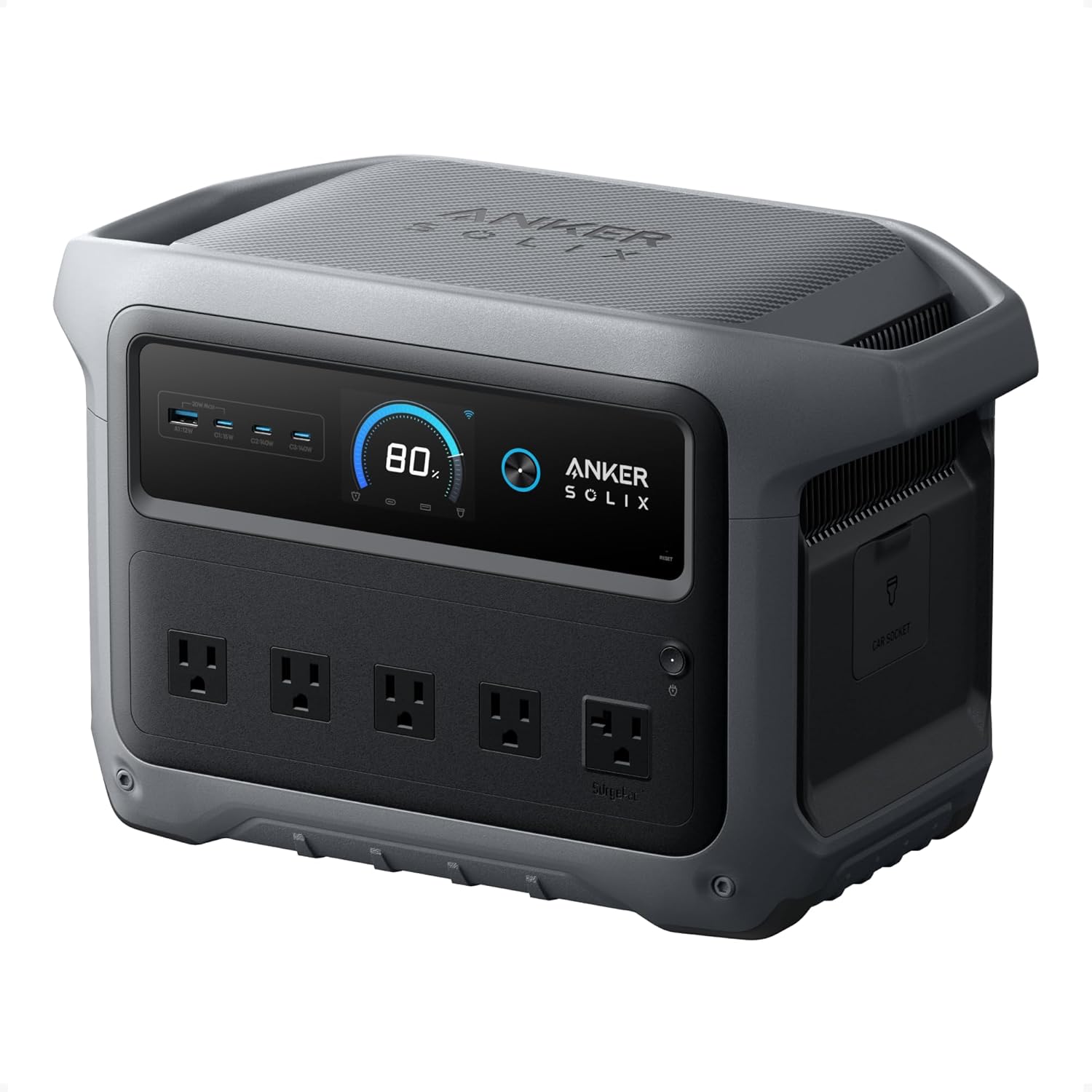
Not every RV needs 2kWh. For teardrop trailers, pop-up campers, and small travel trailers where the daily load is a 12V fridge, lighting, CPAP, and device charging — a 1,024Wh unit with 2,000W output covers the use case at roughly half the price of the 2kWh options above. The SOLIX C1000 Gen 2’s 49-minute full AC charge and 4,000-cycle LFP battery make it particularly good value for the smaller-RV use case.
The 600W maximum solar input fully recharges the unit in under 2 hours with two 300W panels — fast enough for practical boondocking at this capacity. For a full breakdown of the C1000 Gen 2 alongside the rest of the Anker SOLIX lineup, see our Anker solar generator guide.
Pros: 49-min AC charge, 4,000 LFP cycles, 2,000W output, compact and light, 5-year warranty, lower price point
Cons: 1,024Wh limits multi-day use without solar recharge; 600W solar input ceiling lower than 2kWh competitors
Best for: Teardrop trailers, pop-up campers, small travel trailers, anyone who wants capable RV solar power at a lower price point
Can a Solar Generator Run RV Air Conditioning?
This is the most common question — and the honest answer is: sometimes, with the right unit, but not for long. A typical 13,500 BTU RV roof AC unit draws 1,300–1,500W running, with a surge of 1,800–2,500W on startup. The EcoFlow DELTA 2 Max’s X-Boost mode can handle the startup surge and sustain the running load. But at 1,400W running draw on a 2,048Wh unit, you’re looking at roughly 1–1.5 hours of AC before the battery is depleted.
For meaningful air conditioning use from a solar generator, you need either a large battery bank (4,000Wh+) or a smaller, more efficient RV AC unit specifically designed for low-power operation. The Zero Breeze Mark 3 and Hessaire MC61M are among the most solar-compatible RV cooling options at 300–600W running draw. For a dedicated breakdown of this topic, see our solar generator and air conditioner guide.
Solar Panels for RV Solar Generators — What to Pair
All four units above accept third-party solar panels via standard connectors (XT60 for EcoFlow and Bluetti, DC barrel for Jackery, XT60 for Anker). The most practical panel setup for RV use is two foldable or rigid 200W panels for the 2kWh units — hitting 400W total input — or one to two 100–200W panels for the C1000 Gen 2.
Roof-mounted panels are the preferred setup for RVers who want hands-off charging while driving and at camp. For flexible panel options suited to curved RV roofs, see our van and RV solar panel guide. For freestanding ground-mount panels to supplement roof panels at camp, our off-grid solar panel guide covers the best rigid options.
Frequently Asked Questions
What size solar generator do I need for a travel trailer?
For a mid-size travel trailer with a 12V fridge, lighting, CPAP, and device charging but no AC, a 2,000Wh unit like the EcoFlow DELTA 2 Max covers most daily loads with reasonable buffer. For full-time use or if you want to run AC occasionally, step up to a 3,000Wh+ system or an expandable unit like the Bluetti AC200L. Use the load table at the top of this article to calculate your specific daily energy need before buying.
Is a solar generator better than a gas generator for an RV?
For boondocking use, solar generators are quieter, require no fuel, produce no fumes, and can be legally used indoors — significant advantages in an RV where the generator often sits close to sleeping areas. The limitation is that they can’t produce unlimited power as long as fuel lasts — you’re constrained by battery capacity. For short-duration high-wattage loads (running AC for hours), a gas generator still wins on raw capacity. For everyday RV power needs, solar generators have become fully viable for most use cases. For the full comparison, see our solar vs gas generator guide.
Can I charge a solar generator while driving?
Yes — all four units above charge via 12V car outlet. It’s the slowest charging method (typically 6–12 hours for a full charge), but it provides meaningful top-up during a driving day. Some RVers also mount solar panels on the roof that feed the solar generator while driving — combining vehicle motion with solar charging. The EcoFlow DELTA 2 Max accepts up to 1,000W solar input simultaneously with AC or car charging for maximum speed.
How many solar panels do I need to run an RV?
For a daily load of 1,200–1,500Wh (fridge, lighting, devices, CPAP — no AC), two 200W panels producing 800–1,000Wh per day in 4–5 sun hours covers most of the daily need, with AC charging filling any shortfall. For fully self-sufficient boondocking with no AC charging, three to four 200W panels (600–800W) in a good sun location covers a mid-size RV comfortably. See our RV solar panel kit guide for complete system setups.
Do solar generators work with RV hookups?
Yes — solar generators with TT-30R ports (like the Bluetti AC200L) plug directly into your RV’s shore power inlet. Units without a native TT-30R port use a standard 30A to 15A adapter — widely available and fully functional, though you’ll be limited to the 1,800W output of a standard outlet rather than the unit’s full capacity. The adapter approach works well for most RVers; the native TT-30R port is primarily a convenience advantage.
Final Verdict
| Your Situation | Best Pick |
|---|---|
| Best overall — most part-time and full-time RVers | EcoFlow DELTA 2 Max (B0C4DW17PD) |
| Full-time RV, native 30A hookup, max expandability | Bluetti AC200L (B0D17CW6KK) |
| High-wattage loads, largest expansion ceiling | Jackery Explorer 2000 Plus (B0C6DHK68Q) |
| Small trailer, teardrop, budget-conscious | Anker SOLIX C1000 Gen 2 (B0FN7MSY4L) |
For most RVers — part-time campers to full-time boondockers without heavy AC use — the EcoFlow DELTA 2 Max is the right call. Fast charging, strong solar input, expandable, and proven in real RV use. Full-timers who want native 30A hookup and the highest expandability ceiling should step up to the Bluetti AC200L. For small trailers and teardrops, the Anker SOLIX C1000 Gen 2 covers all the essentials at roughly half the price.
For complete RV solar panel setups to pair with any of these units, see our RV solar panel kit guide. For home backup use when the RV is parked, our solar generator for home backup guide covers the right sizing for household loads.