If you buy through our links we may earn a small commission — at no extra cost to you. This never influences our recommendations.
Most rooftop RV air conditioners draw 1,200–2,000 running watts, but the startup surge from the compressor can spike to 2,000–3,500 watts.
That surge number is the one that trips up most portable power stations — a unit can look fine on paper and still shut off the second the compressor kicks on.
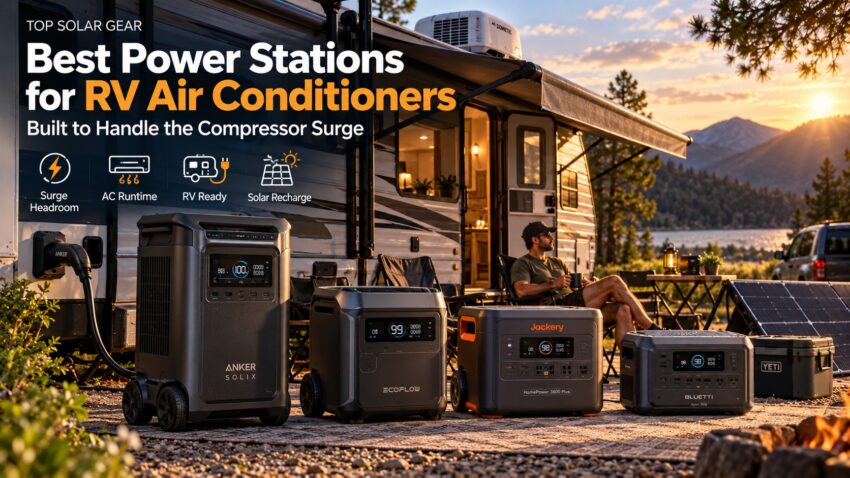
We compared four power stations with the continuous output and surge headroom to actually keep an RV AC running, not just claim to.
Looking for RV power more broadly, beyond just the AC? See our guide to the best solar generator for RV use.
| Power Station | Capacity | Continuous Output | Surge Output |
|---|---|---|---|
| Anker SOLIX F3800 | 3,840Wh | 6,000W | 9,000W |
| EcoFlow DELTA Pro 3 | 4,096Wh | 4,000W | 8,000W |
| Jackery HomePower 3600 Plus | 3,584Wh | 3,600W | 7,200W |
| Bluetti Apex 300 | 2,764.8Wh | 3,840W | 7,680W |
How Much Power Does Your RV Air Conditioner Actually Need?
A 13,500–15,000 BTU rooftop unit — the most common size on travel trailers — typically pulls 1,300–2,000 running watts, with a compressor surge that can roughly double that for a second or two.
All four picks below clear that surge with real margin to spare.
For the full breakdown of running vs. surge watts and how to calculate your own numbers, see Can a Solar Generator Run an Air Conditioner? The Real Math.
Our Top Picks
Anker SOLIX F3800 — Best Overall
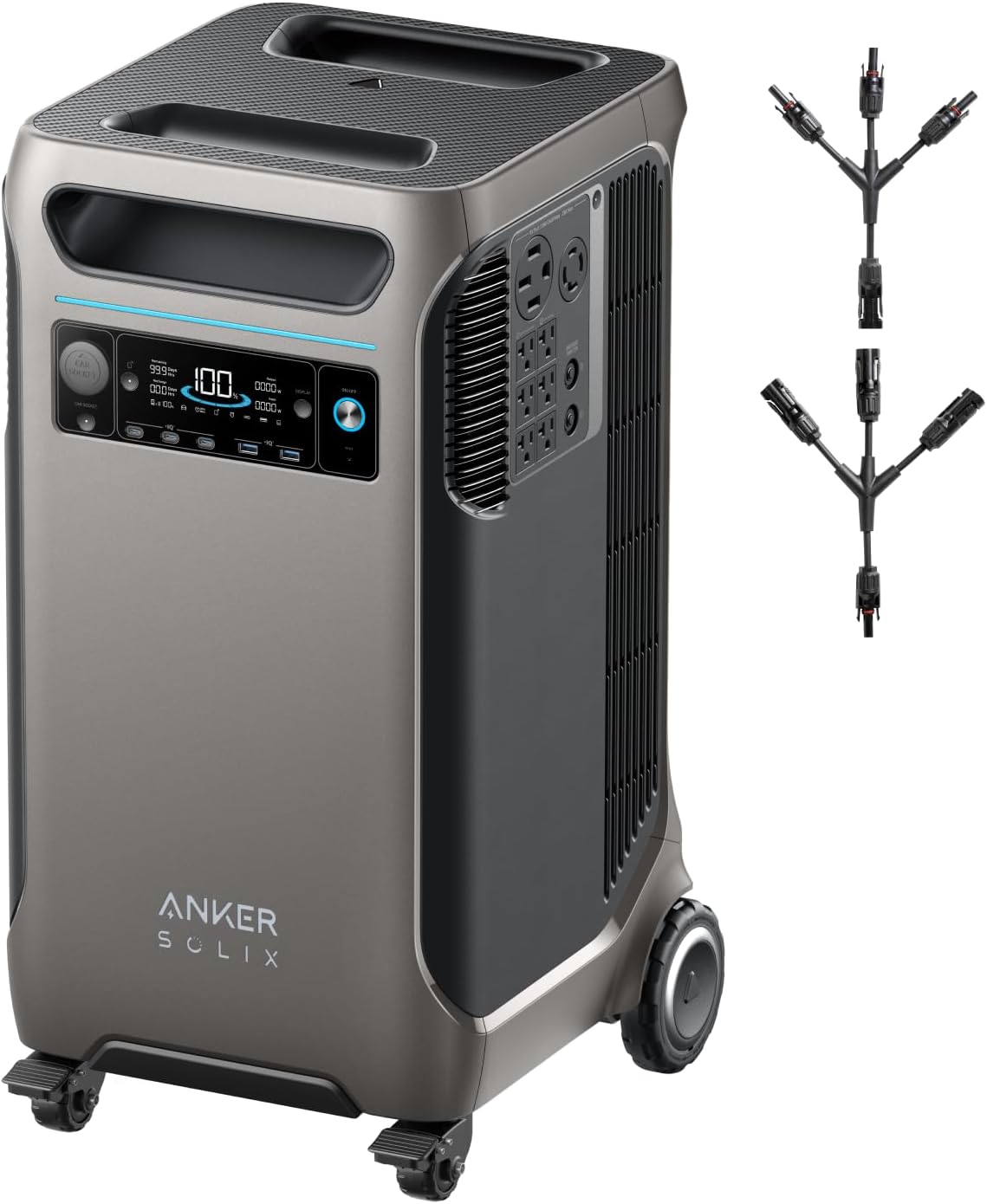
The F3800 is the highest-wattage unit on this list, and it’s the only one of the four built with a direct RV shore-power inlet (NEMA 14-50 and L14-30) instead of relying on a standard household plug adapter.
At 6,000W continuous with a 9,000W surge ceiling, it has enough headroom to run a rooftop AC and other big loads — a microwave, a second AC unit on a larger rig — at the same time.
Independent testing has clocked its inverter efficiency around 91%, among the better figures in this category.
Pros: Highest continuous wattage here; direct RV inlet, no adapter needed; strong solar input (2,400–3,200W) for a full daytime recharge.
Cons: The heaviest and most expensive of the four; large footprint that’s a tight fit in smaller trailers.
Best for: Larger motorhomes and fifth wheels running AC alongside other high-draw appliances.
Full details and current price: Anker SOLIX F3800 on Amazon · read our full Anker SOLIX F3800 review
EcoFlow DELTA Pro 3 — Best for Extended Runtime
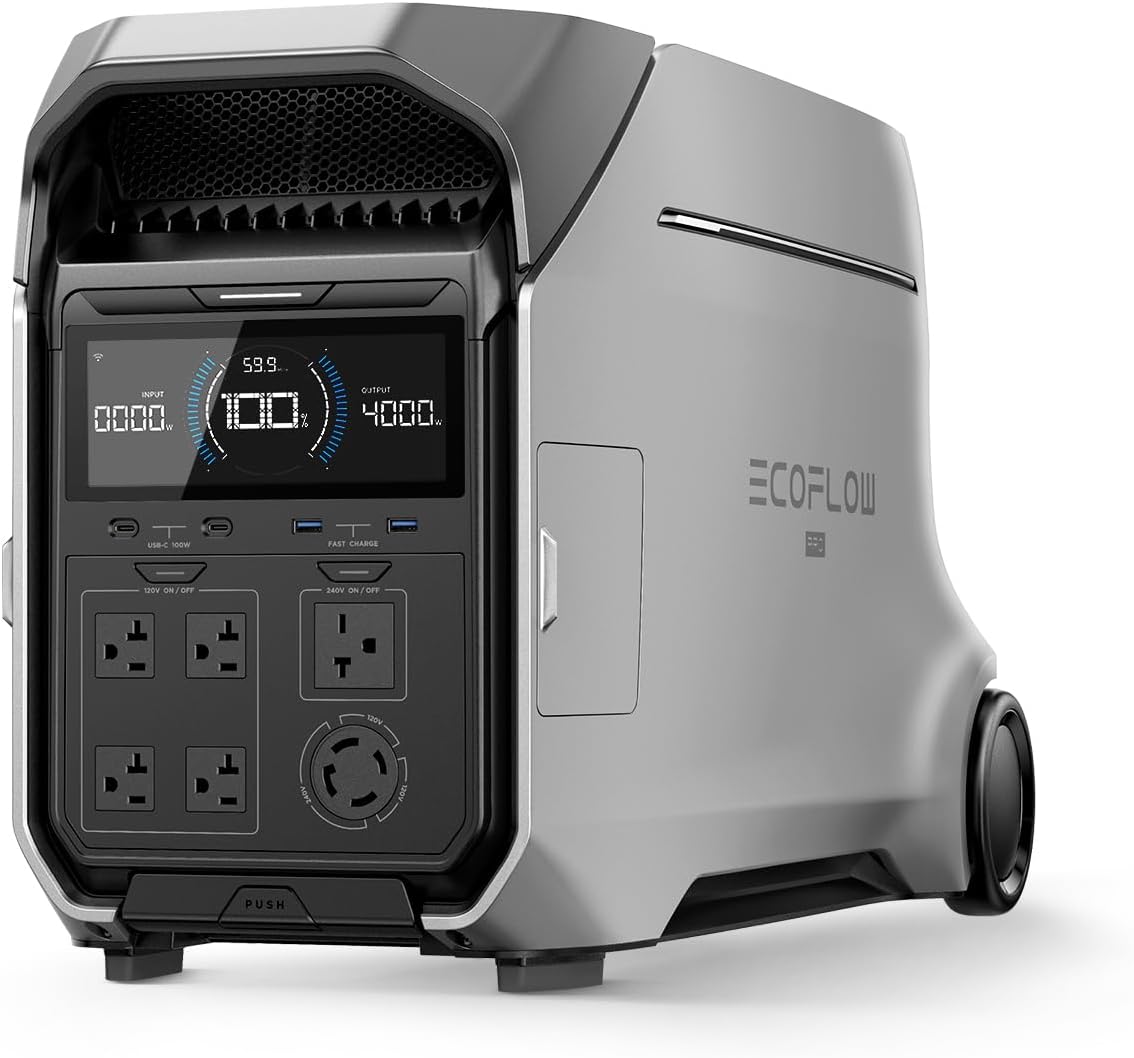
The DELTA Pro 3 has the largest built-in battery of the group at 4,096Wh, which translates to the longest AC runtime before you need to recharge or plug into shore power.
Its 4,000W continuous rating comes with an 8,000W surge ceiling, and EcoFlow’s X-Boost mode lets it stretch to handle loads above its rated continuous output for short periods.
It’s also the unit most likely to double as whole-home backup later, since it’s expandable to 48kWh with add-on batteries.
Pros: Biggest capacity here for longer AC runtime; expandable well beyond RV use if you want home backup too.
Cons: At 113 lbs it’s genuinely heavy to move in and out of a rig; no dedicated RV shore-power inlet, so you’ll use a standard adapter.
Best for: RVers who want the longest runtime per charge and might repurpose the same unit for home backup off-season.
Full details and current price: EcoFlow DELTA Pro 3 on Amazon · read our full EcoFlow DELTA Pro 3 review · see it head-to-head vs. the Anker SOLIX F3800
Jackery HomePower 3600 Plus — Best Value
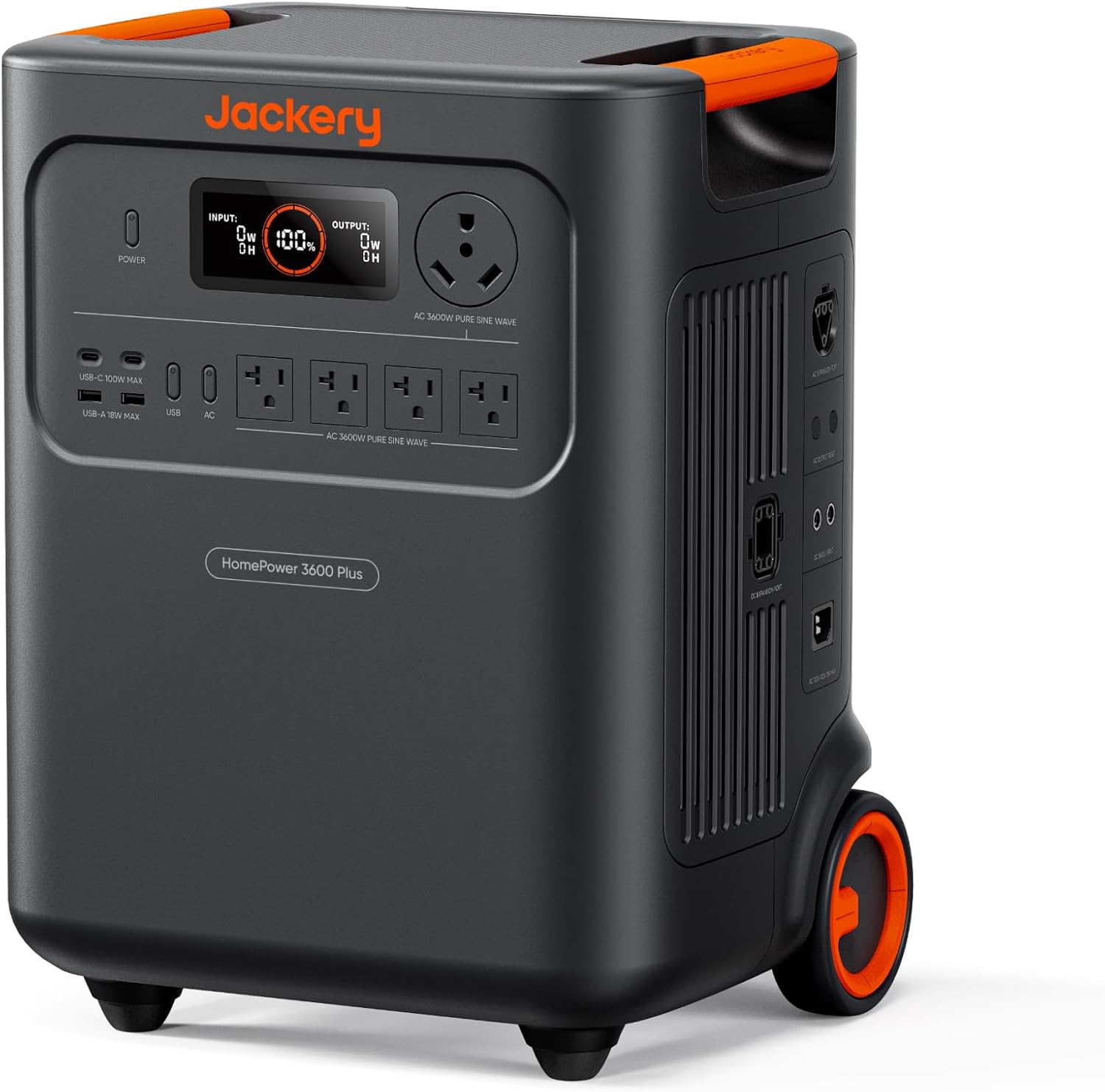
Jackery rates this unit at 3,600W continuous with a 7,200W surge, and third-party lab testing measured real surges up to 5,900W without tripping — a rare case of a manufacturer’s surge claim holding up close to spec under test conditions.
It comes in noticeably cheaper per watt-hour than the F3800 or DELTA Pro 3, which matters if you only need AC coverage and aren’t chasing the biggest number available.
The battery cells are rated to withstand up to 302°F, a detail that’s more relevant than it sounds if this thing is going to sit in a hot RV storage bay.
Pros: Genuine surge performance close to its rating in independent testing; best price-to-power ratio of the four; heat-tolerant cells for RV storage conditions.
Cons: Idle power draw measured around 34W/hour in testing, higher than some competitors, so it sips battery even while the AC compressor is cycled off.
Best for: Budget-conscious RVers who still need full surge capacity for a real rooftop unit.
Full details and current price: Jackery HomePower 3600 Plus on Amazon · read our full Jackery HomePower 3600 Plus review
Bluetti Apex 300 — Most Compact
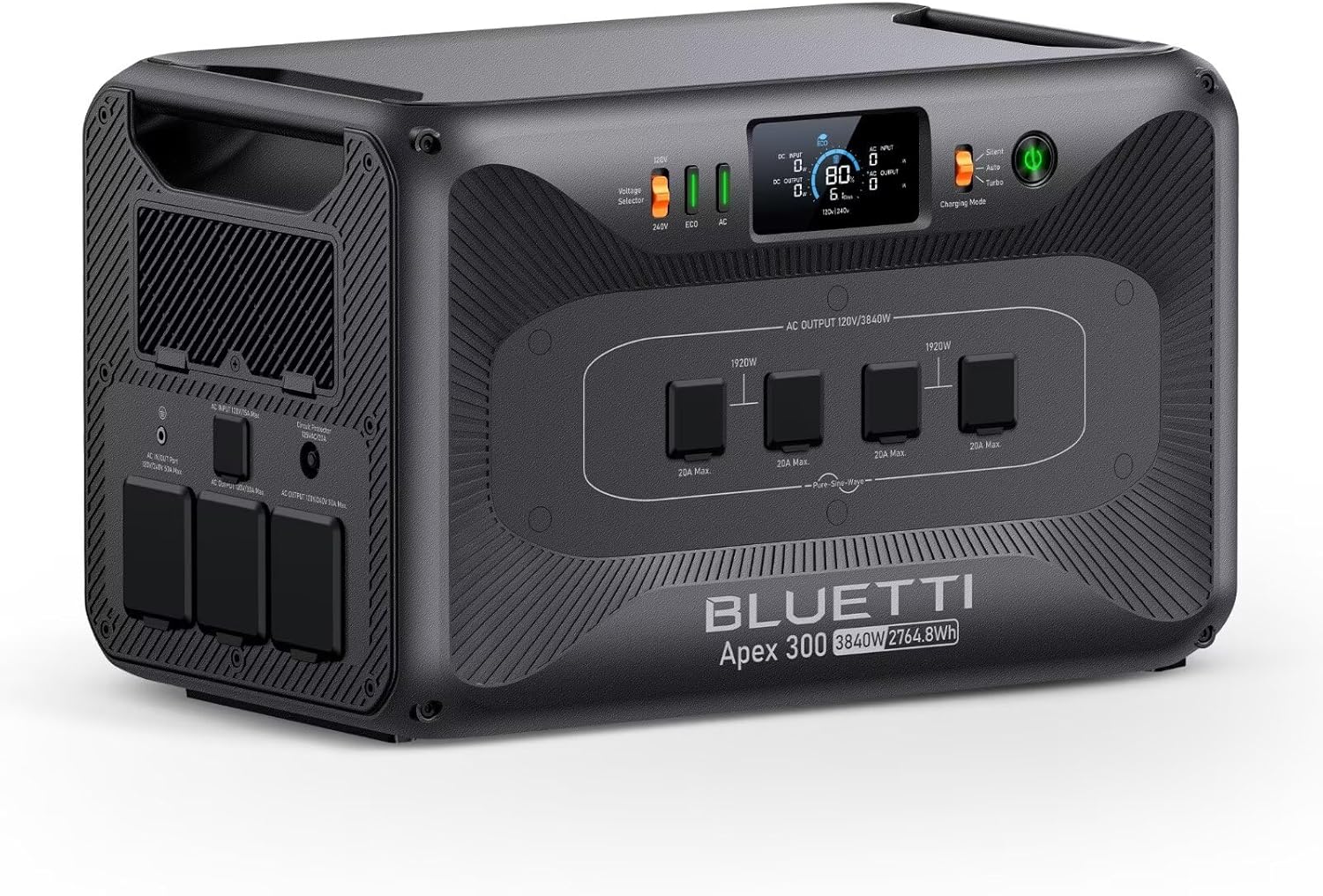
The Apex 300 is the smallest and lightest unit here at 2,764.8Wh, and Bluetti markets it specifically around running RV ACs and ovens directly off its six AC outlets.
Despite the smaller battery, its 3,840W continuous and 7,680W surge ratings are still comfortably ahead of what a rooftop AC needs.
It also supports black-start — the ability to restart itself from solar input alone with zero grid or battery power to begin with — which the other three don’t specifically advertise.
Pros: Smallest and lightest option, easiest to actually store in a smaller rig; black-start capability; marketed and outlet-configured specifically for direct RV appliance use.
Cons: Smallest capacity of the four means the shortest continuous AC runtime before a recharge is needed.
Best for: Smaller trailers, van conversions, or anyone prioritizing weight and footprint over maximum runtime.
Full details and current price: Bluetti Apex 300 on Amazon · read our full Bluetti Apex 300 review
Sizing This Correctly for Your Rig
Rough rule of thumb: a 1,500W-running AC on the Bluetti Apex 300’s 2,764.8Wh battery — the smallest capacity here — works out to roughly 1.8 hours of continuous full-power runtime, and more in practice since the compressor cycles rather than drawing full power constantly.
See How Big of a Portable Power Station Do I Need? if you want to work through the math for a different AC or a bigger rig.
Pre-cooling your RV before you disconnect from shore power, using your AC’s eco mode, and pairing any of these with solar panels all stretch your runtime further — though solar works best as a runtime extender, not a full offset for a rooftop AC’s draw.
One safety note worth taking seriously: some RV electrical management systems can misread the floating-neutral design of a portable power station as an open-ground fault.
If you’re wiring one of these into your RV’s electrical system rather than just running an extension cord to the AC unit, check your power station’s and RV’s documentation, or ask a qualified RV electrician — don’t bypass a safety device to force a connection to work.
More RV and Power Outage Picks
If you’re outfitting a rig for more than just the AC, these guides cover other high-draw scenarios: Best Portable Power Stations for Power Outages, Best Portable Power Station for a Sump Pump, and Jackery vs. Anker vs. EcoFlow vs. Bluetti if you’re still deciding between brands.
Frequently Asked Questions
Can a portable power station really run a full-size RV air conditioner?
Yes, but only with units that clear both the running watts and the surge watts of your specific AC — the four picks above are sized for a typical 13,500–15,000 BTU rooftop unit.
How many watts do I need to run my RV AC?
Budget for 1,200–2,000 running watts depending on BTU size, and a surge of roughly double that for the compressor’s startup moment.
How long will a power station run my RV AC on one charge?
Divide the battery’s watt-hours by your AC’s running watts for a rough baseline, then expect somewhat longer in practice since compressors cycle rather than running continuously.
Do I need a special adapter to connect my RV to one of these?
The Anker SOLIX F3800 and Bluetti Apex 300 both offer RV-oriented connections out of the box; the EcoFlow DELTA Pro 3 and Jackery HomePower 3600 Plus typically use a standard AC outlet adapter instead.
Will running the AC off one of these damage the battery or void the warranty?
Running at or near a unit’s rated continuous output is normal use and within warranty; the risk is exceeding the rated surge or continuous wattage, which is what these picks are specifically sized to avoid.
Final Verdict
| Power Station | Best For |
|---|---|
| Anker SOLIX F3800 | Larger rigs running AC plus other big appliances at once; anyone who wants a direct RV shore-power inlet |
| EcoFlow DELTA Pro 3 | Longest AC runtime per charge; doubling as home backup off-season |
| Jackery HomePower 3600 Plus | Best price-to-power ratio for genuine full-size AC surge capacity |
| Bluetti Apex 300 | Smaller trailers and van builds where weight and footprint matter most |